What Makes a PC the "Best"?
There is no single "best PC" for everyone — the right machine depends entirely on what you need it to do. A home user editing video has very different requirements from a factory floor running a production terminal, or an office deploying hundreds of desk workstations. The "best" PC is the one that matches your workload, your environment, and your budget without paying for capability you will never use.
For most business, industrial, and institutional deployments, the priorities are different from consumer desktops: reliability over raw benchmark scores, low power draw, fanless or quiet operation, long-term availability, and stable driver and OS support. A machine that runs cool and quiet for eight years is often more valuable than one that is 20% faster but needs servicing every year.
Matching the PC to the Workload
| Use Case | Typical Requirements | Suggested Class |
|---|---|---|
| Office productivity, browsing, billing | 8–16 GB RAM, 128–256 GB SSD, 4 cores | Mini PC / Thin Client |
| Point of sale, kiosk, digital signage | Fanless, 24/7 operation, 2× Ethernet | Mini PC / Industrial PC |
| Thin client / VDI endpoint | Low power, no local storage needed, stable OS | Thin Client |
| Front-desk, reception, counter | Integrated screen, small footprint | All-in-One PC |
| Factory, warehouse, control room | Wide-temperature, dust-tolerant, DIN or panel mount | Industrial PC |
| Engineering, light CAD, data work | 6–12 cores, 16–32 GB RAM, NVMe SSD | High-performance Mini PC |
Key Specifications to Evaluate
Processor: Intel's entry and mid-tier lines cover most needs. The Intel® Celeron® and N-series (such as the N5095A, N100, and N150) are excellent for thin clients, kiosks, and office tasks — they run cool, sip power, and handle everyday software without complaint. Step up to Intel® Core™ i3 or i5 processors (12th, 13th, or 14th generation) when you need more parallel throughput for multitasking, virtualisation, or heavier applications.
Memory and storage: 8 GB is the practical minimum for Windows 11; 16 GB gives comfortable headroom for multitasking and multiple browser tabs. For storage, 128 GB suits thin clients and kiosks, while 256–512 GB is better for general office use. Solid-state storage is standard and contributes far more to perceived speed than most processor upgrades.
Connectivity: Dual Gigabit Ethernet is a hallmark of business and industrial machines — it enables network segmentation, failover, or acting as a gateway. Look for multiple HDMI outputs if you need dual displays, and USB 3.2 Gen 2 ports for fast peripherals.
Cooling and durability: Fanless designs eliminate the single most common point of mechanical failure in a small PC. They also prevent dust ingress and suit environments where airborne particles, heat, or vibration would shorten the life of a fan-cooled machine.
Why Thinvent Builds PCs for These Jobs
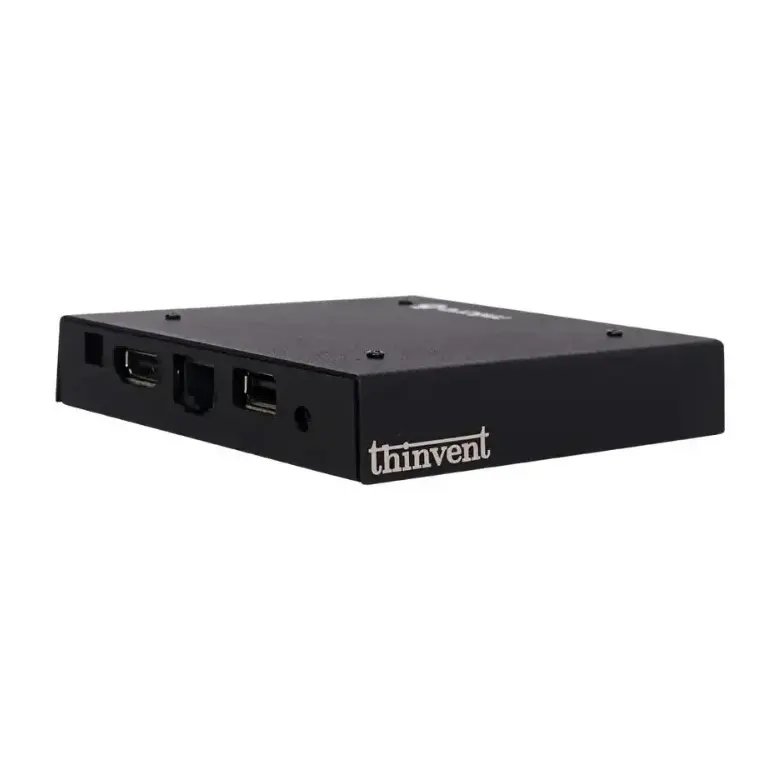
Thinvent manufactures industrial computers, mini PCs, thin clients, and all-in-one PCs designed for continuous operation in offices, factories, banks, hospitals, and retail environments. Our systems are built around Intel® processors, fanless thermal designs, and long-life components, with options for Windows 11 Pro, Ubuntu Linux, FreeDOS, or no operating system at all.
Thinvent Products Featuring This Technology
-
Mini PCs — compact, fanless systems with Intel® N-series and Celeron® processors, ideal for office, kiosk, and signage deployments.
-
Thin Clients — low-power endpoints for VDI and centralised computing, with minimal local storage and stable embedded operating systems.
-
All-in-One PCs — integrated display and compute in a single unit for reception desks, counters, and point-of-sale.
-
Industrial PCs — ruggedised machines built for dust, heat, and 24/7 duty in production and control environments.
Choosing the best PC starts with defining the job it must do. Once you know your workload, environment, and deployment scale, the specification follows naturally.