What Makes a Workstation Computer?
A workstation computer is a high-reliability system built for sustained, demanding workloads rather than casual desktop use. Unlike consumer PCs, workstations prioritise stable performance under continuous operation, support for multiple displays and serial peripherals, generous memory and storage, and long-term availability of identical units so that deployments can be scaled and serviced years later. For industrial, commercial and embedded environments, this reliability matters more than peak benchmark scores.
Key Specifications to Consider
When selecting a workstation computer, the specifications that matter most are the processor, memory, storage and I/O. Modern Intel® Core™ processors such as the i3-1215U deliver 6 cores with frequencies up to 4.4 GHz and 10 MB of cache, which is ample for multitasking, data logging, point-of-sale, kiosk and light CAD or SCADA workloads. Memory of 16 GB DDR4 handles multiple applications comfortably, while a 1 TB SSD provides fast boot times and ample local storage for databases and logs.
| Specification | Typical Workstation Class | Why It Matters |
|---|---|---|
| Processor | Intel® Core™ i3 / i5, 6–12 cores | Responsive multitasking, stable sustained loads |
| Memory | 16 GB DDR4 and above | Multiple apps, virtual machines, large datasets |
| Storage | 256 GB – 1 TB SSD | Fast boot, reliable local data storage |
| Serial Ports | Up to 4x DB9 (RS-232/485) | PLCs, scales, instruments, legacy equipment |
| Operating System | Windows 11 Pro, Linux, DOS | Application compatibility and licensing flexibility |
| Cooling | Fanless | Dust and heat tolerance, no moving parts to fail |
Use Cases and Applications
Workstation-class computers are deployed across manufacturing floors, laboratories, retail back offices and control rooms. Common applications include SCADA and HMI terminals, machine vision controllers, test and measurement benches, point-of-sale back-office systems, digital signage controllers and data acquisition nodes. In these settings, a fanless industrial PC is often preferred because it tolerates dust, vibration and wide temperature ranges, and because the absence of a cooling fan removes a common point of failure.
Choosing Between Fanless Industrial PCs and Traditional Workstations
Traditional tower workstations offer expandability but require filtered, climate-controlled environments and periodic maintenance. Fanless industrial PCs trade internal expansion for sealed, rugged enclosures that mount on DIN rails, walls or behind panels. If your deployment involves shop floors, cabinets, vehicles or remote sites, a fanless industrial PC is usually the more dependable choice. If you need discrete graphics and large internal expansion, a traditional workstation may suit better.
Thinvent Workstation-Class Computers
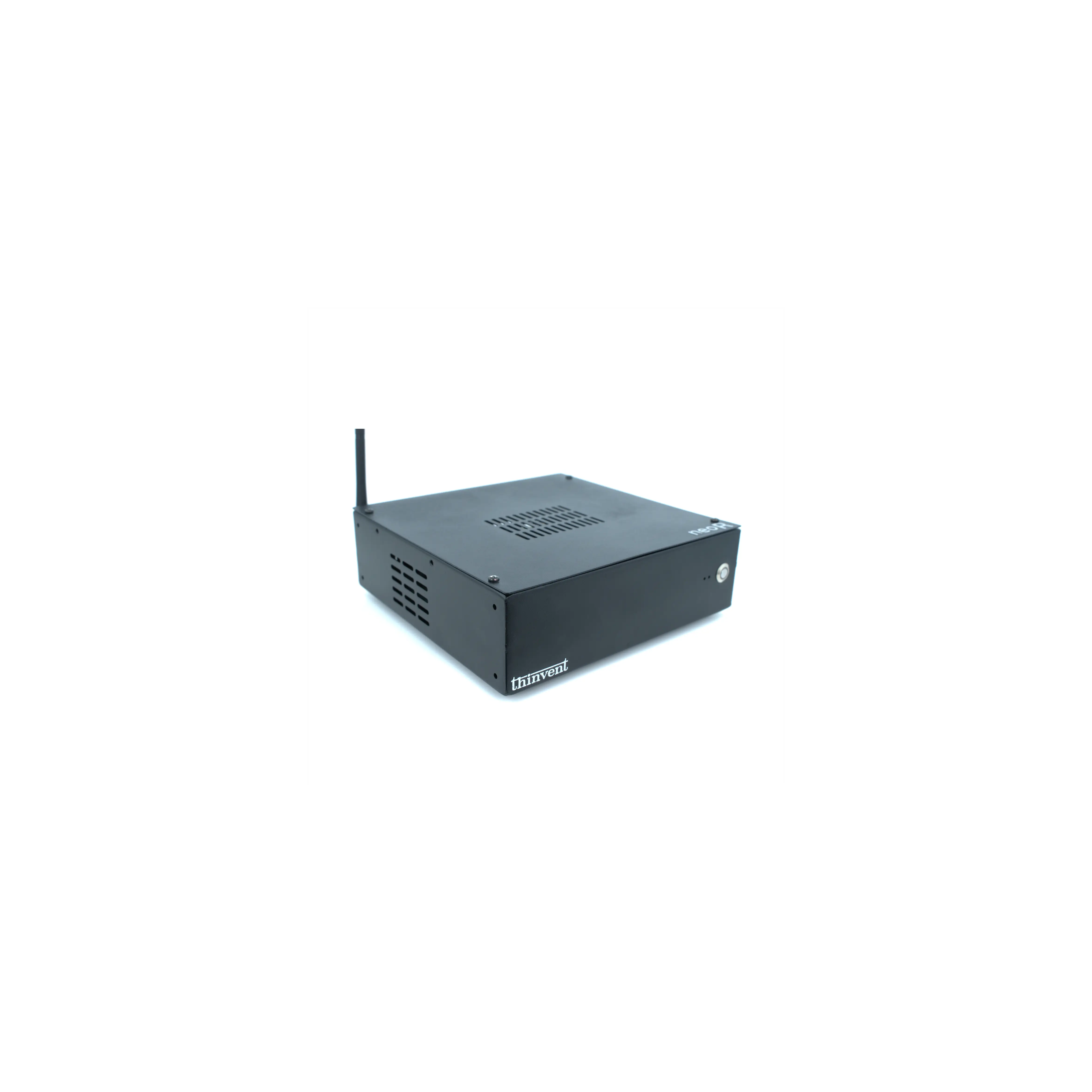
Thinvent manufactures industrial computers, mini PCs, thin clients and all-in-one PCs designed for continuous operation worldwide. Our IPC3 industrial PC pairs an Intel® Core™ i3-1215U processor (6 cores, up to 4.4 GHz, 10 MB cache) with 16 GB DDR4 RAM and a 1 TB SSD in a fanless chassis, with options for up to four DB9 serial ports and a choice of Windows 11 Pro, Windows 11 IoT, DOS, Thinux™ Embedded Linux or no operating system. For lighter workloads, our mini PCs with Intel® N-series processors offer the same fanless reliability in a smaller footprint. All units ship ready for deployment, with consistent configurations available for multi-site rollouts.