Industrial Computers & Hardware Solutions
Industrial computers are purpose-built computing systems designed to operate reliably in harsh environments, including factories, warehouses, outdoor installations, and mission-critical control rooms. Unlike commercial desktops, industrial PCs feature ruggedized components, extended temperature ranges, fanless cooling, and enhanced resistance to dust, vibration, and moisture. They serve as the backbone of automation, data acquisition, edge computing, and IoT gateways across manufacturing, logistics, energy, and transportation sectors.
Key Specifications and Technical Details
Industrial computers are defined by several critical specifications that differentiate them from consumer hardware. Fanless cooling ensures silent operation and prevents dust ingress, with passive heatsinks rated for ambient temperatures from -20°C to 70°C. Wide-input voltage power supplies (e.g., 12V-24V DC) provide stability in fluctuating power environments. Industrial-grade components include solid-state capacitors, extended-life SSDs, and conformal-coated boards that resist humidity and corrosive atmospheres. Typical processor options range from energy-efficient Intel N100 (4-core, 6W TDP) for lightweight tasks to high-performance Intel Core i5-1240P (12-core, 28W TDP) for data-intensive edge analytics.
Use Cases and Applications
Industrial computers power a wide array of applications:
-
Factory Automation: PLC control, HMI interfaces, machine vision systems
-
Edge Computing: Real-time data processing from sensors and cameras
-
Digital Signage: 24/7 media playback in retail and transportation hubs
-
Medical Devices: Patient monitoring, diagnostic equipment in sterile environments
-
Transportation: In-vehicle computing for fleet management and telematics
-
Smart Agriculture: Environmental monitoring in greenhouses and livestock facilities
The choice between ARM-based thin clients (e.g., Cortex A53 with 2GB RAM) and x86 industrial PCs (e.g., Core i5 with 16GB RAM) depends on workload requirements—ARM excels in low-power, single-application roles, while x86 handles multitasking and legacy software compatibility.
Comparison Table: Industrial Computer Tiers
| Feature | Entry-Level (N100) | Mid-Range (i3-1215U) | High-Performance (i5-1240P) |
|---|---|---|---|
| Cores/Threads | 4/4 | 6/8 | 12/16 |
| Max Frequency | 3.4 GHz | 4.4 GHz | 4.4 GHz |
| RAM Capacity | 4-32 GB DDR4 | 8-64 GB DDR4 | 16-64 GB DDR4 |
| Storage | 128-512 GB SSD | 256-1 TB SSD | 512-2 TB SSD |
| Typical TDP | 6W | 15W | 28W |
| Best For | Light edge tasks | Mid-level automation | Heavy analytics |
Thinvent's Industrial Computer Portfolio
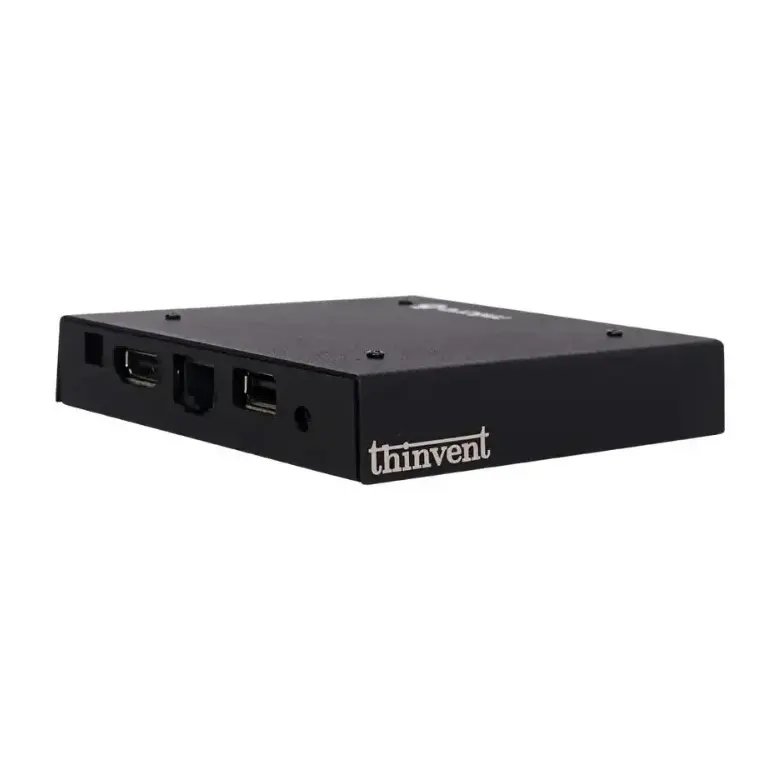
Thinvent offers a comprehensive range of industrial computers tailored to diverse operational needs. The IPC series (IPC1, IPC3, IPC5) provides ruggedized, fanless designs with Intel N100 to Core i5 processors, supporting Windows 11 IoT or Ubuntu Linux for seamless integration into existing systems. For ultra-low-power applications, the Micro 5 and Micro 6 Pro ARM-based thin clients deliver silent operation with Thinux Embedded Linux, ideal for dedicated control panels or IoT gateways. The Aero and Treo Mini PCs bridge the gap between commercial and industrial use, offering compact form factors with optional WiFi and dual display support. All Thinvent industrial computers undergo rigorous testing for shock, vibration, and extended temperature ranges, ensuring 24/7 reliability in the most demanding environments.