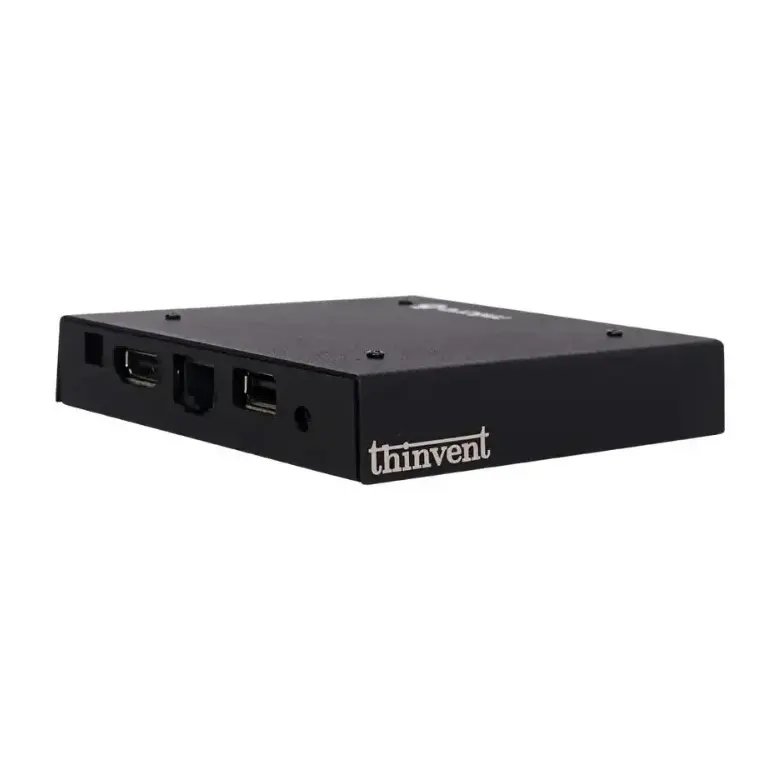
What is an Ultra Compact PC?
An Ultra Compact PC is a highly miniaturized computer system designed to deliver full computing functionality in an exceptionally small form factor. These devices prioritize space efficiency, low power consumption, and reliable, fanless operation, making them ideal for environments where traditional desktops are impractical. They are complete systems, typically featuring a processor, memory, storage, and a full suite of I/O ports, all integrated into a chassis often smaller than a standard book.
Key Specifications and Technical Details
The defining characteristic of an ultra compact PC is its physical size, but performance is not sacrificed. Modern models are powered by efficient processors like the Intel® N-series (e.g., N100), which offer multiple cores, capable integrated graphics, and a Thermal Design Power (TDP) as low as 6W. This allows for completely silent, fanless cooling. Standard configurations include DDR4 or DDR5 RAM (8GB to 16GB), fast NVMe or SATA SSDs (128GB to 512GB), and rich connectivity such as multiple HDMI/DisplayPort outputs, USB 3.2 ports, Gigabit Ethernet, and often support for Wi-Fi and Bluetooth. Their small size is enabled by highly integrated motherboards and the use of DC power adapters.
Use Cases and Applications
The small footprint and rugged design of ultra compact PCs make them perfect for a wide range of embedded and industrial applications.
-
Digital Signage & Kiosks: Mounted discreetly behind displays in retail, hospitality, or transportation hubs.
-
Thin Clients & VDI: As endpoints for virtual desktop infrastructure in offices, call centers, and healthcare.
-
Industrial Automation: Controlling machinery, HMIs (Human-Machine Interfaces), and data acquisition systems on the factory floor.
-
Edge Computing: Processing data locally in smart cities, retail analytics, or IoT gateways where space and power are limited.
-
Home & Office: As a discreet media center, compact workstation, or general-purpose desktop to reduce clutter.
Comparison: Ultra Compact PC vs. Traditional Mini PC
| Feature | Ultra Compact PC | Traditional Mini PC / SFF |
|---|---|---|
| Size | Extremely small (e.g., 120mm x 120mm x 40mm) | Small, but larger (often includes space for 2.5" drives) |
| Cooling | Almost exclusively passive/fanless | Often uses small fans or hybrid cooling |
| Power | Very low TDP (6W-15W), external DC adapter | Higher TDP possible (15W-65W), may use external or internal PSU |
| Expandability | Very limited; relies on USB/Networking | Some models allow for RAM/Storage upgrades or add-on cards |
| Primary Use | Embedded, industrial, fixed-function | General computing, office use, home theater |
Thinvent Ultra Compact PC Solutions
Thinvent specializes in robust, industrial-grade ultra compact PCs engineered for demanding environments. Our Aero series exemplifies this category, featuring fanless aluminum chassis for superior heat dissipation and durability. Powered by efficient Intel processors, these systems are built to operate reliably 24/7 in temperature-variable conditions. Thinvent offers a range of configurations with choices in memory, storage, and operating systems (including Windows, Linux, and our own Thinux™ Embedded OS) to precisely match your project requirements, whether for digital signage, IoT gateways, or space-constrained automation tasks.