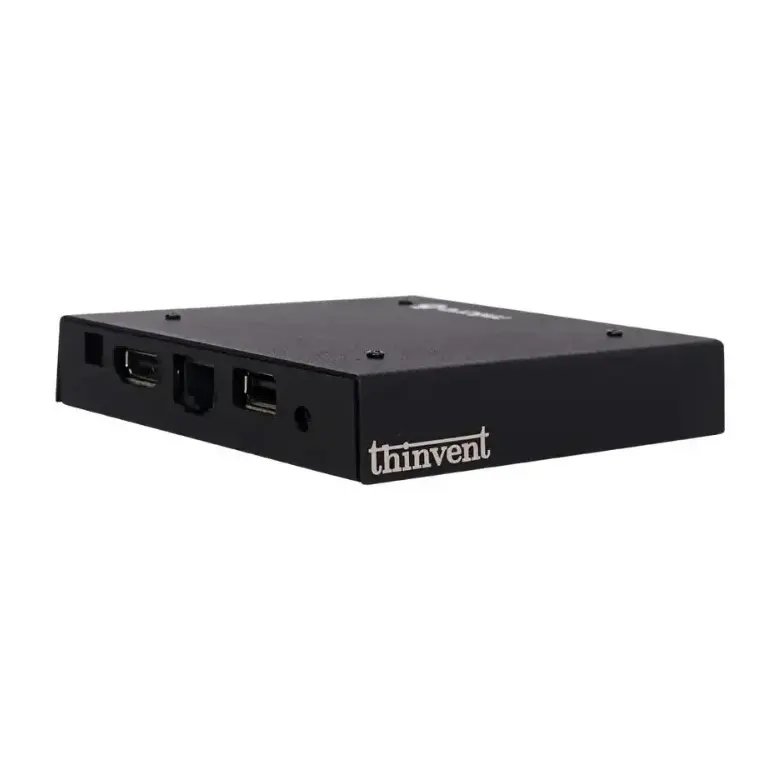
What Is an Industrial Computer?
An industrial computer is a computing platform engineered to run continuously in environments where a standard office desktop or consumer mini PC would struggle. Instead of prioritizing slim looks and low cost, industrial PCs are designed around thermal headroom, wide-voltage power input, long-term component availability and mechanical ruggedness. The result is a machine that keeps running through dust, vibration, heat, cold and unattended 24/7 operation.
The practical difference shows up in three areas: power, I/O and lifecycle. Industrial systems typically accept 12V DC input (often through a locking or terminal-block connector) rather than a proprietary barrel adapter, they expose legacy and industrial interfaces such as RS-232/RS-485 serial ports, digital I/O or dual Gigabit Ethernet, and they are built from components that remain orderable for years so a deployment of 200 units can be replicated and repaired without redesigning the enclosure.
Key Specifications That Matter
Processor: Modern industrial PCs have moved well beyond low-power Atom-class chips. Intel Core i3, i5 and i7 parts from the 12th, 13th and 14th generations deliver hybrid performance-core/efficiency-core designs, large caches and high boost clocks while still fitting into fanless or low-noise chassis. For lighter workloads, Intel N-series and Celeron processors (N95, N100, N150, J4125) offer low thermal design power and silent operation.
Memory and storage: 8GB is the practical floor for a Windows 11 installation running a line-of-business application; 16GB and 32GB are common in machine-vision, virtualisation and multi-application scenarios. M.2 NVMe or SATA SSDs from 128GB to 1TB handle the operating system and data, while DRAM-less or eMMC storage should be avoided where write endurance matters.
Connectivity: Dual Gigabit Ethernet ports support network segmentation — one port for the plant network, one for the enterprise network — or failover and link aggregation. HDMI and DisplayPort outputs drive signage, HMI and control-room displays. USB 3.2 Gen 2 and USB-C ports handle cameras, barcode scanners and high-speed peripherals.
Cooling and ingress protection: Fanless designs remove the single most common point of mechanical failure — the rotating fan — and prevent dust from being drawn through the chassis. Where fans are necessary, filtered, positive-pressure airflow keeps contaminants out.
Serial and legacy I/O: Many industrial devices — PLCs, weighbridges, energy meters, CNC controllers, laboratory instruments — still communicate over RS-232 or RS-485. Multi-port DB9 configurations are often the deciding factor when selecting a controller.
Form Factors Compared
| Form Factor | Typical Use | Strengths | Considerations |
|---|---|---|---|
| Industrial PC | Factory automation, kiosks, gateways | Wide I/O, wide DC input, rugged chassis, long lifecycle | Larger footprint, higher cost |
| Mini PC | Digital signage, office virtualisation, retail | Small, silent, low power draw | Limited expansion, fewer legacy ports |
| Thin Client | VDI |