What Does "395 Mini PC" Mean?
The term "395 mini PC" is generally used as a shorthand search for compact, small-footprint computers — often fanless industrial mini PCs built around Intel processors in the 3xx or N-series range. Buyers searching this term are typically looking for a reliable, space-saving computer that can run a full desktop operating system, drive industrial I/O, or serve as a dependable node in a kiosk, signage, or automation setup. Because "395" is not a standardized Intel model number, it is best understood as a category descriptor rather than a single chip — the practical answer is to match the required workload to a modern, well-supported processor and a chassis designed for the environment it will live in.
Key Specifications That Matter in a Mini PC
When evaluating any compact or industrial mini PC, the specifications that determine real-world suitability are processor class, memory, storage, cooling method, and I/O. Modern Intel options span entry-level efficiency chips (such as the N95, N100 and N150) through to higher-throughput Core i3 parts like the i3-1215U, a 6-core processor running up to 4.4 GHz with 10 MB cache. Memory typically ranges from 4 GB to 64 GB DDR4, and storage from 128 GB to 1 TB SSD. Fanless designs remove the intake vents and moving parts that draw in dust, which matters greatly in workshops, factories and outdoor cabinets. Connectivity is equally important: dual Gigabit Ethernet ports, multiple HDMI outputs, USB 3.2 Gen 2 and USB-C ports determine how many displays, sensors and peripherals a system can handle.
| Attribute | Typical Entry Mini PC | Typical Industrial Mini PC |
|---|---|---|
| Processor | Intel N95 / N100 / N150 | Intel Core i3 / i5 (10th–14th gen) |
| Cores | 4 | 6–12 |
| Memory | 4–8 GB | 8–64 GB |
| Storage | 128–256 GB SSD | 256 GB–1 TB SSD |
| Cooling | Fanless or small fan | Fanless, wide-temperature |
| Ethernet | 1 × Gigabit | 2 × Gigabit |
| Serial / Industrial I/O | Rare | Common (DB9, GPIO, digital I/O) |
| Mounting | Desk / VESA | DIN rail, wall, VESA |
Use Cases and Applications
Compact mini PCs are deployed wherever a full PC is needed but space, power draw or reliability is constrained. Common applications include digital signage and menu boards, point-of-sale and kiosk terminals, thin-client desktop virtualization, machine vision and industrial control, edge data collection and gateway roles, laboratory instrumentation, and building automation. In these settings the priorities differ from a consumer desktop: long product lifecycles, stable driver support, wide input voltage tolerance, protection against dust and vibration, and the ability to keep running unattended for years. A fanless chassis with a solid-state drive and a locked-down operating system image is usually the right combination, since there are no moving parts to fail and no vents to clog.
Choosing the Right Configuration
Start from the software, not the hardware. A lightweight Linux or Windows IoT image running a single kiosk application may be perfectly served by a 4-core N-series processor with 8 GB of RAM and a 256 GB SSD. A system running multiple virtual machines, databases, or vision workloads will benefit from a 6-core or 12-core Core i3/i5, 16–32 GB of RAM and a 512 GB–1 TB SSD. Operating system choice also shapes the build: Windows 11 Pro for standard commercial software, Windows 11 IoT for long-term servicing, Ubuntu Linux 24.04 LTS or an embedded Linux for headless or custom applications, and FreeDOS or no-OS for customers who deploy their own image. Finally, count your ports before you buy — dual Ethernet, dual HDMI, USB-C and serial ports are far easier to specify up front than to add later.
Thinvent Products Featuring This Technology
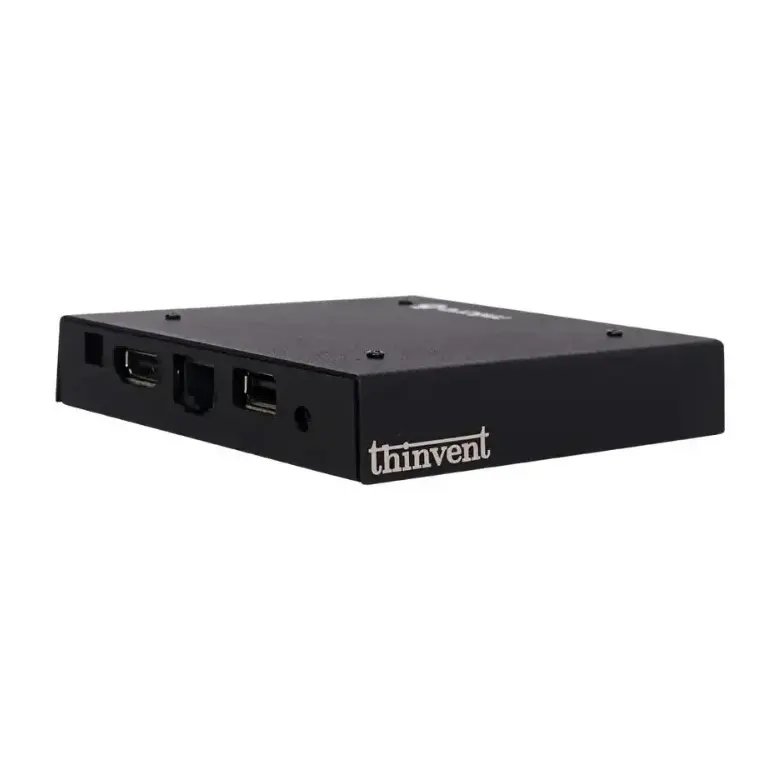
Thinvent manufactures fanless industrial computers, mini PCs, thin clients and all-in-one PCs built around Intel and ARM platforms, designed for continuous operation in demanding environments. The IPC3 industrial PC family, for example, pairs an Intel Core i3-1215U processor (6 cores, up to 4.4 GHz, 10 MB cache) with 16 GB DDR4 RAM and a 1 TB SSD, and is offered with Windows 11 Pro, Windows 11 IoT Value, DOS, or Thinux embedded Linux, with optional quad DB9 serial ports for industrial equipment. Across the range, Thinvent systems are available with 4 to 64 GB memory, 128 GB to 1 TB SSD storage, single or dual Gigabit Ethernet, and flexible display outputs, so customers can match a configuration precisely to their deployment.