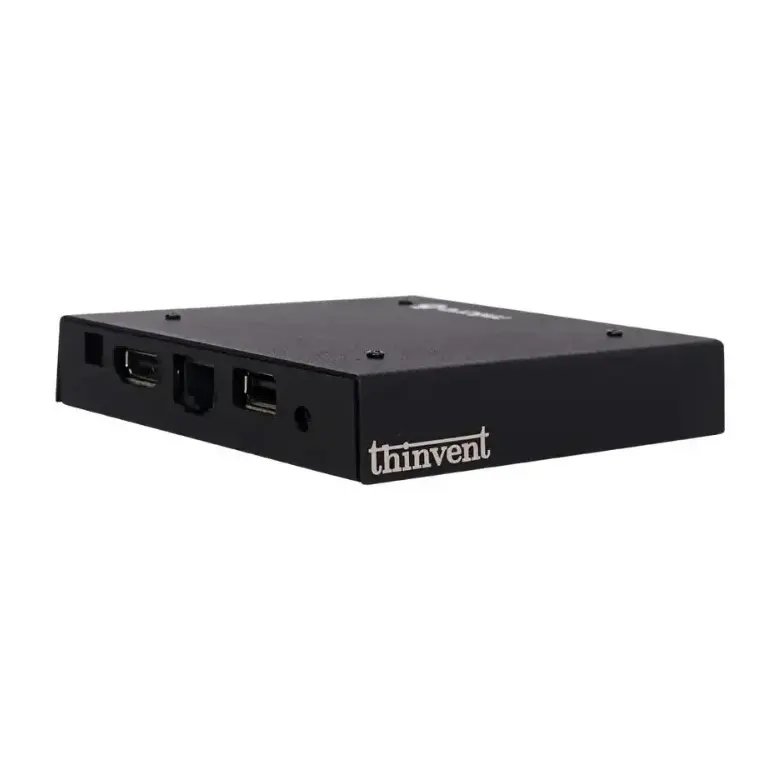
What Are Compact Fanless Mini PCs?
Compact fanless mini PCs are small-form-factor computers designed for industrial and embedded applications where reliability, space constraints, and silent operation are critical. These systems eliminate moving parts like fans, using passive cooling solutions such as heat sinks and chassis design to dissipate heat. This makes them ideal for environments with dust, debris, or vibration, where traditional computers with fans might fail. They offer a balance of performance, durability, and energy efficiency in a minimal footprint.
Key Specifications and Technical Details
A typical compact fanless mini PC, like those featuring the Intel N100 processor, is built around low-power, efficient components. Core specifications often include:
-
Processor: Modern Intel processors like the 4-core N100 (up to 3.4 GHz) from the 12th Generation, offering a good balance of performance and thermal efficiency.
-
Memory: Configurations typically range from 8GB to 16GB of DDR4 RAM, sufficient for multitasking and running industrial software.
-
Storage: Solid-state drives (SSDs) from 128GB to 512GB provide fast boot times and reliable data storage without mechanical hard drives.
-
Connectivity: Standard features include Gigabit Ethernet for network reliability, multiple USB ports (including USB 3.2), and HDMI outputs for display. Many models operate without Wi-Fi for enhanced security in controlled environments.
-
Power: Low-voltage DC input (e.g., 12V) allows for flexible power sourcing and integration with industrial power systems.
Use Cases and Applications
The robust, silent design of fanless mini PCs makes them suitable for a wide range of demanding applications:
-
Digital Signage & Kiosks: Reliable 24/7 operation in public spaces like retail stores, airports, and museums.
-
Industrial Automation: Controlling machinery and HMIs (Human-Machine Interfaces) on factory floors resistant to dust and particulates.
-
Thin Clients & VDI: Serving as endpoints for virtual desktop infrastructure in offices, call centers, and healthcare.
-
Edge Computing: Processing data locally in IoT networks, transportation systems, and smart city infrastructure.
-
Embedded Systems: Integration into medical devices, point-of-sale systems, and other specialized equipment.
Comparison of Common Processor Options
For compact fanless designs, processor choice is key to balancing performance and thermal output.
| Processor Model | Cores / Threads | Max Turbo Frequency | Typical TDP | Best For |
|---|---|---|---|---|
| Intel N100 | 4 / 4 | 3.4 GHz | 6W | General-purpose industrial computing, digital signage, basic automation. |
| Intel N95 | 4 / 4 | 3.4 GHz | 15W | Slightly higher burst performance for more demanding embedded tasks. |
| Intel J4125 | 4 / 4 | 2.7 GHz | 10W | Legacy and cost-sensitive applications requiring proven reliability. |
Thinvent's Range of Compact Fanless Mini PCs
Thinvent offers a comprehensive lineup of industrial-grade compact fanless mini PCs designed for global deployment. Our Aero series, for example, features the efficient Intel N100 processor in a rugged, fanless chassis. These systems are built with industrial longevity in mind, supporting a variety of operating systems including Windows 11 IoT, Windows 11 Pro, Ubuntu Linux, and our own Thinux™ Embedded Linux to meet diverse software requirements. With configurations available in different memory, storage, and OS bundles—often including essential peripherals—Thinvent provides reliable computing solutions for automation, digital signage, edge computing, and thin client deployments worldwide.