What Does "Android CPU" Mean?
An "Android CPU" is not a specific chip — it is shorthand for a processor paired with Google's Android operating system. Android runs on ARM-based system-on-chips (SoCs) from suppliers such as Qualcomm, MediaTek, Rockchip and Amlogic, and on some x86 processors as well. What defines an Android device is the software stack and its application model, not a single silicon part. When buyers search for an "Android CPU," they usually want a compact, low-power computer that boots Android, runs Android apps, and can be managed remotely.
ARM vs x86 for Android Workloads
ARM SoCs are the native home of Android. They typically integrate the CPU cores, GPU, memory controller and I/O into one chip, which keeps boards small, power draw low, and fanless cooling practical. x86 processors from Intel can also run Android through emulation layers or dedicated Android-x86 style builds, which suits organisations that want Android apps alongside a familiar PC architecture. The trade-off is straightforward: ARM gives the best power efficiency and the widest Android app compatibility, while x86 gives easier integration with existing Windows and Linux tooling.
| Aspect | ARM-based Android | x86 running Android |
|---|---|---|
| Power draw | Very low, often fanless | Low to moderate |
| Android app compatibility | Native | Layer or emulation dependent |
| Board size | Very compact | Compact to standard |
| Typical use | Kiosks, signage, POS | Hybrid PC/Android deployments |
Where Android Computers Fit
Android computers are common in digital signage players, self-service kiosks, queue-management displays, point-of-sale terminals, classroom tablets and industrial HMIs. The appeal is a touch-first interface, over-the-air app updates, and a large pool of developers familiar with the platform. For these roles, the priority is 24x7 stability, wide operating temperature tolerance, and enough RAM and storage for local caching rather than raw benchmark speed.
Choosing the Right Hardware
Match the processor to the workload. Light signage and single-app kiosks are comfortable on a 4-core SoC with 4-8 GB RAM and 128 GB storage. Multi-app kiosks, video walls or edge analytics benefit from 6-12 cores, 16 GB RAM or more, and 256 GB or larger SSD or eMMC storage. Check the ports you actually need: dual HDMI for two displays, Gigabit Ethernet for wired networks, and USB 3.2 Gen 2 plus USB-C for peripherals and service access. Fanless designs are preferable in dusty or high-traffic locations because there is no intake to clog.
Thinvent Products for Android-Style Deployments
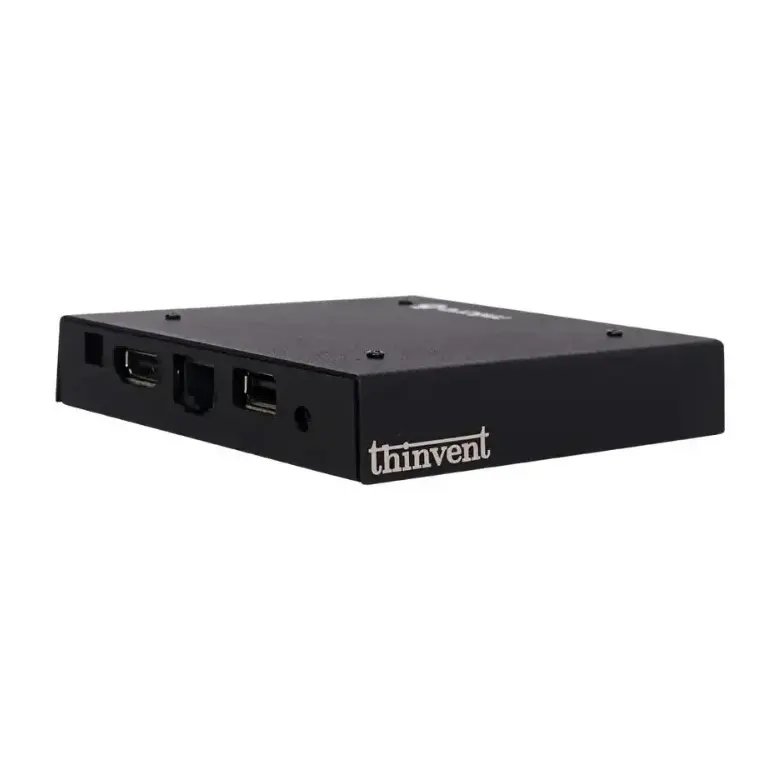
Thinvent builds compact, fanless industrial computers, mini PCs, thin clients and all-in-one PCs on both Intel and ARM platforms, engineered for continuous operation in kiosks, signage and industrial control. Our Intel-based mini PCs and all-in-one systems support Windows, Linux and embedded Linux images, and our ARM-based platforms are suited to Android and Linux application stacks where power efficiency and a small footprint matter most. Whether you need a single self-service terminal or a fleet of managed displays, Thinvent can supply the form factor, processor class and connectivity to match your deployment.