Which PC Is Best? It Depends on the Application
There is no single "best PC" — the right machine is the one that matches the demands of your workload, your environment and your deployment model. A general-purpose office desktop, a fanless industrial computer running 24/7 on a factory floor, a thin client streaming a virtual desktop, and an all-in-one PC on a reception desk all solve different problems. The fastest way to choose well is to define four things first: what software will run, how many users or devices it serves, where it will be installed, and how long it must stay in service.
Start With the Workload, Not the Spec Sheet
The processor sets the ceiling for what a system can do. Light tasks such as browsing, billing, data entry and thin-client sessions run comfortably on efficient Intel Celeron or N-series chips. Business productivity, multi-tab work, light virtualisation and industrial HMI software benefit from Intel Core i3 or i5 processors with more cores and cache. Memory and storage should follow the workload: 4–8 GB RAM suits kiosks and thin clients, 16 GB is the practical baseline for multitasking and industrial applications, and 32–64 GB is appropriate for virtualisation hosts and heavy data work. SSD storage from 128 GB to 1 TB covers everything from stateless terminals to local data logging.
| Typical Application | Recommended Class | Suggested Baseline |
|---|---|---|
| Thin client / VDI access | Thin Client, ARM or Intel N-series | 4–8 GB RAM, 128–256 GB SSD |
| Office productivity, billing, POS | Mini PC, Intel i3 | 8–16 GB RAM, 256–512 GB SSD |
| Industrial control, HMI, SCADA | Industrial PC, Intel i3/i5 | 16 GB RAM, 512 GB–1 TB SSD |
| Digital signage, kiosk, reception | All-in-One PC | 8–16 GB RAM, 256 GB SSD |
| Virtualisation, edge server | Industrial PC, Intel i5 | 32–64 GB RAM, 1 TB SSD |
Match the Form Factor to the Environment
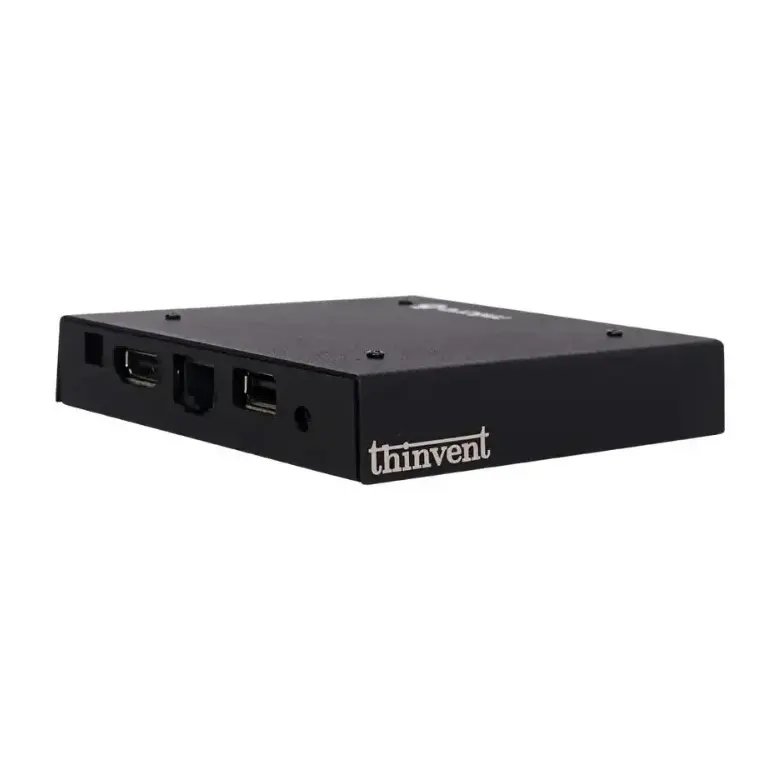
Form factor is often the deciding factor in real deployments. Mini PCs deliver desktop performance in a small footprint for offices and retail counters. Thin clients are purpose-built to connect to centralised virtual desktops, reducing per-seat cost and management effort. All-in-One PCs combine the computer and display in one unit, ideal for customer-facing spaces. Industrial PCs add wide-temperature tolerance, fanless cooling, vibration resistance, DIN-rail or wall mounting and long-life components so the system keeps running in dust, heat and continuous operation. If the machine sits in a clean, air-conditioned office, a commercial mini PC is usually enough; if it sits beside a machine tool, an industrial PC is the safer choice.
Operating System, Connectivity and Longevity
The operating system should match your software stack and IT policy. Windows 11 Pro suits mainstream business and industrial applications, while embedded Linux builds are common for kiosks, gateways and appliances where stability and low licensing overhead matter. Consider connectivity too: dual Gigabit Ethernet for network segmentation, multiple HDMI outputs for dual-display setups, USB 3.2 Gen 2 and USB-C for fast peripherals, and serial ports (DB9) for legacy industrial equipment such as PLCs, weighbridges and controllers. Finally, plan for lifecycle: industrial deployments often need five to ten years of consistent supply, so choose a platform with a stable, long-availability processor and a vendor that supports the same model over time.
Thinvent Products Built for These Choices
Thinvent manufactures across all four form factors, so the same engineering approach applies whether you need a mini PC, thin client, all-in-one or industrial computer. A strong example is the Thinvent® Industrial PC IPC3, built on the Intel® Core™ i3-1215U processor (6 cores, up to 4.4 GHz, 10 MB cache) with 16 GB DDR4 RAM and 1 TB SSD. It is offered with Windows 11 Pro, Windows 11 IoT Value, DOS, or Thinux™ Embedded Linux, and can be configured with Quad DB9 serial ports for industrial equipment integration. This flexibility lets you standardise on one hardware family while matching each deployment's OS, I/O and mounting requirements.