What Are The Best Industrial Computers?
The "best" industrial computer depends entirely on your specific application requirements. For industrial and commercial environments, the ideal system prioritizes reliability, durability, and consistent performance over raw consumer-grade speed. Key factors include fanless cooling for silent, dust-resistant operation, wide operating temperature ranges, and robust connectivity for integrating with machinery and sensors. Industrial PCs are engineered for 24/7 operation in harsh conditions where standard computers would fail.
Key Specifications and Technical Details
When evaluating industrial computers, focus on these core specifications:
-
Processor: Modern Intel processors like the N-series (e.g., N100) offer excellent performance-per-watt for embedded applications, while Core i3/i5/i7 series provide higher computational power for demanding tasks.
-
Form Factor: Options include compact Mini PCs for space-constrained installations, Panel PCs for human-machine interfaces (HMI), and ruggedized systems for extreme environments.
-
Memory & Storage: Adequate RAM (8GB-32GB) ensures smooth multitasking, while SSD storage (128GB-1TB) provides fast boot times and data access with no moving parts for increased reliability.
-
Connectivity: Multiple Gigabit Ethernet ports, USB 3.2, serial ports (COM), and HDMI/DisplayPort outputs are essential for industrial connectivity and multi-display setups.
-
Operating System: Support for Windows IoT, Linux distributions (like Ubuntu), or a "Without OS" option allows for customization and deployment of specialized software stacks.
Common Use Cases and Applications
Industrial computers serve as the backbone for automation and digitalization across sectors:
-
Factory Automation: Machine control, PLC supervision, and production line monitoring.
-
Digital Signage & Kiosks: Powering interactive displays in retail, hospitality, and public transportation.
-
Thin Client & VDI: Centralized computing for office environments, call centers, and secure workspaces.
-
Edge Computing: Data processing and analytics at the source, in IoT networks and smart city infrastructure.
-
Medical & Laboratory Equipment: Reliable computing for diagnostic devices and imaging systems.
Comparison of Common Industrial PC Form Factors
| Form Factor | Key Features | Ideal For |
|---|---|---|
| Mini PC / Box PC | Compact, fanless, wall-mountable, versatile I/O. | Space-limited control cabinets, digital signage, edge servers. |
| Panel PC / All-in-One | Integrated touchscreen display, sealed front panel. | HMI stations, operator interfaces, kiosks, control rooms. |
| Rackmount Industrial PC | Standardized chassis for server racks, high expansion. | Data acquisition systems, network appliances, telecom. |
| Thin Client | Low-power, centrally managed, enhanced security. | Virtual Desktop Infrastructure (VDI), task worker stations. |
Thinvent's Range of Industrial Computing Solutions
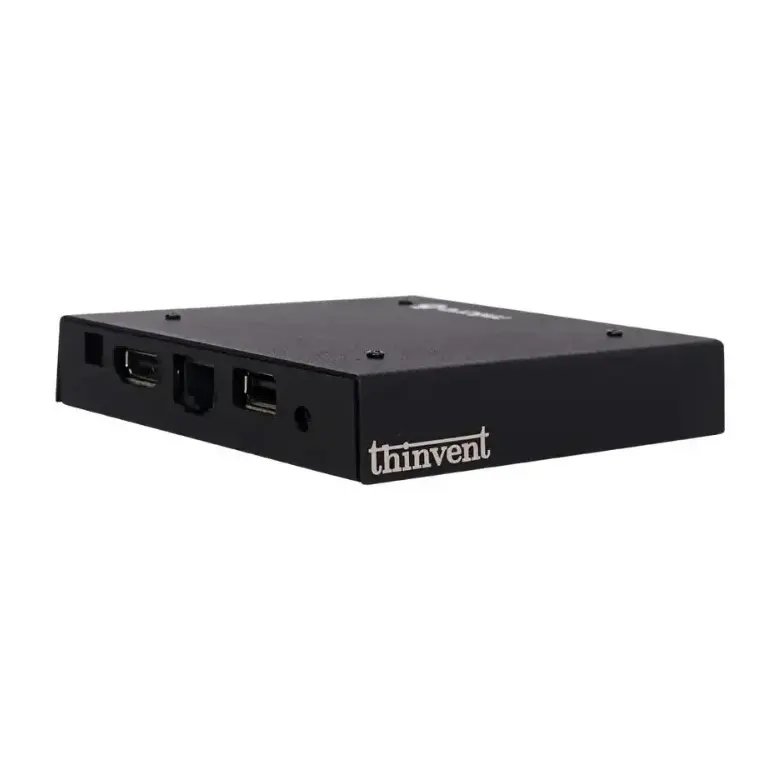
Thinvent designs and manufactures a comprehensive portfolio of industrial-grade computing hardware. Our product lines include the Aero Series of ultra-compact, fanless Mini PCs, perfect for embedded applications and digital signage. For interactive interfaces, we offer robust All-in-One Panel PCs with various screen sizes and touch technologies. Our systems feature modern Intel processors, from efficient N-series chips to powerful Core i-series CPUs, and support multiple operating systems to fit any project requirement. Built for reliability, Thinvent computers are engineered to deliver uninterrupted performance in commercial and industrial settings worldwide.