What Makes a Mini PC Brand the Best?
Choosing the best mini PC brand comes down to more than raw specifications. The strongest brands combine dependable hardware, consistent quality control, long product lifecycles, responsive support, and a clear focus on the environments where the machine will actually run. A mini PC that performs well on a climate-controlled desk may struggle on a factory floor, in a retail back office, or inside a kiosk exposed to dust and heat. The best brand for you is therefore the one whose design priorities match your deployment.
Key Factors to Evaluate
When comparing mini PC brands, look at these technical and practical dimensions:
-
Processor and chipset: Intel® processors such as the Celeron®, N-series, and Core™ i3/i5 families cover everything from basic office tasks to demanding multi-application workloads.
-
Thermal design: Fanless, passively cooled chassis eliminate moving parts, reduce dust ingress, and improve long-term reliability in dusty or hot settings.
-
Memory and storage: 8GB to 32GB DDR4/DDR5 RAM and 128GB to 1TB SSD options let you match the machine to the workload.
-
Connectivity: Dual Gigabit Ethernet, multiple HDMI outputs, USB 3.2 Gen 2, and USB-C determine how easily the unit fits into existing infrastructure.
-
Operating system flexibility: Windows 11 Pro, Ubuntu Linux, embedded Linux, FreeDOS, or no OS at all — the right brand lets you standardise on your preferred platform.
-
Lifecycle and support: Long-term availability of the same model reduces requalification effort when you scale a deployment.
Matching the Brand to the Use Case
Different deployments demand different priorities. A digital signage or kiosk rollout benefits from fanless cooling, dual HDMI, and a compact footprint. A thin-client or VDI environment prioritises low power draw, Gigabit Ethernet, and stable remote-management support. Industrial automation and edge computing need wide-temperature tolerance, dust resistance, and reliable 24/7 operation. Office and education deployments value quiet operation, easy imaging, and broad OS compatibility. A brand that offers a coherent range across these categories — rather than a single generic box — is usually the better long-term partner.
Comparison: What to Look For
| Criterion | Why It Matters | Ideal Specification |
|---|---|---|
| Cooling | Reliability in dust/heat | Fanless passive design |
| Processor | Performance per watt | Intel® Celeron®, N-series, Core™ i3/i5 |
| Memory | Multitasking headroom | 8–32GB DDR4/DDR5 |
| Storage | Boot speed, local data | 128GB–1TB SSD |
| Networking | Stable wired links | Dual Gigabit Ethernet |
| Display outputs | Multi-screen setups | 1–2× HDMI, USB-C |
| OS support | Standardisation | Windows 11 Pro, Ubuntu, Linux, FreeDOS |
| Lifecycle | Deployment stability | Long-term model availability |
Rather than chasing the single highest benchmark score, weigh reliability, serviceability, and supply consistency. For most commercial and industrial buyers, those factors deliver more value over a five-year deployment than a marginal CPU speed advantage.
Thinvent Mini PCs
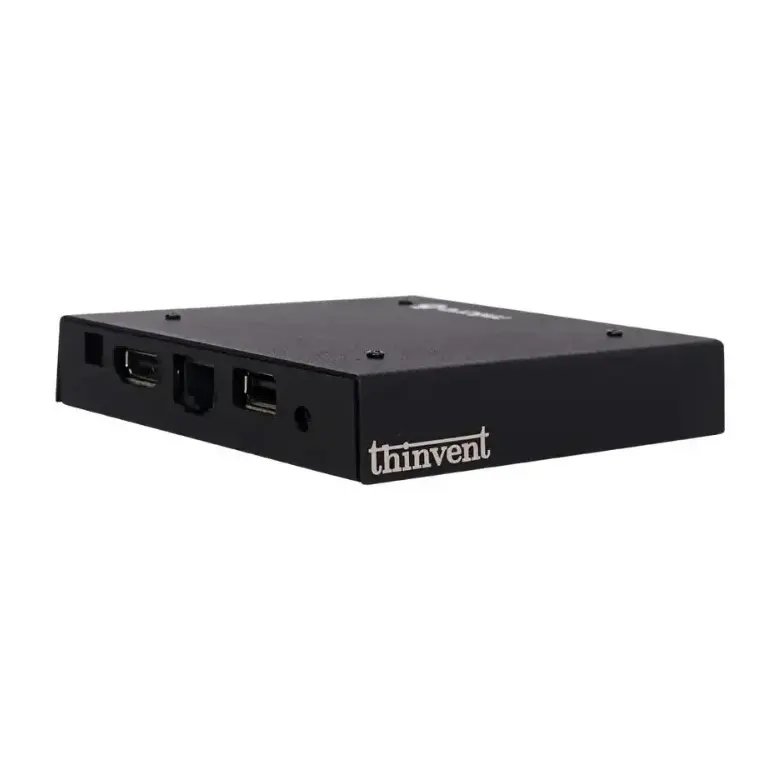
Thinvent designs and manufactures mini PCs, thin clients, industrial computers, and all-in-one PCs built around exactly these priorities. The Thinvent® Aero Mini PC family pairs Intel® processors with 16GB DDR4 RAM and 128GB SSD storage in a compact, fanless chassis, and is available with Windows 11 Pro, Windows 11 IoT, Ubuntu Linux, Thinux™ Embedded Linux, FreeDOS, or no operating system — so you can standardise on whichever platform your deployment requires. With dual-display support, Gigabit Ethernet, and a design intended for continuous operation, Thinvent mini PCs suit office, retail, signage, kiosk, and light industrial use, and are backed by a range of configurations to match different workload and budget requirements.