What "CB" Refers To in Industrial Computing
"CB" is a compact abbreviation that appears in industrial computing contexts with several possible meanings. Most commonly, it refers to a circuit board or carrier board — the PCB assembly that hosts a processor and provides the interface between the CPU and the rest of a system. In other contexts, CB may denote a control box, the enclosure that houses the computing hardware on a factory floor or in a kiosk. Because the term is ambiguous, the right approach is to identify the underlying requirement: a rugged, compact computer that can be embedded into a larger machine or cabinet.
Key Specifications to Look For
When selecting a computer for board-level or control-box integration, the critical specifications are the processor, memory, storage, thermal design, and I/O. A modern industrial PC typically pairs an Intel® Core™ or Intel® Celeron® processor with DDR4 memory and solid-state storage. The Intel® Core™ i3-1215U, for example, is a 6-core processor running up to 4.4 GHz with 10 MB of cache — enough headroom for multi-tasking control software, SCADA clients, and data logging simultaneously. Fanless designs are preferred because they eliminate a common point of failure: the cooling fan.
Typical Use Cases
Systems in this class are deployed where a standard desktop PC would not survive. Common applications include:
-
Machine control and CNC interfaces — where serial ports (DB9) connect to legacy controllers
-
Kiosks and self-service terminals — compact enclosures with no moving parts
-
Data acquisition and gateway nodes — continuous operation with low maintenance
-
Digital signage and display control — driving HDMI outputs in retail or transit environments
Comparison of Integration Options
| Requirement | Board-Level / Embedded | Fanless Industrial PC | Standard Desktop |
|---|---|---|---|
| Vibration tolerance | High | High | Low |
| Operating temperature range | Wide | Wide | Narrow |
| Expandability | Limited | Moderate | High |
| Maintenance needs | Low | Low | Moderate |
| Serial / legacy I/O | Common | Common | Rare |
Choosing the Right Platform
The decision usually comes down to how much integration work the deployment can absorb. A board-level solution offers the smallest footprint but requires custom enclosure, power, and thermal design. A fanless industrial PC arrives ready to mount, with validated power input, I/O, and cooling already engineered. For most control-box and cabinet deployments, the pre-integrated route shortens time to deployment and reduces the risk of thermal or power issues discovered late in a project.
Thinvent Products Featuring This Technology
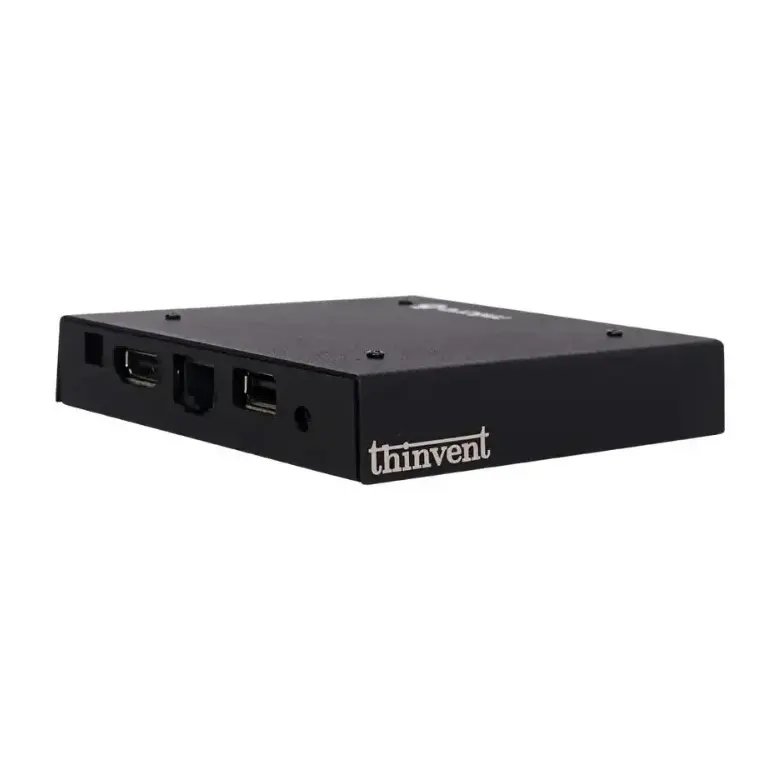
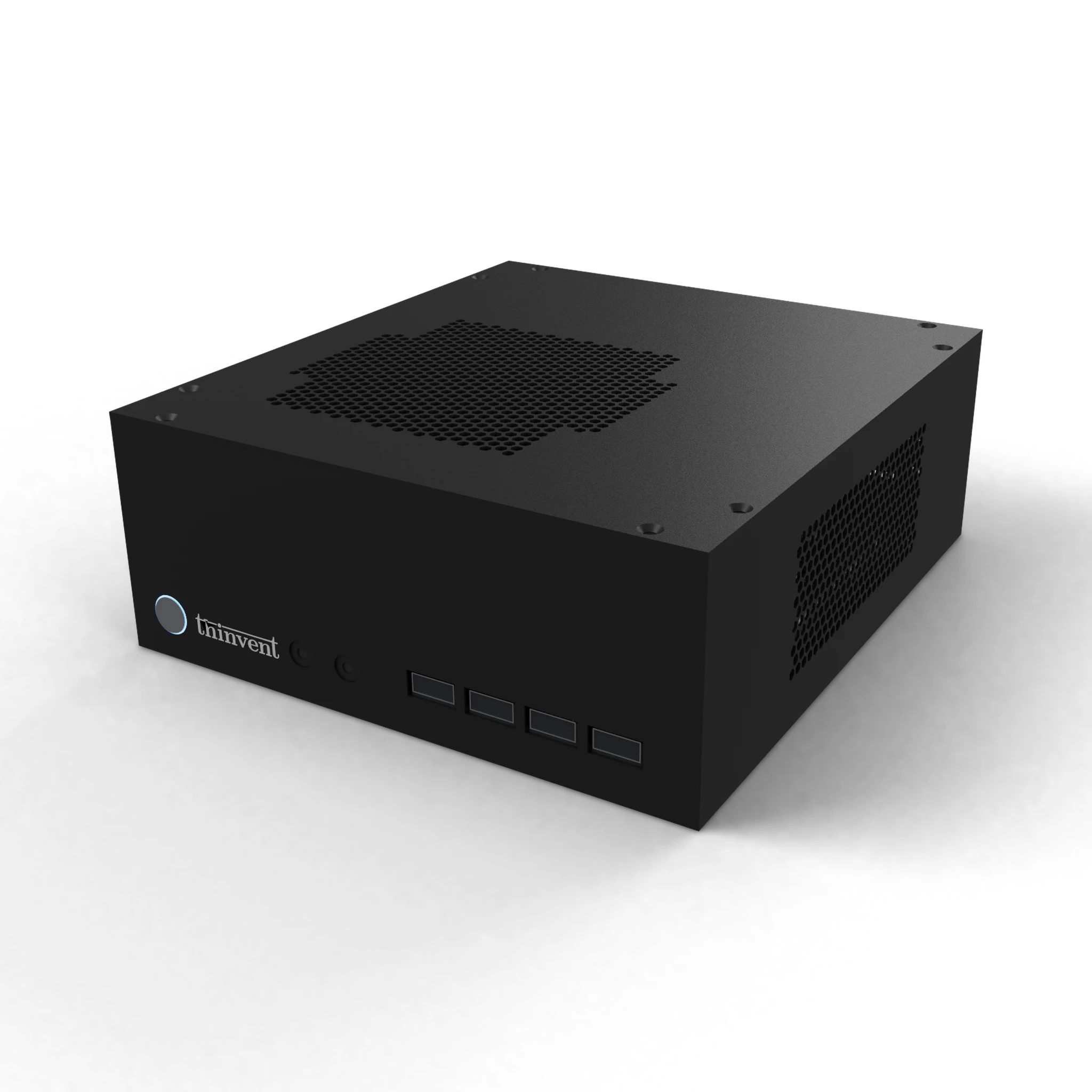
Thinvent's Industrial PC range is built around exactly these requirements. The Thinvent® Industrial PC IPC3 pairs an Intel® Core™ i3-1215U processor (6 cores, up to 4.4 GHz, 10 MB cache) with 16 GB DDR4 RAM and a 1 TB SSD, powered by a 12 V 10 A adapter. It is available with Quad DB9 serial ports for connecting legacy industrial equipment, and ships with a choice of operating systems including Windows 11 Professional, Windows 11 IoT Value, DOS, and Thinux™ Embedded Linux. A no-WiFi configuration keeps the unit suited to secured networks where wireless is not permitted. For lighter workloads, Thinvent also offers mini PCs and thin clients built on Intel Celeron® and Intel N-series processors, all sharing the same fanless, long-life design philosophy.