What Are Cloud-Based Tools?
Cloud-based tools are software applications and services hosted on remote servers and accessed via the internet. They eliminate the need for local software installation and heavy-duty local processing, shifting the computational workload to powerful data centers. For end-users, this means accessing tools like CRM platforms, project management software, design suites, and data analytics dashboards directly through a web browser or a lightweight client application.
Hardware Requirements for Cloud Tools
While processing happens remotely, the local client device—your industrial computer—still has critical requirements. It must reliably handle the user interface, maintain a stable and fast network connection, and support modern web standards. Key specifications include:
-
Reliable Connectivity: Multiple Gigabit Ethernet ports for a wired, stable connection are often preferred over Wi-Fi in industrial settings to ensure uninterrupted access.
-
Sufficient RAM: Adequate memory (typically 8GB or more) is essential for smooth multitasking across multiple browser tabs and applications.
-
Fast Storage: An SSD (Solid State Drive) drastically improves system responsiveness, application launch times, and overall user experience.
-
Modern Processor: A capable, multi-core CPU (like Intel's N-series or Core i3/i5) ensures smooth video playback for conferencing and handles modern web applications efficiently.
-
Robust Operating System: A stable OS like Windows 11 Pro, Ubuntu Linux, or a lightweight embedded OS is crucial for long-term, trouble-free operation.
Applications and Use Cases
Industrial computers powering cloud tools are deployed across various sectors:
-
Digital Signage & Kiosks: For content management systems that update menus, advertisements, or information remotely.
-
Factory Floor Terminals: Accessing cloud-based MES (Manufacturing Execution Systems), inventory management, and quality control dashboards.
-
Thin Clients & VDI: Acting as endpoints to virtual desktops hosted in the cloud, centralizing IT management and security.
-
Retail & Hospitality POS: Running cloud-based point-of-sale and inventory systems for seamless transactions and real-time reporting.
Recommended System Configurations
| Use Case | Recommended Processor | Minimum RAM | Recommended Storage | Key Features |
|---|---|---|---|---|
| Basic Terminal / Digital Signage | Intel N100, Celeron | 8 GB | 128 GB SSD | Fanless, Gigabit Ethernet, Multiple Display Outputs |
| General Office & Thin Client | Intel i3, i5 (10th Gen+) | 16 GB | 256 GB SSD | Reliable performance for multitasking, USB 3.2 ports |
| Advanced Industrial Workstation | Intel i5, i7 (12th Gen+) | 32 GB | 512 GB+ SSD | High core count for complex UIs, robust connectivity options |
Thinvent Solutions for Cloud-Based Environments
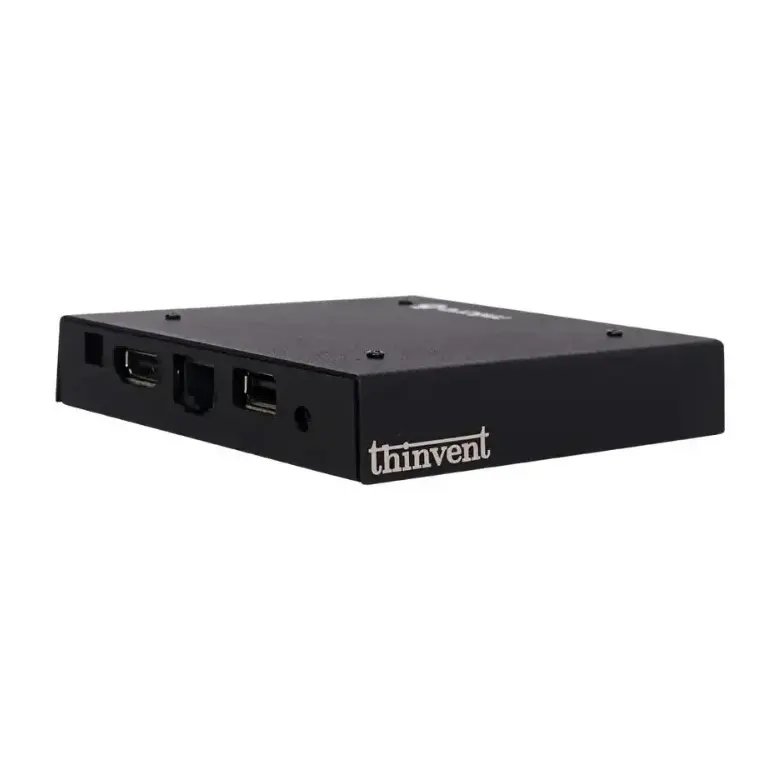
Thinvent offers a comprehensive range of industrial computing hardware engineered for reliability in cloud-centric workflows. Our fanless Mini PCs and Industrial PCs are built with robust components to ensure 24/7 operation in diverse environments. They feature modern Intel processors, fast DDR4/DDR5 RAM, and SSD storage, all paired with extensive connectivity options like dual Gigabit Ethernet and multiple USB ports. Available with a choice of operating systems—including Windows 11 Pro, Ubuntu Linux, and our own Thinux™ Embedded Linux—Thinvent devices provide a secure, stable, and powerful foundation for accessing any cloud-based tool, from simple SaaS applications to graphics-intensive virtual desktops.