Understanding Industrial Computer CPU Performance
The Central Processing Unit (CPU) is the core component determining the performance, efficiency, and reliability of an industrial computer. Unlike consumer-grade processors, industrial CPUs are engineered for 24/7 operation in demanding environments, prioritizing stability, longevity, and consistent performance over peak speeds. Key specifications to evaluate include core count, clock speed (base and turbo frequencies), cache size, thermal design power (TDP), and the processor's generation and architecture. A higher core count improves multitasking and parallel processing, essential for machine vision or data acquisition, while a larger cache reduces latency for frequently accessed data.
Key Specifications for Reliability
Reliability in industrial settings is non-negotiable. Industrial CPUs are often part of fanless systems with robust thermal management to eliminate moving parts that can fail. They support extended temperature ranges (often from -20°C to 70°C), higher shock and vibration resistance, and long-term availability to ensure supply chain stability for years. Processors with lower TDP are favored for fanless designs, as they generate less heat. Furthermore, industrial platforms often support Error-Correcting Code (ECC) memory, which detects and corrects data corruption—a critical feature for financial, medical, or automation control systems where data integrity is paramount.
CPU Selection for Industrial Applications
Choosing the right CPU depends entirely on the application's computational demands and environmental conditions.
-
ARM-based Processors (e.g., Cortex-A53/A55): Ideal for lightweight, dedicated tasks. They are extremely power-efficient, generate minimal heat, and are perfect for digital signage, thin clients, kiosks, and basic HMIs where low cost and fanless operation are key.
-
Intel Celeron/Pentium & N-Series (e.g., N95, N100): Offer a balance of x86 compatibility and low power consumption. Suitable for more interactive kiosks, entry-level industrial gateways, and light PLC systems.
-
Intel Core i3/i5/i7 (U & P-Series): Deliver high performance for demanding applications. Use Intel Core i3 (e.g., 1215U) for mid-range automation, i5 (e.g., 1240P, 1335U) for advanced machine vision, edge computing, and complex SCADA systems, and i7 for the most intensive AI inference and real-time analytics.
| Application | Recommended CPU Type | Key Considerations |
|---|---|---|
| Digital Signage / Thin Client | ARM, Intel Celeron/N-Series | Low power, fanless, cost-effective |
| PLC/HMI Interface | Intel Celeron, Intel Core i3 | Stable performance, extended temperature |
| Machine Vision / Edge AI | Intel Core i5/i7 (P-series) | High core/thread count, high turbo frequency |
| Industrial Automation Server | Intel Core i5/i7 | High cache, support for ECC memory |
Thinvent Industrial Computers with Optimized CPUs
Thinvent designs its industrial computing solutions around precisely matched CPUs to ensure optimal performance and legendary reliability for every use case. Our portfolio includes:
-
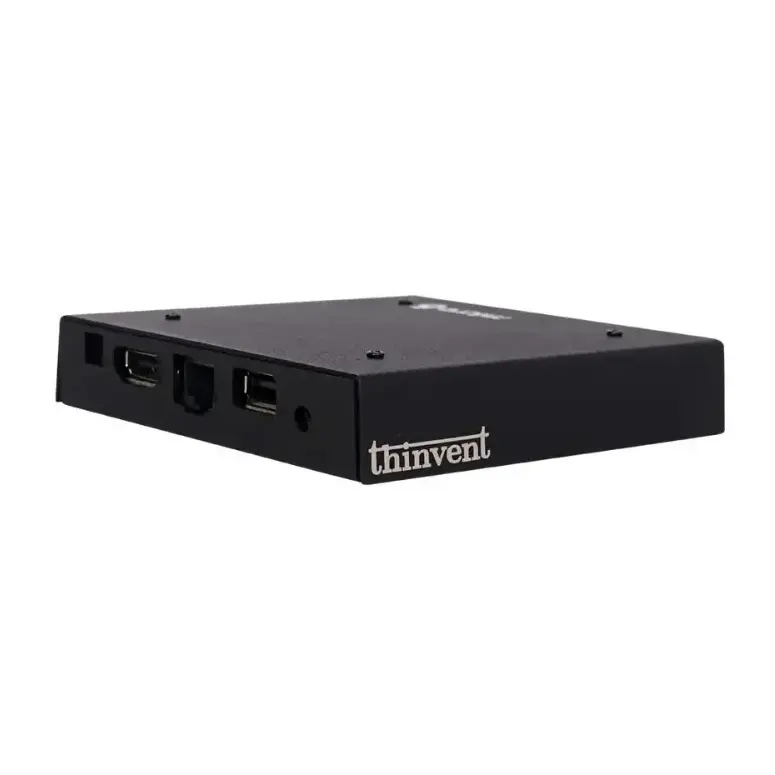
Thinvent Micro Series: Utilizing ultra-efficient ARM Cortex processors, these thin clients and mini PCs are built for always-on, fanless operation in space-constrained and cost-sensitive deployments like digital signage and point-of-sale.
-
Thinvent Industrial PC (IPC) Series: Featuring Intel Core processors from the 12th and 13th generations (like the i3-1215U and i5-1240P), these rugged computers are engineered for factory floors, offering robust performance for automation, control systems, and data acquisition with wide temperature tolerance.
-
Thinvent Aero Mini PC & Uno All-in-One: Powered by the latest Intel Core processors (including 14th Gen), these systems blend high performance with sleek form factors. They are perfect for engineering workstations, medical imaging, and advanced kiosks where computational power and reliability cannot be compromised.