What Is the Dell OptiPlex 380?
The Dell OptiPlex 380 is a small-form-factor desktop PC that Dell launched around 2009–2010 as part of its business-focused OptiPlex line. It was offered in Mini-Tower (MT), Desktop (DT) and Small Form Factor (SFF) chassis, and was built around Intel Core 2 Duo / Core 2 Quad processors on the G41 chipset, with DDR3 memory and a 3.5-inch hard disk bay. Dell still hosts a support and documentation page for the model, so drivers, service manuals and the technical guidebook remain available for owners.
Typical Specifications
| Component | OptiPlex 380 (typical configuration) |
|---|---|
| Processor | Intel Core 2 Duo / Core 2 Quad (e.g. Q9505 @ 2.83 GHz) |
| Chipset | Intel G41 |
| Memory | DDR3, typically 1–4 GB (2 DIMM slots) |
| Storage | 3.5" SATA HDD (e.g. 2 TB) |
| Optical | DVD-RW |
| Graphics | Integrated Intel GMA X4500 |
| OS (original) | Windows 7 (32-bit or 64-bit) |
| Chassis | Mini-Tower, Desktop, Small Form Factor |
What Does a Dell OptiPlex 380 Cost Today?
Because the OptiPlex 380 is a machine from the Windows 7 era, it is no longer sold new by Dell — Dell's product page for it now serves as a support and documentation hub rather than a purchase page. Any pricing you see today comes from the second-hand and refurbished market, where listings are usually for used Mini-Tower units with a Core 2 Quad, a small amount of DDR3 RAM and a mechanical hard drive. Prices vary widely by region, condition, and whether the unit includes a licensed operating system, so there is no single "list price" to quote.
Is It Still a Sensible Buy?
For basic legacy tasks — running an old line-of-business application, acting as a print server, or light document work — a used OptiPlex 380 can still function. However, it is worth weighing the practical limits: Core 2-era CPUs, DDR3 memory ceilings, mechanical drives, no native USB 3.0, no modern TPM/Windows 11 support, and much higher idle power draw than a current mini PC. When you add the cost of a replacement drive, more RAM, and an OS licence, a used tower often costs more over its remaining life than a new, low-power, fanless mini PC.
Modern Alternatives for the Same Job
If your goal is simply "a small, cheap, reliable desktop for office or kiosk work," current-generation mini PCs are the natural replacement. They draw a fraction of the power, boot from SSD in seconds, run Windows 11 or Linux natively, and mount behind a monitor to free up desk space. They are also far easier to deploy in volume because they are fanless (no dust-clogged fans to service) and can run headless in cabinets, kiosks and shop floors.
Thinvent Products for This Use Case
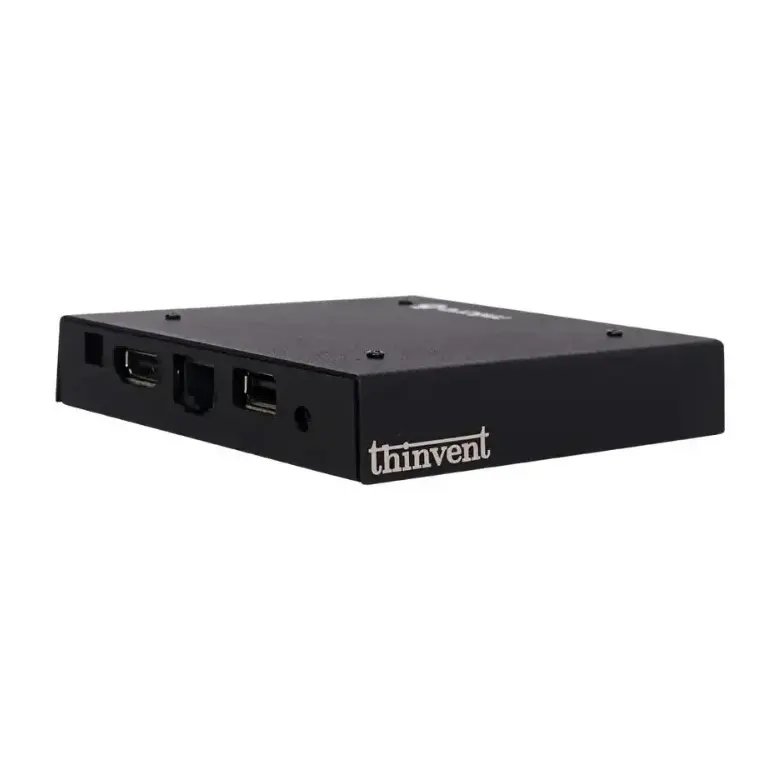
Thinvent builds fanless mini PCs, industrial computers, thin clients and all-in-one PCs designed for exactly the workloads that ageing office desktops handle today — but with current Intel processors, SSD storage, DDR4 memory and long-term OS support. The Thinvent® Aero Mini PC family, for example, pairs a 4-core Intel processor with up to 16 GB DDR4 RAM and 128 GB SSD, and is available with Windows 11 Pro, DOS, or Thinux™ Embedded Linux, with or without a keyboard-and-mouse set. For multi-user or VDI deployments, Thinvent thin clients let you centralise compute while keeping the desk-side hardware cool, silent and maintenance-free.