Understanding Storage in Industrial PCs
The word "disk" in modern computing almost always refers to solid-state storage rather than a spinning hard disk drive (HDD). Industrial computers, mini PCs, thin clients and all-in-one PCs have largely moved to SSDs (solid-state drives) because they have no moving parts, resist shock and vibration, operate silently, and tolerate the wide temperature ranges found on factory floors and outdoor cabinets. When a specification sheet lists a "disk", it is telling you the capacity and type of storage the system ships with — typically an M.2 or 2.5-inch SATA/NVMe SSD.
Capacity, Interface and Endurance
Storage capacity is measured in gigabytes (GB) or terabytes (TB), with common industrial configurations at 128GB, 256GB, 512GB and 1TB. The interface matters: SATA SSDs are widely compatible and cost-effective, while NVMe drives over PCIe deliver much higher sequential and random throughput. For industrial use, endurance ratings (TBW — terabytes written) and power-loss protection are often more important than raw speed, because these systems may log data continuously for years. DRAM-less versus DRAM-cached controllers, wear leveling and over-provisioning all affect how long a disk lasts in a 24/7 deployment.
| Storage Type | Typical Capacity | Interface | Best Suited For |
|---|---|---|---|
| SATA SSD | 128GB – 1TB | SATA III | General industrial control, kiosks |
| NVMe SSD | 256GB – 1TB+ | PCIe | Data logging, edge analytics |
| eMMC | 32GB – 128GB | Soldered | Thin clients, light OS images |
| HDD | 500GB – 2TB+ | SATA | Rare; archive/NVR bulk storage |
Choosing the Right Disk Size
A thin client or kiosk running a locked-down OS may need only 32–128GB, since applications stream from a server. An industrial PC running Windows 11 Pro, a database, or local video analytics will typically want 256GB to 1TB so that logs, images and updates fit comfortably with headroom for wear leveling. It is good practice to keep 20–30% of the disk free: this preserves write performance and extends SSD life. For applications that write heavily — surveillance recording, SCADA historians, machine vision — choose higher-endurance drives and consider separate disks for the OS and the data.
Use Cases and Applications
Disk choice follows the workload. Factory-floor HMIs and PLC gateways favour small, robust SATA SSDs. Edge servers and AI inference boxes benefit from NVMe for fast model and dataset access. Digital signage and all-in-one PCs usually need modest capacity but high reliability, since they run unattended. Thin clients often use minimal or even diskless storage, booting from the network, which reduces failure points and simplifies fleet management. In every case, fanless, wide-temperature designs pair best with SSDs because neither component relies on moving parts.
Thinvent Products Featuring This Technology
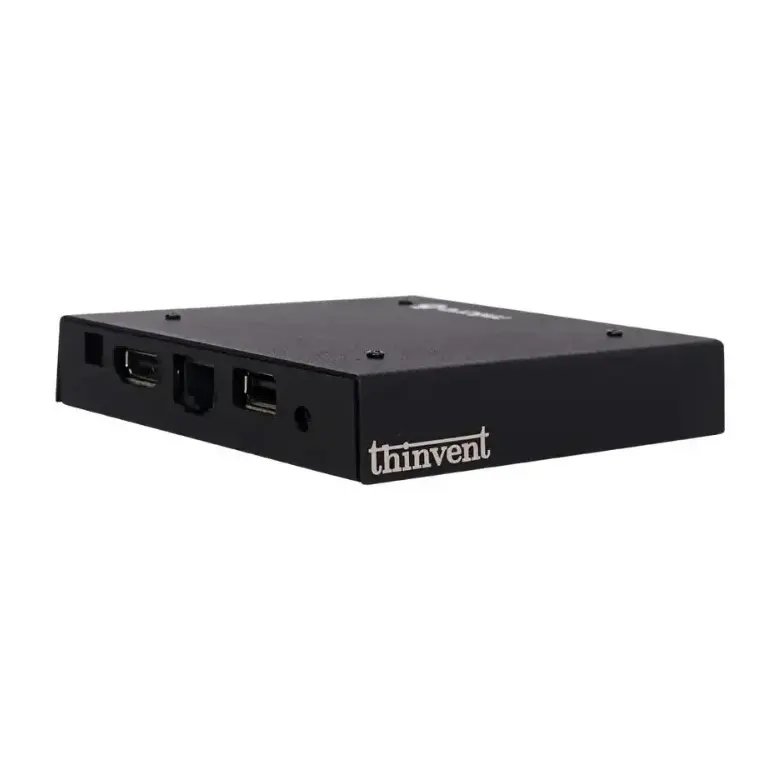
Thinvent builds industrial computers, mini PCs, thin clients and all-in-one PCs that ship with SSD storage options spanning 128GB, 256GB, 512GB and 1024GB. Our IPC3 industrial PC, for example, pairs an Intel® Core™ i3-1215U processor and 16GB DDR4 RAM with a 1TB SSD, and is available with Windows 11 Professional, Windows 11 IoT Value, DOS, or Thinux™ Embedded Linux. Whether you need a compact fanless mini PC for a control cabinet or a fleet of thin clients with minimal local storage, Thinvent's range lets you match disk capacity and operating system to your exact deployment.