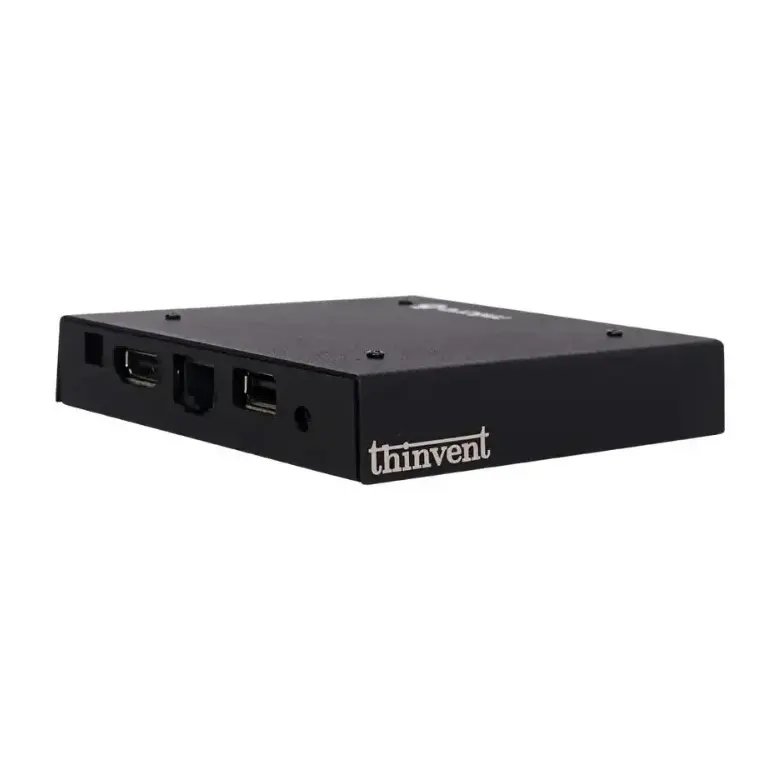
An industrial PC (IPC) is a computing platform engineered for environments where a standard desktop or office mini PC would fail. Instead of prioritising slim aesthetics and low cost, an industrial computer is designed around continuous duty: wide-temperature components, fanless passive cooling, vibration-tolerant mounting, protection against dust and metal particulates, and a long, stable supply of identical units so a deployment can be rolled out and serviced for years without a hardware revision breaking the software image.
What separates an industrial PC from a desktop
The most visible difference is cooling. Industrial PCs typically use a fanless chassis where the processor is thermally bonded to a finned aluminium or steel body, so heat leaves by conduction and natural convection. With no fan, there is no intake to pull in dust, no bearing to wear out, and no airflow path for conductive debris. The practical effect is a machine that survives a workshop, a factory floor or an outdoor cabinet rather than a climate-controlled office.
Beyond thermals, industrial PCs are specified for the electrical and mechanical realities of the site: wide-range DC input (commonly 12 V or 9–36 V), DIN-rail or VESA mounting, watchdog timers, and in many cases optically isolated or surge-protected serial and digital I/O. Legacy DB9 RS-232/RS-485 ports are still standard on industrial models because PLCs, weighbridges, barcode scanners, energy meters and CNC controllers continue to speak serial protocols that predate USB.
Typical specifications
| Attribute | Common industrial spec | Why it matters |
|---|---|---|
| Cooling | Fanless passive heatsink | No dust ingress, no moving parts to fail |
| Processor | Intel Core i3/i5, N-series Celeron | Balanced performance-per-watt for 24/7 duty |
| Memory | 8–32 GB DDR4/DDR5 | Headroom for SCADA, HMIs and databases |
| Storage | 128 GB – 1 TB SSD | Shock resistance, fast boot after power loss |
| Serial | Quad DB9 RS-232/485 | PLC, meter and legacy device connectivity |
| Networking | Dual Gigabit Ethernet | Segregated control and plant networks |
| OS | Windows 11 Pro/IoT, Linux, FreeDOS | Long-term OS support and licensing flexibility |
| Power | 12 V DC adapter or wide-range DC | Works from DIN-rail supplies and battery plants |
Where industrial PCs are deployed
The defining requirement across applications is unattended operation. In manufacturing, an IPC runs the HMI or SCADA node on a production line, logging machine data and pushing it to MES. In logistics and warehousing, it drives pick-to-light stations, conveyor control and fleet management dashboards. In energy and utilities, it acts