What Makes a "Good" Industrial Computer?
A good industrial computer is one that keeps running when conditions stop being comfortable. Unlike a desktop PC that lives in a climate-controlled office, an industrial PC (IPC) is expected to work in a factory bay, a warehouse, a kiosk, a control cabinet or a vehicle — often for years, often unattended. The measure of quality is not peak benchmark numbers but sustained reliability: stable thermals, wide input voltage tolerance, protection against dust and vibration, and a long lifecycle during which the same model can be re-ordered without requalification.
The practical checklist for evaluating one usually comes down to a handful of items: a processor that matches the workload without wasting power, fanless or well-managed cooling, industrial-grade storage, adequate I/O for the machines being connected, and an operating system that can be locked down and updated on your schedule rather than the vendor's.
Key Specifications to Look At
| Specification | What It Affects | Typical Good Practice |
|---|---|---|
| Processor | Compute headroom, power draw | Intel® Celeron®/N-series for light tasks; Core™ i3/i5 for multitasking, vision, or databases |
| Cores / Frequency | Responsiveness under parallel load | 4–6 cores and 3.0–4.4 GHz turbo covers most edge workloads |
| Cooling | Dust ingress, noise, service life | Fanless chassis where possible; sealed, filterless designs |
| Memory | Virtual machines, browser tabs, SCADA | 8–16 GB DDR4 as a baseline; 32–64 GB for heavy virtualisation |
| Storage | Boot speed, shock resistance | 128 GB–1 TB SSD or eMMC rather than spinning disks |
| Serial / Digital I/O | Legacy equipment, PLCs, meters | Multiple RS-232/RS-485 DB9 ports, GPIO, isolated inputs |
| Networking | Remote management, redundancy | Dual Gigabit Ethernet for segmentation or failover |
| Power Input | Brownouts, vehicle and DIN-rail supplies | Wide-range DC input with surge and reverse-polarity protection |
| OS Support | Long-term maintenance | Windows 11 Pro/IoT, Linux LTS, or embedded images you control |
Use Cases Where Reliability Matters More Than Raw Speed
Industrial computers show up in places where a reboot is an event, not a convenience. Common deployments include:
-
Factory automation and machine control — HMIs, SCADA nodes and PLC gateways, frequently using serial ports to talk to older controllers.
-
Vision and inspection stations — where a higher-core processor and fast SSD reduce cycle time.
-
Digital signage and kiosks — fanless units that run continuously in public spaces and tolerate poor ventilation.
-
Thin client and VDI fleets — low-power endpoints connecting to centralised servers, easy to replace and centrally managed.
-
Edge data collection and IoT gateways — dual Ethernet to separate the plant network from the business network.
-
Vehicle, kiosk and outdoor cabinets — wide-voltage DC input and vibration-tolerant mounting.
Choosing Between Form Factors
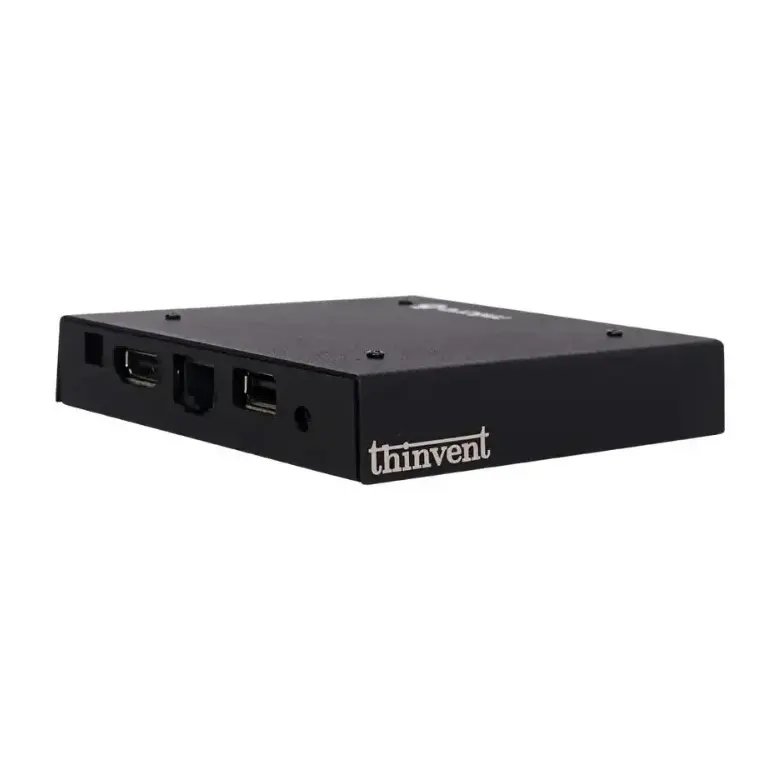
Mini PCs suit desk-side and light edge roles where space is tight. Industrial PCs add rugged enclosures, wider power input, watchdog timers and more I/O. All-in-one PCs combine the computer and display into one panel-mount unit, which is convenient for HMIs. Thin clients are the right answer when the heavy lifting happens on a server and the endpoint only needs to render a session. Matching the form factor to the environment early avoids over-specifying cost or under-specifying reliability.
Thinvent's Range of Industrial and Edge Computers
Thinvent manufactures fanless industrial computers, mini