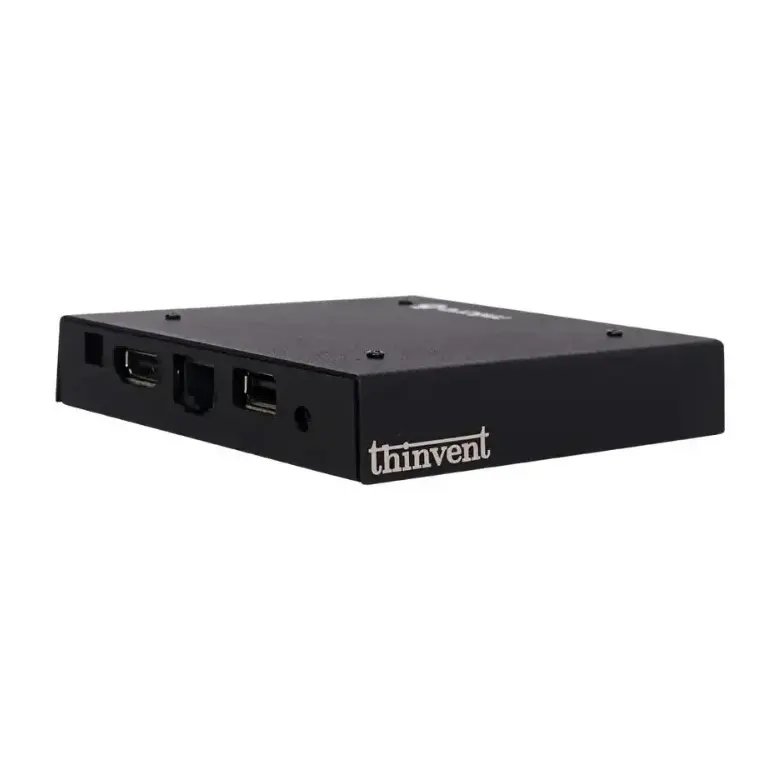
What Is an Intel Core i3-1215U Industrial PC?
An Intel Core i3-1215U industrial PC combines a 12th generation Intel processor with a chassis built for continuous, unattended operation on a factory floor, in a kiosk, or inside a control cabinet. The i3-1215U is a 6-core mobile-class CPU (2 performance cores plus 4 efficient cores) running up to 4.4 GHz with 10 MB of Intel Smart Cache. Because it is a 15 W-class part, it can be cooled passively, which means no fan to clog with dust, no filter to service, and no moving part to fail.
Key Specifications of the i3-1215U Platform
| Specification | Detail |
|---|---|
| Processor | Intel Core i3-1215U, 12th generation |
| Cores / Threads | 6 cores (2P + 4E), 8 threads |
| Max Turbo Frequency | Up to 4.4 GHz |
| Cache | 10 MB Intel Smart Cache |
| Memory | DDR4, typically 16 GB, expandable |
| Storage | SSD, commonly 1 TB |
| Graphics | Intel UHD integrated graphics, dual display capable |
| Typical OS | Windows 11 Pro, Windows 11 IoT, Linux, or DOS |
| Cooling | Fanless / passive heatsink designs available |
| Serial I/O | Up to quad DB9 RS-232/RS-485 ports on some models |
The hybrid core layout is the practical advantage here: the performance cores handle a database query, an HMI screen refresh, or a vision inspection pass quickly, while the efficient cores keep background services, loggers, and communication daemons running at low power. The result is a machine that responds quickly under load without drawing the power or generating the heat of a desktop-class CPU.
Where an i3-1215U Industrial PC Fits
These systems are usually specified where a normal office PC would not survive. Typical deployments include:
-
Factory automation and machine control — HMI panels, SCADA nodes, and PLC supervisory stations that run 24/7.
-
Kiosks and self-service terminals — ticketing, check-in, queue management, and information points in public or semi-outdoor locations.
-
Edge data acquisition — collecting and buffering data from sensors, meters, and legacy equipment before sending it upstream.
-
Serial-heavy installations — older instruments, weighbridges, CNC controllers, and lab equipment that communicate over RS-232 or RS-485 and need multiple DB9 ports.
-
Digital signage and control rooms — dual-display output for dashboards, camera walls, and production boards.
Choosing the Right Configuration
The processor is only one decision. In practice, buyers configure three things: memory and storage (16 GB RAM and a 512 GB to 1 TB SSD is a common balance for multi-application industrial workloads), the operating system (Windows 11 Pro for standard software, Windows 11 IoT for long-term servicing, or a Linux build for locked-down appliances), and the I/O complement — the number of serial ports, Ethernet ports, HDMI outputs, and USB 3.2 Gen 2 ports the installation actually needs. Buying a model with the right port count built in avoids USB-to-serial adapters, which are a frequent source of intermittent faults in industrial settings.
Thinvent Industrial PCs with Intel Core i3-1215U
Thinvent builds the IPC3 series around the Intel Core i3-1215U, offered in multiple configurations so you can match the unit to the job rather than over-specify it. Available options include 16 GB DDR4 RAM with a 1 TB SSD, a 12 V 10 A power adapter, and a choice of Windows 11 Professional, Windows 11 IoT Value, DOS, or Thinux™ Embedded Linux. Models with quad DB9 serial ports are available for installations that talk to multiple legacy devices over RS-232/RS-485, and the range is designed for fanless, dust-tolerant operation in industrial environments. If you need help matching an IPC3 variant to your application, Thinvent's team can advise on memory, storage, OS, and port configuration.