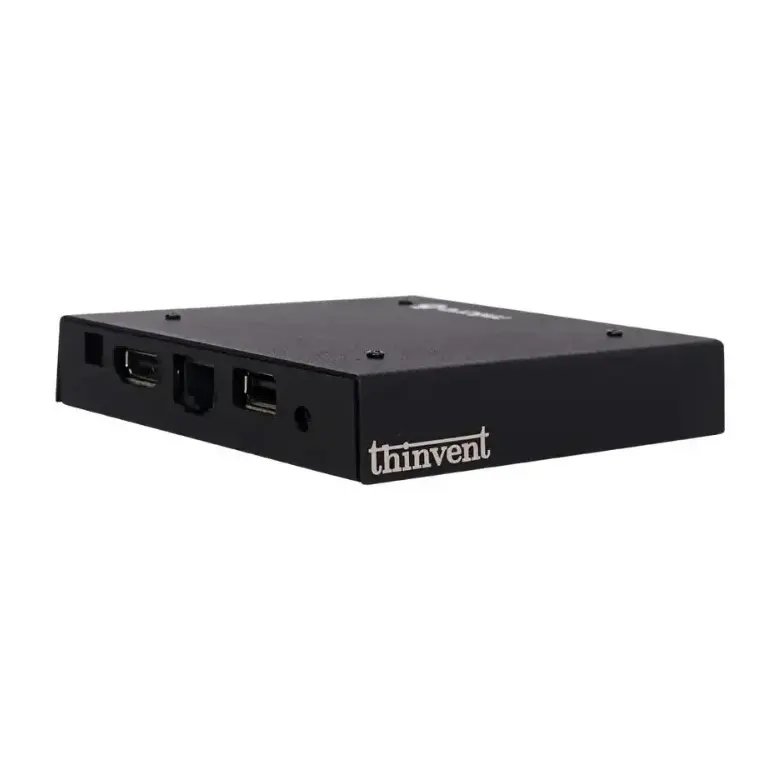
Industrial computers are purpose-built systems designed to run continuously in environments where a standard desktop would struggle — factory floors, kiosks, vehicles, control cabinets, and remote sites. Unlike office PCs, they prioritise stable thermals, wide voltage input tolerance, dust and vibration resistance, long lifecycle availability, and fixed I/O layouts that never change mid-deployment. Choosing the right one starts with three questions: what software will run on it, how many serial or network devices must connect, and how much heat, dust, or vibration the enclosure will face.
What Defines an Industrial-Grade System
The defining trait of an industrial PC is predictability. Components are selected for multi-year availability rather than peak benchmark scores, so a fleet deployed today can still be matched with spares three years later. Cooling is usually passive — a machined aluminium chassis acts as the heatsink, eliminating the fan that is the single most common point of failure in dusty settings. Power input is often a wide-range DC jack (commonly 12V) so the unit can run from a DIN-rail supply, a vehicle battery, or a UPS without an inline adapter. Storage is solid-state, and memory is soldered or socketed depending on how much field upgrade flexibility the deployment needs.
Typical Specifications at a Glance
| Attribute | Common Options | Why It Matters |
|---|---|---|
| Processor | Intel® Celeron®, Intel® N-series, Core™ i3 / i5 | Balances performance per watt against workload |
| Cores | 4 to 12 | More cores help with multi-tasking HMI and database work |
| Memory | 4 GB to 64 GB DDR4/DDR5 | 8–16 GB covers most industrial software stacks |
| Storage | 128 GB to 1 TB SSD | Silent, shock-resistant, fast boot |
| Display output | 1–2 × HDMI | Dual-screen control rooms and digital signage |
| Networking | Gigabit Ethernet, often dual-port | Redundant links or separate OT/IT networks |