What Makes a Computer "High-Tech" Today?
A high-tech computer is not simply a machine with the fastest processor. In industrial, commercial and embedded environments, the term describes a system that combines modern silicon, silent fanless thermal design, wide operating temperature tolerance, long-term component availability and the I/O needed to talk to real-world equipment. That combination is what separates a consumer desktop from an industrial PC built to run continuously on a factory floor, in a kiosk, in a control cabinet or on a laboratory bench.
The Core Technical Building Blocks
Modern high-tech industrial computers are typically built around low-power, high-efficiency processors such as the Intel® Celeron®, N-series (N95, N100, N150) and Core™ i3/i5 families, paired with DDR4 or DDR5 memory and NVMe/solid-state storage. Because there are no moving parts in a fanless chassis, dust, vibration and airborne contaminants have far less impact on reliability. Typical configurations range from 4 GB to 64 GB of RAM and 128 GB to 1 TB of SSD storage, with video output over HDMI, dual displays, Gigabit Ethernet (often dual-port for network segmentation) and USB 3.2 Gen 2 connectivity. Serial ports such as RS-232/RS-485 DB9 remain essential for PLCs, weighbridges, barcode scanners, CNC controllers and legacy instrumentation.
| Attribute | Consumer Desktop | Industrial / High-Tech PC |
|---|---|---|
| Cooling | Fan (intake of dust) | Fanless, passive heatsink |
| Duty cycle | Hours per day | 24/7 continuous |
| Mounting | Desk only | DIN rail, VESA, wall, cabinet |
| I/O | Standard USB/HDMI | Serial, GPIO, dual LAN, multi-display |
| Lifecycle | Short | Long-term supply and revision control |
| Operating temperature | Narrow | Extended range |
Where These Systems Are Used
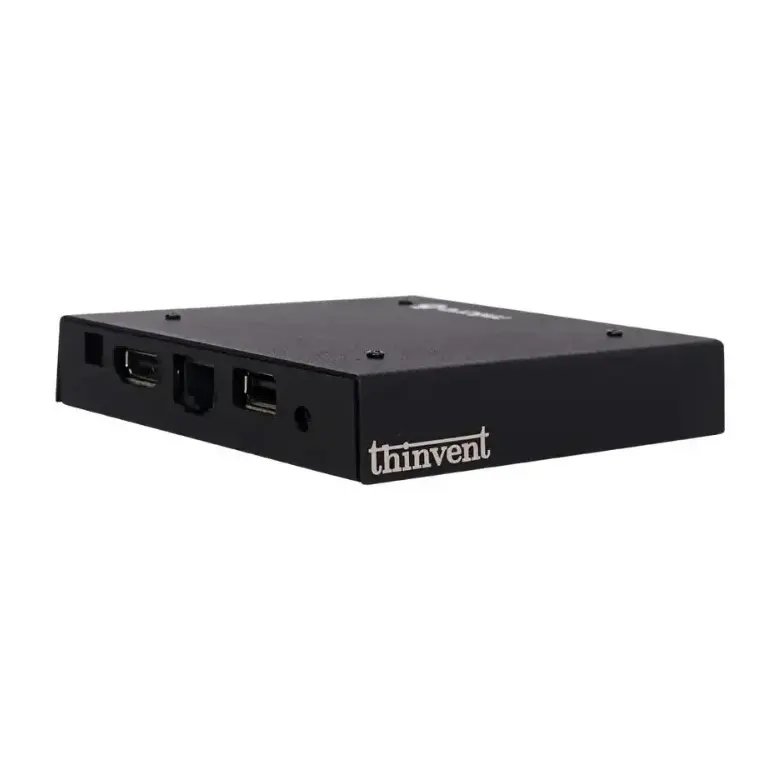
High-tech industrial computers appear across manufacturing execution systems, SCADA/HMI terminals, machine vision front-ends, digital signage players, edge gateways, hospital and pharmacy terminals, warehouse picking stations, kiosks, ATMs, and laboratory data-acquisition rigs. Thin client deployments in VDI environments use the same hardware philosophy: a compact, locked-down endpoint that boots reliably, draws little power and is easy to manage across hundreds of seats. All-in-one models with 21.5" or 23.8" displays suit point-of-sale, reception and shop-floor dashboards where a separate monitor would be impractical.
Software and Operating System Choices
Industrial buyers usually need control over the OS image. Windows 11 Pro and Windows 11 IoT Value provide long-term servicing and enterprise management; Ubuntu Linux 24.04 LTS and embedded Linux distributions suit custom applications and containerised edge workloads; FreeDOS or a "without OS" option lets integrators deploy their own image and licensing. Look for systems that expose BIOS-level features such as power-on-after-power-failure, wake