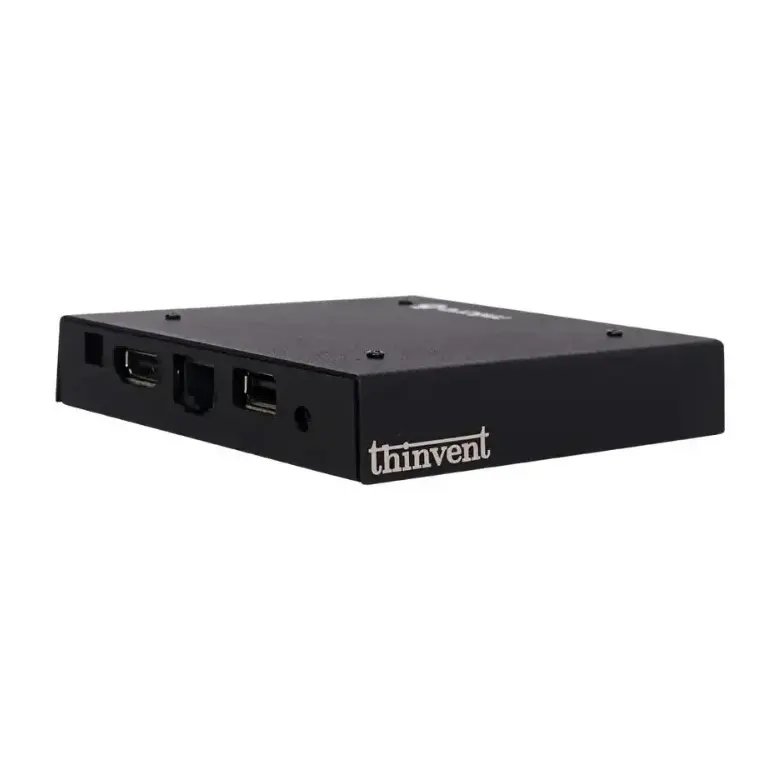
The HP t520 is a thin client built on an AMD G-Series system-on-chip, with up to 8 GB of DDR3L memory and up to 64 GB of solid-state flash storage. The closest Thinvent alternative is the Thinvent Neo S Thin Client with an Intel Celeron J1900 processor, 4 GB of RAM and 128 GB of SSD storage, which runs Windows 11 Pro.
HP t520 vs Thinvent Neo S Thin Client
| HP t520 Flexible Thin Client | Thinvent Neo S Thin Client | |
|---|---|---|
| Processor | AMD G-Series SoC (processor frequency 1.2 GHz) | Intel Celeron J1900, 4 cores, up to 2.4 GHz |
| Cores/Threads | Not confirmed | 4 cores |
| RAM | Up to 8 GB DDR3L | 4 GB DDR3 |
| Storage | Up to 64 GB solid-state flash | 128 GB SSD |
| Form Factor | Thin Client | Thin Client |
| Operating System | Not confirmed | Microsoft Windows 11 Pro (also available: Windows 11 IoT, Ubuntu Linux, Thinux Embedded Linux, Without OS, DOS) |
| Cooling | Not confirmed | Fanless passive cooling |
| Ethernet | Integrated Gigabit Ethernet LAN | 1000 Mbps Ethernet |
| Wireless | Not confirmed | No WiFi |
Key differences
-
The Thinvent Neo S Thin Client has 128 GB of SSD storage, twice the maximum 64 GB of solid-state flash storage listed for the HP t520.
-
The Thinvent Neo S Thin Client is fanless, with passive cooling.
-
The Thinvent Neo S Thin Client has an Intel Celeron J1900 processor with 4 cores, a 4-core configuration we could confirm.
-
The HP t520 supports up to 8 GB of RAM, which is double the 4 GB installed in the Thinvent Neo S Thin Client.
-
The Thinvent Neo S Thin Client includes a VGA port, two DB9 serial ports and a parallel port in addition to HDMI.
-
The HP t520 is built on an AMD G-Series processor, while the Thinvent Neo S Thin Client uses an Intel processor.
Which one should you choose?
Choose the HP t520 if you need a thin client with AMD G-Series processing and up to 8 GB of memory. Choose the Thinvent Neo S Thin Client if you need more storage, fanless operation, legacy serial and parallel ports, and a choice of Windows 11 Pro or Linux.