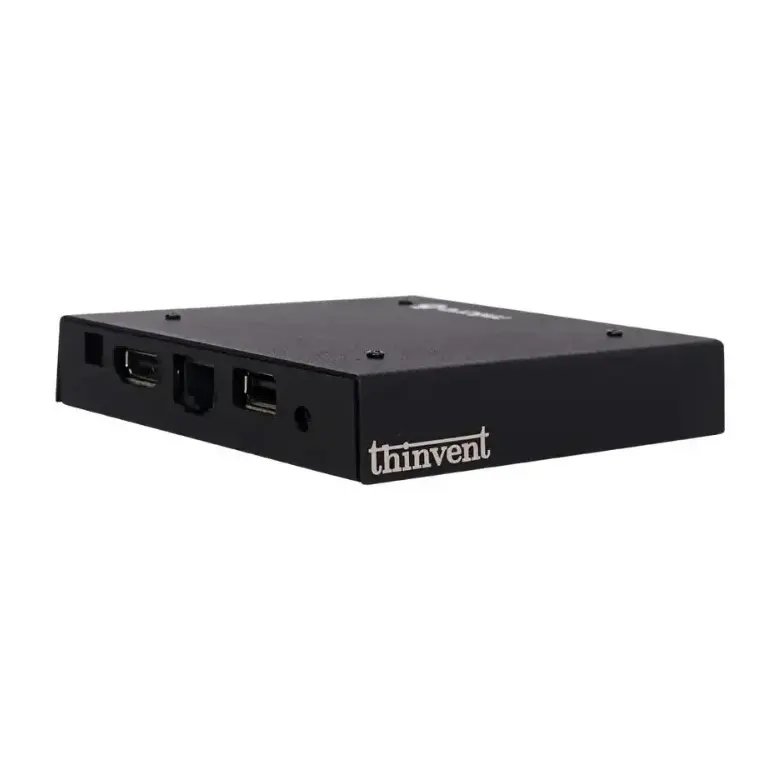
Industrial computers are built to run reliably in environments where ordinary desktop PCs fail: factory floors, control cabinets, outdoor kiosks, and remote installations exposed to dust, vibration, and wide temperature swings. Unlike consumer machines that rely on fans and vents, a well-designed industrial PC uses passive (fanless) cooling, a wide-input power supply, and a rugged chassis so it can keep running around the clock for years with minimal maintenance.
What Defines an Industrial PC
The core requirements are durability and long-term availability. Key characteristics include:
-
Fanless, ventless chassis — no fans means no dust ingestion and no moving parts to wear out, which suits dusty or greasy environments.
-
Wide DC power input — typically 12V or 9–36V DC via an external adapter, allowing operation from industrial power rails or battery systems.
-
Extended temperature range — designed to operate across wide ambient temperatures rather than only in air-conditioned offices.
-
Rich legacy I/O — multiple serial (DB9 RS-232/RS-485) ports, digital I/O, and dual Ethernet for connecting to PLCs, sensors, weighbridges, barcode scanners, and older machinery.
-
Wall, DIN-rail, or VESA mounting — so the unit can be fixed inside a panel or enclosure rather than sitting on a desk.
-
Long lifecycle and OS flexibility — support for Windows 11 Pro, Windows 11 IoT, Linux, or DOS so deployments can match existing software stacks.
Typical Specifications
Modern industrial PCs pair efficient Intel® processors with generous memory and SSD storage. A representative configuration looks like this:
| Feature | Typical Industrial PC |
|---|---|
| Processor | Intel® Core™ i3-1215U (6 cores, up to 4.4 GHz, 10 MB cache) |
| Memory | 16 GB DDR4 |
| Storage | 1 TB SSD |
| Cooling | Fanless passive design |
| Power | 12V DC adapter |
| Networking | Gigabit Ethernet (single or dual) |
| Serial I/O | Up to quad DB9 RS-232/RS-485 |
| Operating System | Windows 11 Pro / Windows 11 IoT / Linux / DOS |
| Mounting | Wall, DIN-rail, or VESA |
The 12th-generation Intel® Core™ i3-1215U offers a strong balance of performance and power efficiency, with six cores (2 performance + 4 efficient) that handle multitasking, data logging, and light machine-vision tasks without the heat output of higher-wattage chips — an important factor in a sealed, fanless enclosure.
Where Industrial PCs Are Used
Common deployments include:
-
Factory automation and machine control — HMI terminals, SCADA nodes, and PLC front-ends connected over serial or Ethernet.
-
Data acquisition and logging — collecting readings from sensors, meters, and instruments in process industries.
-
Kiosks and self-service terminals — ticketing, check-in, and information points in public or semi-outdoor locations.
-
Surveillance and edge computing — local video or analytics processing where a cloud round-trip is impractical.
-
Transportation, energy, and utilities — substations, fleet systems, and remote monitoring cabinets.
Choosing the Right Model
When selecting an industrial PC, match the processor and memory to your software workload, confirm the serial and Ethernet port count your equipment requires, and check the operating temperature and mounting options against the installation site. Decide early whether you need an OS pre-installed or a bare/DOS system for your own image, and whether dual Gigabit Ethernet is needed for network segmentation between control and business networks.
Thinvent Industrial PCs
Thinvent manufactures rugged, fanless industrial computers designed for continuous operation. The IPC3 series pairs the Intel® Core™ i3-1215U processor with 16 GB DDR4 RAM and 1 TB SSD storage in a compact, ventless chassis powered by a 12V adapter. Configurations are available with quad DB9 serial ports for legacy equipment integration, single or dual Gigabit Ethernet, and a choice of Windows 11 Pro, Windows 11 IoT Value, DOS, or Thinux™ Embedded Linux. With worldwide availability and multiple mounting options, Thinvent industrial PCs are built to keep running where ordinary computers cannot.