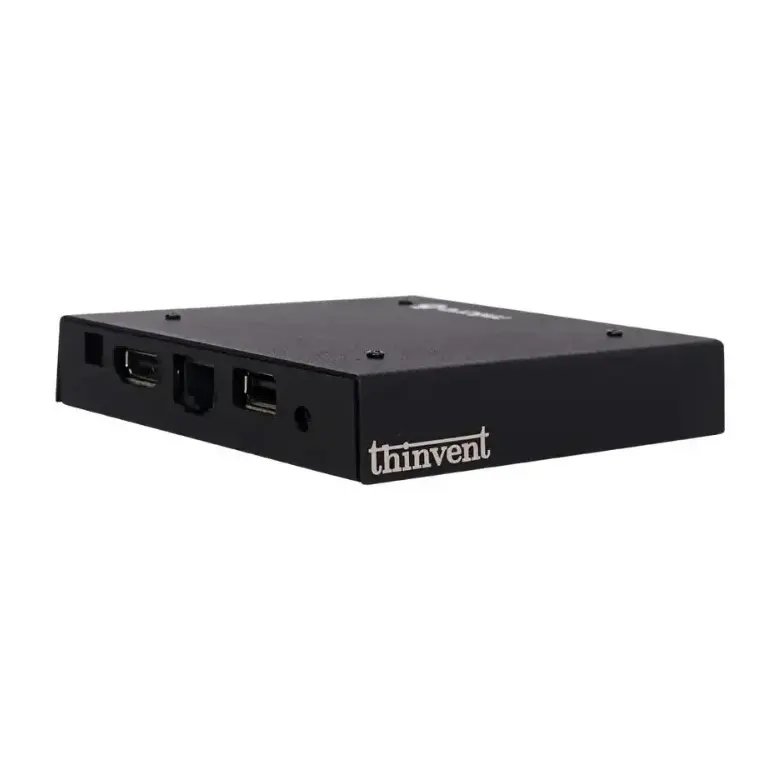
What Is an Industrial Desktop?
An industrial desktop is a ruggedised, fixed-installation computer built for continuous operation in environments where an ordinary office desktop would struggle. Rather than being designed around a one-to-three-year refresh cycle in a climate-controlled office, an industrial desktop is engineered around multi-year availability, wide-temperature tolerance, vibration and shock resistance, and protection from dust, metal filings, humidity and electrical noise. It typically runs 24/7, often unattended, and is mounted inside a control cabinet, on a DIN rail, on a shop-floor trolley or at a production workstation.
The distinction is not just mechanical. Industrial desktops use long-lifecycle components, offer extended serial and digital I/O, support legacy operating systems and industrial fieldbuses, and are validated for sustained thermal loads. A commercial mini PC may match the raw CPU benchmark of an industrial unit, but it will rarely match the mean time between failures, the connector retention, or the ability to keep running in a 50 °C panel with conductive dust in the air.
Key Technical Characteristics
| Attribute | Typical Industrial Desktop | Typical Office Desktop |
|---|---|---|
| Cooling | Fanless heatsink/chassis, or filtered industrial fan | Open-frame fan, unfiltered |
| Operating temperature | Wide range, often 0–50 °C or beyond | Narrow, office-grade |
| Mounting | DIN rail, VESA, wall bracket, cabinet shelf | Desk only |
| Serial / fieldbus ports | Multiple RS-232/RS-485 DB9 | Rare, usually via adapter |
| Storage | Industrial SSD, wear-levelling aware | Consumer SSD/HDD |
| Power | 12 V or 9–36 V DC, wide-input options | Mains ATX PSU |
| Lifecycle | Long-term supply and revision control | Short, consumer-driven |
| OS support | Windows IoT, Windows Pro, Linux, DOS | Consumer Windows |
Fanless designs matter more than they first appear. Removing the fan removes the single most common point of mechanical failure, eliminates a path for dust ingress, and removes a source of audible noise on a quiet production floor. Heat is instead conducted to a finned chassis, which is why industrial enclosures are often heavier and best mounted with clearance for convection.
Processor and Memory Choices
Modern industrial desktops typically span two tiers. Entry and mid-range units use efficiency-class Intel processors such as the Celeron, N-series or U-series Core chips, which deliver strong per-watt performance with low heat output — ideal for fanless enclosures, HMI panels, data-logging gateways and kiosk terminals. Higher-performance units use Intel Core i3, i5 or i7 processors for applications such as machine vision pre-processing, multi-camera inspection, CAD/CAM workstations and on-premise databases.
Memory and storage follow the workload. 8 GB is comfortable for HMI and thin-client duty, 16 GB suits general industrial workstation and SCADA use, and 32 GB or 64 GB is appropriate where virtual machines, large SCADA historians or vision pipelines are in play. Solid-state storage is effectively mandatory: capacities of 256 GB, 512 GB and 1 TB cover most deployments, and shock-resistant SSDs tolerate the vibration that rotating media cannot.
Typical Applications
-
Factory automation and machine control — operator stations, line-side HMIs, PLC supervisory nodes and cell controllers.
-
SCADA and process monitoring — historian servers, alarm annunciation terminals and reporting workstations.
-
Machine vision and quality inspection — image capture and pre-processing near the conveyor.
-
Warehouse and logistics — forklift-m