What Is an Industrial Computer?
An industrial computer is a ruggedized computing system built to run continuously in environments where a standard desktop PC would quickly fail — factory floors, outdoor cabinets, vehicles, kiosks and remote sites. Unlike consumer machines, industrial PCs prioritise wide-temperature operation, dust and vibration resistance, fanless cooling, long product lifecycles and stable I/O rather than raw clock speed alone. They are typically mounted on DIN rails, VESA brackets or inside control panels, and they often run 24×7 for years without intervention.
Key Specifications to Evaluate
When selecting an industrial computer, look beyond the CPU headline. The table below summarises the specifications that matter most in embedded and edge deployments.
| Specification | Why It Matters |
|---|---|
| Processor | Intel® Core™ and Intel® N-series CPUs balance performance and power; 6-core parts like the i3-1215U handle multitasking, PLC polling and local analytics |
| Memory | 8–32 GB DDR4 covers most SCADA, HMI and vision workloads |
| Storage | 128 GB–1 TB SSD, often with wide-temperature ratings for harsh sites |
| Cooling | Fanless designs avoid dust ingress and moving-part failure |
| Serial I/O | DB9 RS-232/485 ports connect PLCs, meters and legacy controllers |
| Networking | Dual Gigabit Ethernet supports segregated control and IT networks |
| Power | 12 V DC input suits vehicle, solar and panel power |
| Operating System | Windows 11 Pro, Windows 11 IoT, Linux or DOS depending on software stack |
Typical Use Cases
Industrial PCs and mini PCs are deployed as SCADA nodes, HMI controllers, machine-vision front ends, data-logging gateways and edge servers. In retail and logistics they drive kiosks, digital signage and warehouse terminals. In building automation they act as BMS supervisors, and in manufacturing they bridge OT equipment to MQTT, OPC-UA or Modbus TCP networks. Because they are compact and fanless, they also suit medical carts, laboratory instruments and mobile installations where a full tower chassis is impractical.
Choosing Between a Mini PC, Thin Client and Industrial PC
A mini PC is the general-purpose option for office, digital signage and light edge work. A thin client is optimised for virtual desktop infrastructure (VDI) and remote sessions, using minimal local storage. An industrial PC adds wide-temperature components, isolated or multi-port serial interfaces, DIN-rail mounting and extended lifecycle availability. If your workload involves PLCs, vibration, dust or 24×7 duty, choose the industrial class; if it is purely desk-based, a mini PC or thin client is more cost-effective.
Thinvent Products Featuring This Technology
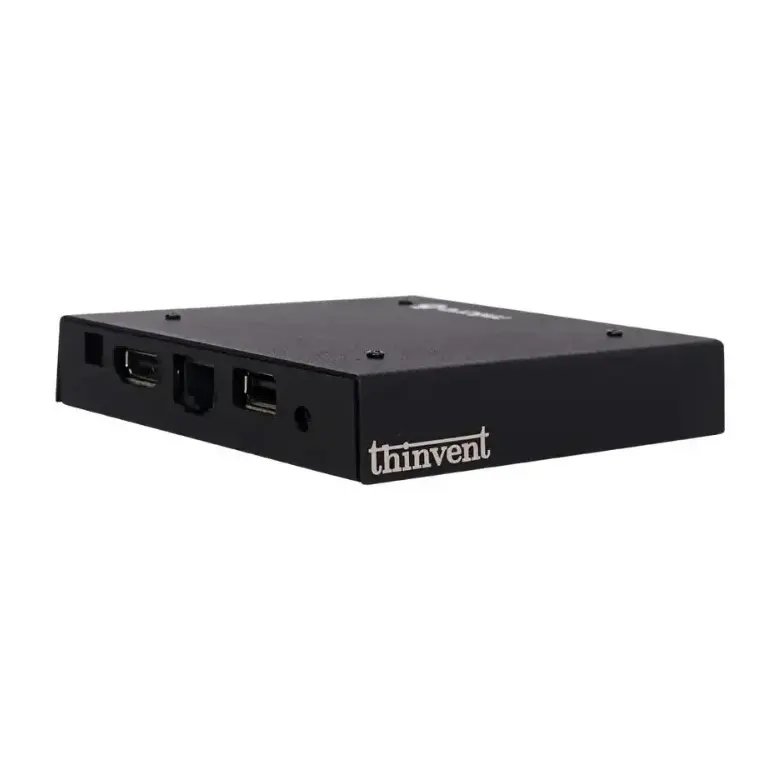
Thinvent manufactures industrial computers, mini PCs, thin clients and all-in-one PCs for customers worldwide. The Thinvent® Industrial PC IPC3 family pairs Intel® Core™ i3-1215U processors (6 cores, up to 4.4 GHz, 10 MB cache) with 16 GB DDR4 RAM and 1 TB SSD storage, and is available with quad DB9 serial ports for PLC and instrumentation connectivity. Operating system options span Windows 11 Pro, Windows 11 IoT Value, DOS and Thinux™ Embedded Linux, so the same hardware platform can be standardised across mixed software environments. Thinvent's broader range covers fanless mini PCs, VDI-ready thin clients and all-in-one terminals, all built for long-term, low-maintenance deployment.