What Defines Advanced Industrial Computing Solutions?
Advanced industrial computing solutions are purpose-built systems designed to operate reliably in demanding environments while delivering high performance for automation, data processing, and control applications. Unlike consumer-grade computers, these solutions feature ruggedized construction, extended temperature ranges, vibration resistance, and long-term lifecycle support. They integrate powerful processors—from energy-efficient ARM Cortex cores to high-performance Intel Core i5/i7—with optimized memory and storage configurations to handle real-time data acquisition, edge computing, and machine vision tasks.
Key Technical Specifications and Capabilities
Modern industrial computers leverage multiple processor architectures to balance power efficiency and computational throughput. ARM-based systems (e.g., Cortex A53/A55) offer fanless, low-power operation ideal for IoT gateways and embedded controllers, while Intel 12th/14th Gen Core processors (like the i5-1240P with 12 cores up to 4.4 GHz) provide the muscle for complex analytics and multi-threaded workloads. Memory configurations range from 2GB for lightweight terminals to 32GB for data-intensive applications, and storage options include eMMC for reliability and SSD for speed. Connectivity features such as dual-band WiFi, multiple USB ports, and HDMI outputs ensure seamless integration with industrial networks and peripherals.
Applications Across Industries
These advanced systems excel in diverse use cases:
-
Factory Automation: IPC units control robotic arms, PLCs, and assembly lines with deterministic performance.
-
Edge Computing: Mini PCs process sensor data locally, reducing cloud dependency for real-time decision-making.
-
Digital Signage: All-in-one PCs drive high-resolution displays in retail, transportation, and hospitality.
-
Healthcare: Fanless thin clients operate silently in patient monitoring and diagnostic equipment.
-
Transportation: Rugged computers withstand shock and vibration in fleet management and railway systems.
The choice between ARM and Intel architectures depends on power constraints, processing needs, and software compatibility—ARM excels in ultra-low-power scenarios, while Intel dominates compute-intensive tasks.
Comparison of Processor Options
| Processor | Cores/Threads | Max Frequency | Cache | Ideal Use Case |
|---|---|---|---|---|
| ARM Cortex A53 | 4/4 | 2.0 GHz | 1 MB | IoT gateways, low-power terminals |
| Intel N100 | 4/4 | 3.4 GHz | 6 MB | Entry-level industrial PCs |
| Intel i3-1215U | 6/8 | 4.4 GHz | 10 MB | Mid-range automation |
| Intel i5-1240P | 12/16 | 4.4 GHz | 12 MB | High-performance edge computing |
Thinvent's Advanced Industrial Computing Portfolio
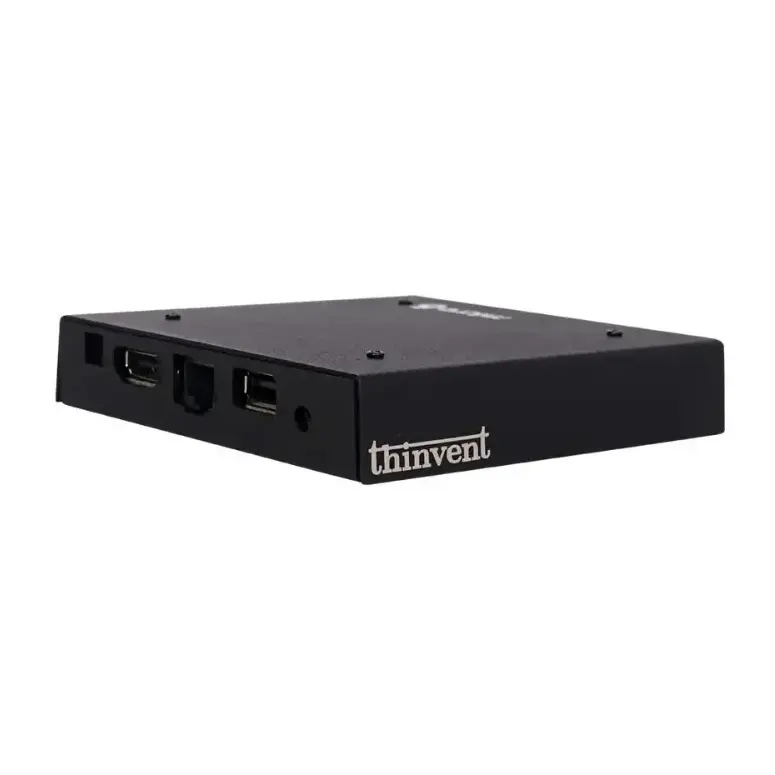
Thinvent offers a comprehensive range of industrial computing solutions tailored to modern manufacturing, logistics, and smart infrastructure needs. Our lineup includes fanless Industrial PCs (IPC series) with Intel Core i3/i5 processors and 12-32GB RAM for heavy-duty automation, compact Mini PCs (Treo, Aero) with N100 to Core i5 options for space-constrained edge deployments, and ARM-based thin clients (Micro series) for energy-sensitive IoT applications. All systems support Windows 11 IoT, Ubuntu Linux, or Thinux Embedded Linux, and are built with industrial-grade components for 24/7 operation in temperatures from 0°C to 50°C. Explore Thinvent's solutions to find the perfect balance of performance, reliability, and efficiency for your next industrial project.