What Does "LE" Mean for a Mini PC?
When buyers search for "le" in the context of mini PCs and industrial computers, they are usually looking for a compact, low-energy (low-power) fanless computer that runs quietly and reliably around the clock. A "low-energy" mini PC is designed to draw minimal power, typically through an external 12V DC adapter, while still delivering enough performance for everyday business, kiosk, digital signage, and edge computing tasks. The result is a small, silent machine that can be mounted behind a monitor, inside a cabinet, or on a DIN rail without needing a noisy cooling fan.
Key Specifications That Define a Low-Energy Mini PC
A modern low-energy mini PC pairs an efficient Intel® processor with solid memory and storage. Typical configurations include a 4-core Intel® Celeron® or Intel® N-series processor running up to around 2.9 GHz with 4 MB cache, 16 GB DDR4 RAM, and 128 GB SSD storage. Power is supplied by a compact 12V adapter, and many models ship without WiFi for security-sensitive deployments where wired networking is preferred. Operating system options usually include Windows 11 Pro, Windows 11 IoT, Ubuntu Linux, embedded Linux, or DOS, giving integrators flexibility for locked-down or custom software stacks.
| Feature | Typical Low-Energy Mini PC |
|---|---|
| Processor | Intel® 4-core, up to 2.9 GHz, 4 MB cache |
| Memory | 16 GB DDR4 |
| Storage | 128 GB SSD |
| Power | 12V DC adapter |
| Cooling | Fanless / passive |
| OS Options | Windows 11 Pro/IoT, Ubuntu, Embedded Linux, DOS |
| Networking | Wired Ethernet (WiFi optional) |
Where Low-Energy Mini PCs Are Used
Because they consume little power and have no moving parts, low-energy mini PCs suit long-running, unattended deployments. Common applications include point-of-sale terminals, kiosks, digital signage players, thin client endpoints for VDI, laboratory and factory data collection, CCTV monitoring stations, and edge gateways. Their silent, fanless operation makes them ideal for clinics, classrooms, and offices where noise matters, while the low power draw keeps electricity costs and heat output down in enclosed cabinets.
Choosing the Right Configuration
Start with the workload: light office, browsing, and kiosk tasks are well served by a 4-core Intel® Celeron® or N-series chip with 16 GB RAM and a 128 GB SSD. For heavier multitasking or virtualization, step up to higher-core Intel® Core™ i3 or i5 options with more memory and storage. When security or stability is critical, choose models without WiFi and select an appropriate OS such as Windows 11 IoT or embedded Linux. Confirm the mounting options and port layout match your installation before ordering.
Thinvent's Products Featuring This Technology
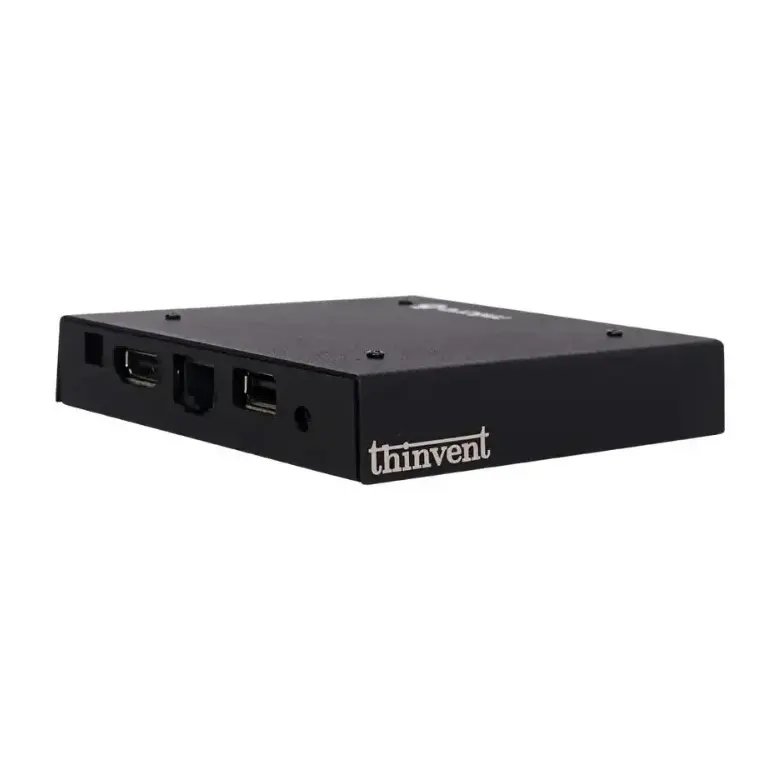
Thinvent offers a range of low-energy, fanless mini PCs, thin clients, industrial PCs, and all-in-one computers built on efficient Intel® processors. The Thinvent® Aero Mini PC, for example, pairs an Intel® 4-core processor running up to 2.9 GHz with 16 GB DDR4 RAM, a 128 GB SSD, and a 12V 10A adapter in a compact, WiFi-free chassis. It is available with Windows 11 IoT, Windows 11 Pro, Ubuntu Linux, Thinux™ Embedded Linux, or DOS, and can be bundled with a Thinvent® keyboard and mouse set for turnkey deployments.