What the Lenovo ThinkCentre M910s Is
The Lenovo ThinkCentre M910s is a small form factor (SFF) business desktop from Lenovo's ThinkCentre line. According to Lenovo's official platform specifications, the M910s (SFF) supports Intel Celeron, Pentium, and 6th/7th generation Intel Core i3, i5, and i7 processors, built on the Intel Q270 chipset. It offers up to 64GB of DDR4-2400 memory across four 288-pin DIMM slots, dual-channel capable, and supports a mix of 2.5"/3.5" SATA drives, 2.5" SATA SSDs, and M.2 PCIe NVMe SSDs. Graphics come from integrated Intel HD Graphics 510/530/610/630 with one VGA and two DisplayPort outputs, and some models shipped with a discrete NVIDIA GeForce GT 730.
Key Specifications at a Glance
Typical M910s configurations found in the market include a Core i7-7700 (4 cores / 8 threads, 3.6 GHz base, up to 4.2 GHz) with 8GB or 16GB DDR4 RAM and either a 256GB SSD or 1TB HDD, running Windows 10 Pro 64-bit. Networking is Gigabit Ethernet via Intel I219-LM with Wake on LAN, and manageability features include Intel AMT 11.0 and optional Intel vPro. Security is handled by TPM 2.0 (TCG Certified). Front and rear I/O includes USB 3.1 Gen1 ports, audio jacks, serial and optional parallel ports, and PS/2 options.
| Feature | Lenovo ThinkCentre M910s (SFF) |
|---|---|
| Processor | 6th/7th Gen Intel Core i3/i5/i7, Celeron, Pentium |
| Chipset | Intel Q270 |
| Memory | Up to 64GB DDR4-2400, 4x DIMM, dual-channel |
| Storage | SATA HDD/SSD, M.2 PCIe NVMe, optional DVD |
| Graphics | Intel HD 510/530/610/630; optional NVIDIA GT 730 |
| Video Out | 1x VGA, 2x DisplayPort (up to 3 displays) |
| Ethernet | Gigabit (Intel I219-LM), Wake on LAN |
| Manageability | Intel AMT 11.0, optional vPro |
| Security | TPM 2.0 |
Who Uses an SFF Desktop Like This
Small form factor desktops of this class are common in offices, call centres, banking back-offices, and retail counters, where a compact chassis fits under or beside a desk while still offering multiple display outputs and legacy ports. They are typically deployed for document work, ERP and billing terminals, point-of-sale stations, and general productivity. Because these machines are often several generations old, buyers evaluating one today usually compare it against newer, more power-efficient alternatives.
Modern Alternatives to Consider
If you are evaluating an M910s-class machine for a new deployment, the main trade-offs are age, power draw, and operating system support. A modern fanless mini PC with a current-generation Intel processor can deliver similar everyday performance with lower power consumption, no moving parts, quieter operation, and support for current operating systems such as Windows 11 Pro and Ubuntu Linux. For multi-display office work, thin client deployments, or industrial environments where dust and heat are a concern, a sealed fanless design often outlasts a traditional SFF tower with a spinning fan.
Thinvent Products in This Category
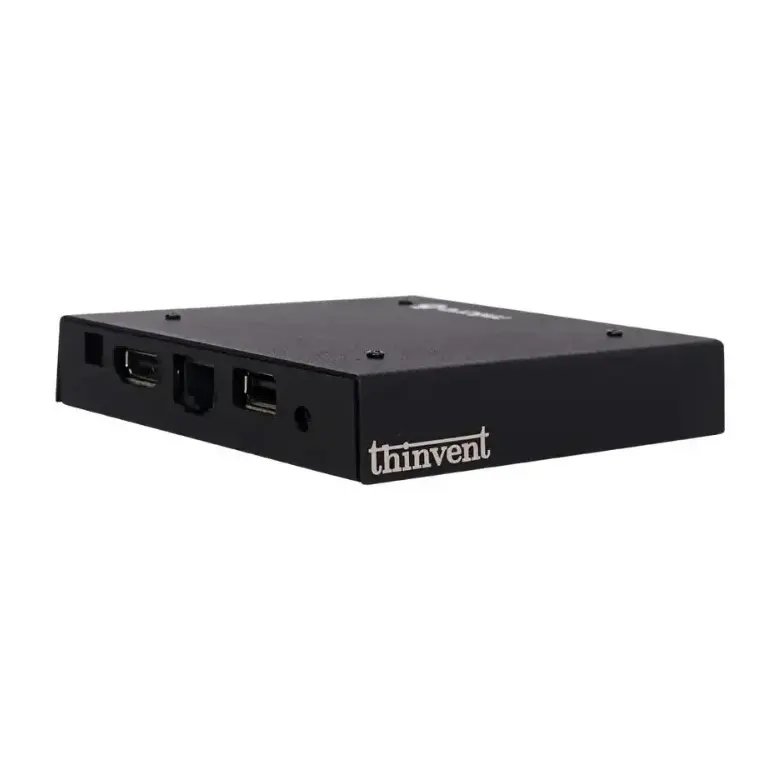
Thinvent builds fanless mini PCs, thin clients, industrial computers, and all-in-one PCs designed for exactly these roles. Our Aero Mini PC family, for example, pairs Intel processors with up to 16GB DDR4 RAM and SSD storage, running Windows 11 IoT, Windows 11 Pro, DOS, or Thinux Embedded Linux, with no fans to draw in dust. Whether you are replacing an ageing SFF desktop on an office desk or standardising a fleet of thin clients across branches, Thinvent offers quiet, low-maintenance systems built for continuous operation.
Thinvent Alternatives to Lenovo
| Specification | Lenovo ThinkCentre M910s | Thinvent Aero Mini PC |
|---|---|---|
| Processor | Intel Core i5 / i7 (6th–7th Gen) | Intel Celeron N5095A (11th Gen) |
| Cores/Threads | Up to 4C / 8T | 4C / 4T |
| RAM (max) | 32 GB DDR4 | 16 GB DDR4 |
| Storage | 256 GB SSD (up to 1 TB) | 128 GB SSD |
| Form Factor | Small Form Factor (SFF) | Mini PC |
View these products:
The Thinvent Aero Mini PC is the closest match in our lineup for compact, desk-friendly business computing, offering a modern 11th-generation Intel platform with a smaller footprint than a traditional SFF chassis. The honest trade-off is that the Aero uses a Celeron N5095A with fewer threads and a lower RAM ceiling than the M910s's Core i5/i7 configuration, so it suits everyday office, browsing, and POS-style workloads rather than heavy multitasking or demanding applications.