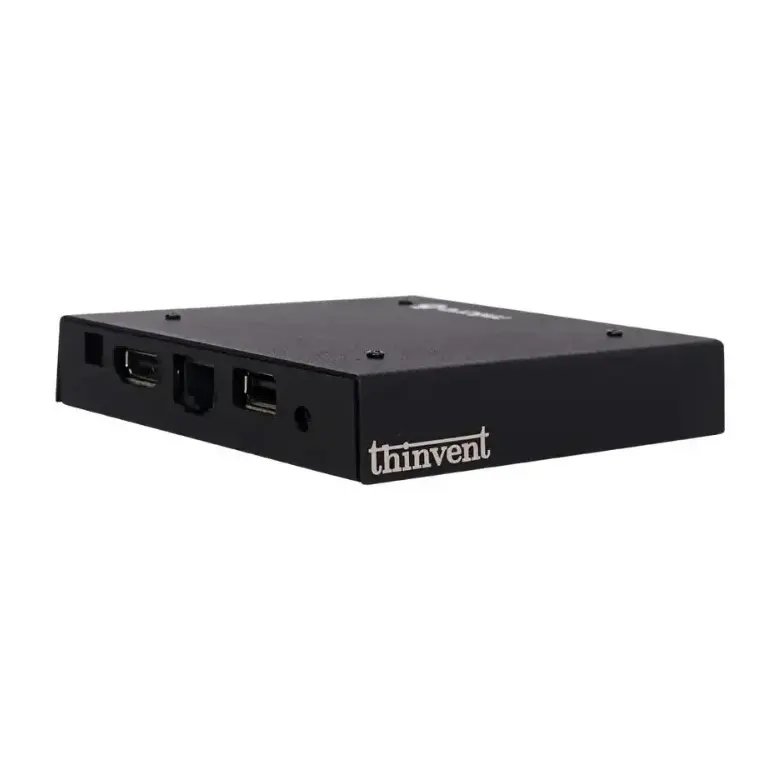
The Mac mini (M1, 2020) is Apple's compact desktop built around the 8-core Apple M1 chip, with 8 GB of memory and a 256 GB or 512 GB SSD by default. The closest Thinvent alternative is the Thinvent Treo Mini PC with AMD Ryzen 5 7430U, a 6-core mini PC that offers much larger memory and storage options.
Mac mini M1 vs Thinvent Treo Mini PC
| Mac mini (M1, 2020) | Thinvent Treo Mini PC, AMD Ryzen 5 7430U | Thinvent Treo Mini PC, Intel Core i5-1240P | |
|---|---|---|---|
| Processor | Apple M1 (3.2 GHz) | AMD Ryzen 5 7430U (up to 4.3 GHz) | Intel Core i5-1240P (up to 4.4 GHz) |
| Cores/Threads | 8 (4 performance + 4 efficiency) | 6 cores | 12 cores |
| RAM | 8 GB | Up to 64 GB | Up to 64 GB |
| Storage | 256 GB or 512 GB SSD | Up to 2 TB SSD | Up to 2 TB SSD |
| Form Factor | Mini desktop | Mini PC | Mini PC |
| GPU | 8-core GPU | Not stated | Not stated |
| Neural Engine | 16-core | Not stated | Not stated |
Key differences
-
Memory: The Thinvent Treo Mini PC supports up to 64 GB of RAM, compared with 8 GB on the Mac mini M1 configuration described here.
-
Storage: Thinvent Treo Mini PCs offer SSD capacities up to 2 TB, while the Mac mini M1 ships with 256 GB or 512 GB by default.
-
Core count: The Thinvent Treo Mini PC with Intel Core i5-1240P has 12 cores, while the Apple M1 has 8 cores.
-
Wireless options: Thinvent Treo Mini PCs are available with or without dual band Wi-Fi.
-
Processor design: The Apple M1 uses an Arm-based 5-nm design with a dedicated Neural Engine, while the Thinvent models use x86 Intel and AMD processors.
Which one should you choose?
Choose the Mac mini M1 if you want Apple's macOS ecosystem and its integrated 8-core GPU and Neural Engine in a compact desktop. Choose a Thinvent Treo Mini PC if you need more memory, larger SSD capacity, or a Windows- or DOS-compatible x86 platform for business and industrial workloads.