What Are MineAway Computers?
"MineAway computers" most commonly refers to computer hardware used to run mining industry software — geological modelling, mine planning, and resource estimation tools such as Micromine Origin, Geobank, Beyond, Alastri, and Spry. It can also refer to the hardware sold by Mineaway, a South African retailer of new, pre-owned, and refurbished computers and software. In both cases, the underlying requirement is the same: a dependable computer that can run demanding 64-bit mining applications reliably, often in dusty, hot, or remote site conditions.
Hardware Requirements for Mining Software
Modern mining software is 64-bit and uses the same behind-the-scenes graphics technology as 3D games, so it performs best on a system with a capable graphics subsystem, ample RAM, and fast storage. Micromine's published system requirements note that DisplayLink-based docking stations do not work well with OpenGL software products and several other common mining products, so direct display outputs are preferred over USB display adapters.
Typical practical configuration for mine planning and geological modelling workloads:
| Component | Practical Recommendation | Why It Matters |
|---|---|---|
| Processor | Intel Core i3/i5, 12th gen or newer, 4–10 cores | Responsive modelling, fast file operations |
| Memory | 16 GB minimum, 32 GB for large datasets | 3D models and block models are memory-hungry |
| Storage | 512 GB – 1 TB SSD | Fast project load and save times |
| Graphics | Direct HDMI/DisplayPort output, no DisplayLink | Required for OpenGL-based mining software |
| Networking | Gigabit Ethernet, dual ports preferred | Site LAN, licence servers, data sync |
| Chassis | Fanless or industrial, wide-temperature | Dust, heat, vibration on site |
Where These Systems Are Deployed
Mining and mineral engineering environments place computers in places office PCs were never designed for: exploration core sheds, survey offices, control rooms, weighbridges, and remote exploration camps. Here the priorities shift from pure performance to uptime — dust ingress, ambient temperatures well above 40 °C, unstable power, and the need for serial connections to legacy survey and instrumentation equipment.
Choosing Between an Office PC and an Industrial Computer
A standard desktop can run mining software in a climate-controlled office. But when the same workload moves to a site office, a vehicle-mounted setup, or a control cabinet, an industrial computer is the better fit. Fanless industrial PCs remove the intake fan that pulls dust into the chassis, tolerate wider temperature ranges, run on 12 V DC, and offer serial ports (DB9) for connecting total stations, GNSS receivers, and older instrumentation. They also tend to have longer service life and stable supply, which matters when a fleet of machines must be maintained identically for years.
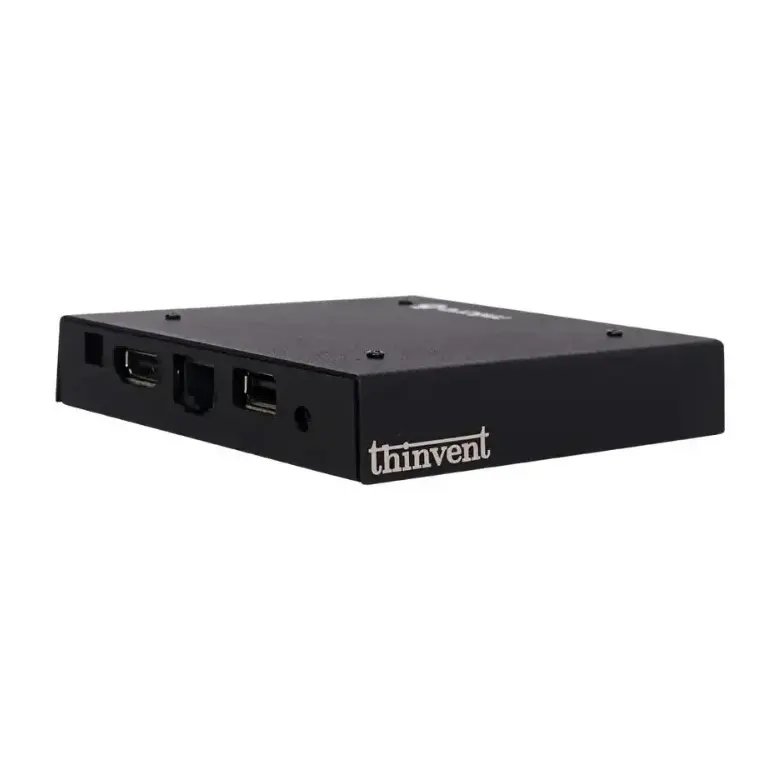
Thinvent Industrial Computers for Mining Workloads
Thinvent builds fanless industrial PCs, mini PCs, thin clients, and all-in-one computers designed for exactly this kind of deployment. The Thinvent IPC3 series is available with Intel Core i3-1215U processors (6 cores, up to 4.4 GHz, 10 MB cache), 16 GB DDR4 RAM and 1 TB SSD storage, with options for quad DB9 serial ports for survey and instrumentation equipment, and a choice of Windows 11 Pro, Windows 11 IoT, DOS, or Thinux™ Embedded Linux. For control rooms and operator stations, Thinvent all-in-one PCs and thin clients provide a compact, low-maintenance alternative to desktop towers, with gigabit Ethernet and direct HDMI output suited to OpenGL-based mining software.