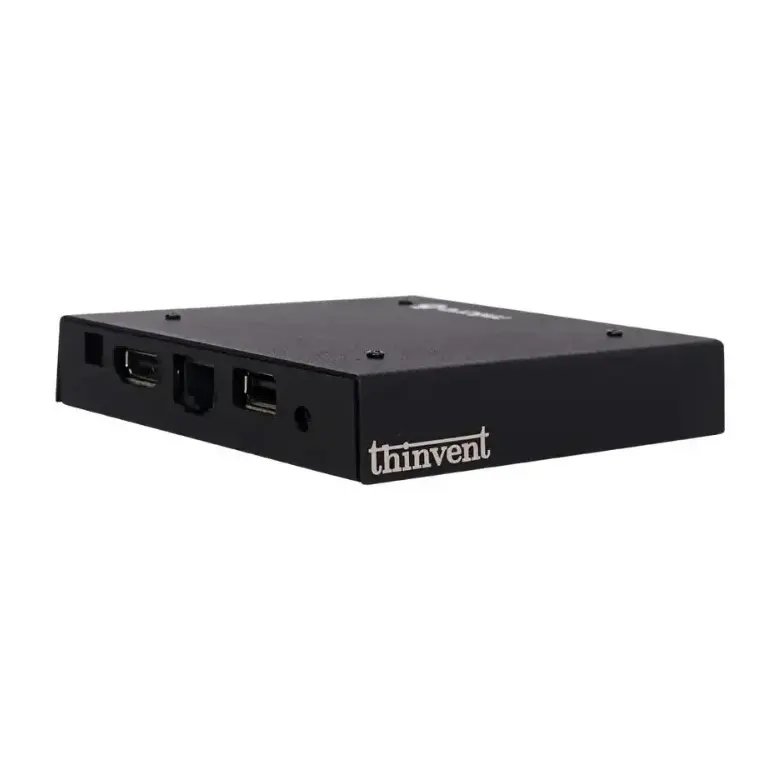
What Is a Mini Server Computer?
A mini server computer is a compact, always-on system designed to host services, store data, or run applications for a small network of users or devices. Unlike a desktop PC that is switched on and off through the day, a mini server stays running continuously, so reliability, thermal design, and low power draw matter far more than raw clock speed. Typical mini servers are built around low-power Intel® processors, fanless chassis, and solid-state storage, which removes the two most common failure points in a small server: spinning disks and mechanical fans.
Key Specifications to Look For
When evaluating a mini server computer, the priorities are different from a gaming or office PC. CPU efficiency and core count matter more than peak frequency, memory should be sufficient to hold your workload and caching in RAM, and storage should be SSD-based for durability and speed. A mini server also benefits from dual Gigabit Ethernet ports for separating management and data traffic, or for acting as a router, firewall, or VPN gateway. Wide-input DC power and a fanless metal chassis help the system survive dusty workshops, cabinets, and 24x7 duty cycles.
| Specification | Why It Matters for a Mini Server |
|---|---|
| Processor | Low-power Intel® Celeron®, N-series, or Core™ i3 for efficient 24x7 operation |
| Cores | 4–6 cores handle file serving, DNS, containers and light virtualisation |
| Memory | 8–16 GB DDR4 for multiple services; 32 GB for virtual machines |
| Storage | 256 GB–1 TB SSD for fast, vibration-tolerant, silent operation |
| Ethernet | Dual Gigabit ports for WAN/LAN separation or redundancy |
| Cooling | Fanless design means no dust ingress and no fan to fail |
| Operating System | Linux or Windows 11 Pro / IoT, depending on your software stack |
Common Use Cases
Mini servers are widely used as file and print servers in small offices, as NAS and backup targets, as home-lab virtualisation hosts, and as edge gateways that collect data from sensors and machines. In retail they run point-of-sale back-ends; in clinics they store imaging and records locally; in factories they act as protocol converters and data loggers on the shop floor. Because they are small, quiet, and low power, they can be mounted inside a cabinet, on a DIN rail, or behind a counter without a dedicated server room, air conditioning, or UPS rack.
Mini Server vs. Traditional Tower Server
A tower server offers more drive bays and expansion slots but consumes far more power, generates noise and heat, and needs a controlled environment. A mini server trades expansion capacity for efficiency, silence, and a much smaller footprint. For workloads such as file sharing, DNS/DHCP, VPN, monitoring, and a handful of containers, a modern mini server with a 6-core Intel® Core™ i3 and 16 GB RAM delivers more than enough performance while drawing a fraction of the power. Where you need many disks or heavy virtualisation, a tower or rack server still makes sense.
Choosing the Right Configuration
Start from the software you intend to run. A single service such as a VPN or file share needs only 4–8 GB RAM and a 128–256 GB SSD. A container host or small virtualisation node is better served by 16 GB RAM, a 6-core processor, and a 512 GB–1 TB SSD. If the server will sit in a dusty or hot location, prioritise fanless cooling and a metal enclosure over higher clock speeds. Dual Ethernet is worth having if the box will route traffic or sit between networks. Finally, choose an operating system you can maintain: Ubuntu Linux, an embedded Linux image, or Windows 11 Pro/IoT all work well on mini server hardware.
Thinvent Mini Server and Industrial PC Range
Thinvent builds compact, fanless computing hardware suited to mini server roles, including industrial PCs and mini PCs powered by Intel® processors. Configurations such as the IPC3 with an Intel® Core™ i3-1215U (6 cores, up to 4.4 GHz, 10 MB cache), 16 GB DDR4 RAM, and a 1 TB SSD are well matched to file serving, edge data collection, and light virtualisation. Options include quad DB9 serial ports for connecting legacy equipment, Windows 11 Professional, Windows 11 IoT, DOS, or Thinux™ Embedded Linux, and no-WiFi variants for secure wired deployments. With solid-state storage, wide-input DC power, and a fanless design, Thinvent systems are built to keep running quietly, shift after shift, in offices, clinics, and factory floors.