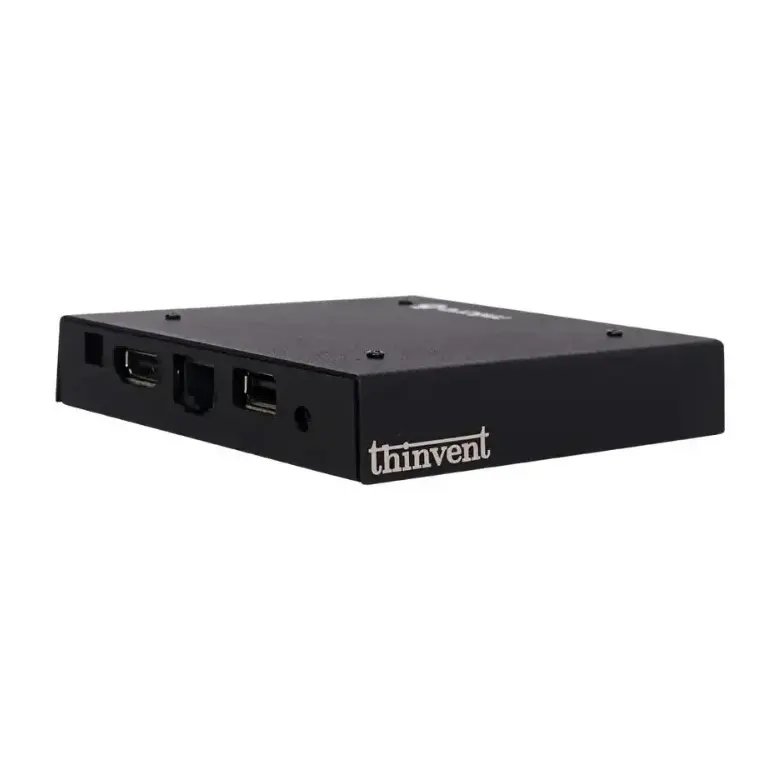
The Minisforum N40 is a fanless mini PC with an Intel Celeron N4020 processor, 4 GB of RAM and 64 GB of eMMC storage, running Windows 10 Pro. The Thinvent Treo Mini PC with Intel Celeron N5095A is the closest Thinvent match. It has up to 32 GB of RAM and up to 2 TB of SSD storage, and the buyer can choose from several operating systems.
Minisforum N40 vs Thinvent Treo Mini PC
| Minisforum N40 | Thinvent Treo Mini PC, Intel Celeron N5095A | Thinvent Treo Mini PC, Intel Core i3-1215U | |
|---|---|---|---|
| Processor | Intel Celeron N4020 | Intel Celeron N5095A | Intel Core i3-1215U |
| Cores/Threads | Not confirmed | 4 cores | 6 cores |
| RAM | 4 GB (maximum 4 GB) | 4 GB to 32 GB | 4 GB to 64 GB |
| Storage | 64 GB eMMC (maximum 64 GB) | 128 GB to 2 TB SSD | 128 GB to 2 TB SSD |
| Form Factor | Mini PC | Mini PC | Mini PC |
| Operating System | Windows 10 Pro | Windows 11 Pro (also Windows 11 IoT, Ubuntu Linux, Thinux Embedded Linux, Without OS, DOS) | Windows 11 Pro (also Windows 11 IoT Value, Ubuntu Linux, Thinux Embedded Linux, Without OS, DOS) |
| Wireless | Wi-Fi, 2.4G and 5G | Wi-Fi 5 (802.11ac), dual band, or no Wi-Fi | Wi-Fi 5 (802.11ac), dual band, or no Wi-Fi |
| Cooling | Fanless | Not confirmed | Not confirmed |
| Display Outputs | HDMI, VGA | HDMI, VGA | HDMI, VGA |
Key differences
-
The Thinvent Treo supports up to 32 GB of RAM with the Celeron N5095A and up to 64 GB with the Core i3-1215U. The N40 is limited to 4 GB.
-
The Thinvent Treo has SSD storage from 128 GB up to 2 TB. The N40 maximum is 64 GB of eMMC.
-
The Thinvent Treo lets the buyer choose from Windows 11 Pro, Windows 11 IoT, Ubuntu Linux, Thinux Embedded Linux, Without OS, or DOS. The N40 ships with Windows 10 Pro.
-
The Thinvent Treo with Core i3-1215U has 6 cores, which is more processing capacity than the N40's Celeron N4020.
-
The Thinvent Treo has a 2.5 GbE-class Gigabit Ethernet port and 4 USB 3.0 ports on the Celeron N5095A model. The N40 has 3 USB 3.0 ports.
-
The Thinvent Treo is a mini PC that uses a Celeron N5095A, the same Intel Celeron family as the N40's Celeron N4020. The N40 is fanless, and we could not confirm the cooling design of the Thinvent Treo.
Which one should you choose?
Choose the Minisforum N40 if you need a compact fanless machine with 4 GB of RAM and 64 GB of eMMC storage for light tasks on Windows 10 Pro. Choose the Thinvent Treo Mini PC if you need more RAM, larger SSD storage, a choice of operating systems, or a faster Intel Core processor.