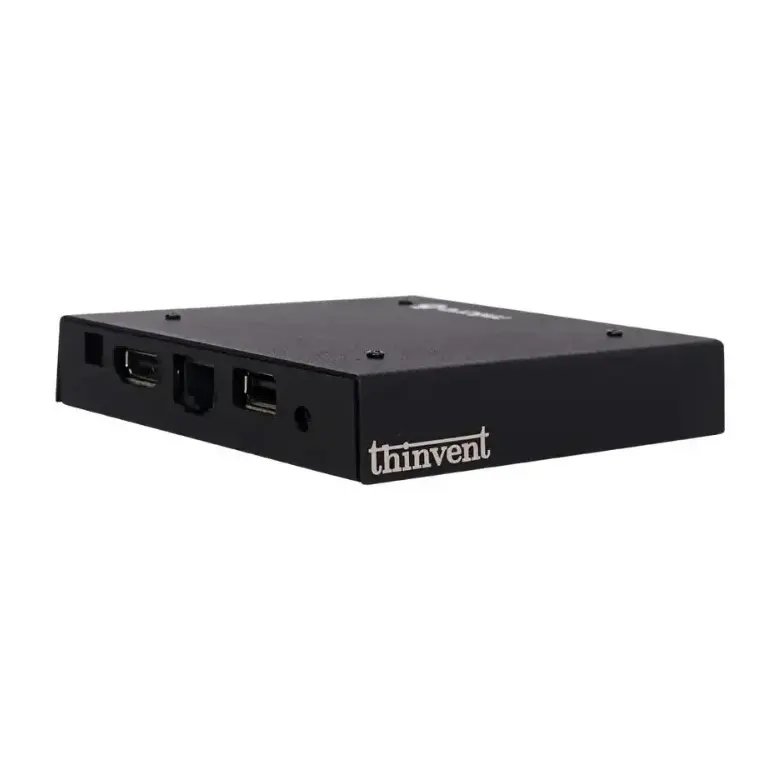
What Are Compact Fanless Mini PCs?
Compact fanless mini PCs are small-form-factor computing devices designed for industrial and commercial environments where reliability, space constraints, and silent operation are critical. These systems eliminate moving parts like fans, using passive cooling solutions such as heat sinks and chassis design to dissipate heat. This design makes them ideal for dusty, dirty, or vibration-prone settings where traditional computers with fans would fail. They offer a balance of performance, durability, and energy efficiency in a minimal footprint.
Key Specifications and Technical Details
A typical industrial fanless mini PC, like those featuring Intel's N-series processors, is built around low-power, high-efficiency components. Core specifications often include:
-
Processor: Modern Intel processors (e.g., N100) with 4 cores, high burst frequencies (up to 3.4 GHz), and integrated graphics.
-
Memory: Configurations typically range from 8GB to 16GB of DDR4 RAM for smooth multitasking.
-
Storage: Solid-state drives (SSDs) from 128GB to 512GB provide fast boot times and reliable data storage.
-
Connectivity: Multiple Gigabit Ethernet ports, USB 3.2 ports, HDMI/DisplayPort outputs, and optional Wi-Fi/Bluetooth.
-
Power: Low-voltage DC input (e.g., 12V), enabling easy integration with industrial power systems and PoE (Power over Ethernet) capabilities.
-
Operating Temperature: A wide range (often -20°C to 60°C) to withstand harsh conditions.
Use Cases and Applications
The robust, silent, and compact nature of these PCs makes them perfect for embedded and edge computing tasks.
-
Digital Signage & Kiosks: Powering interactive displays in retail, hospitality, and public spaces.
-
Industrial Automation: Acting as a controller for PLCs, HMIs, and machine vision systems on the factory floor.
-
Thin Client & VDI: Providing secure, centralized desktop access for office and call center environments.
-
IoT Gateways: Collecting, processing, and transmitting data from sensors in smart city, agricultural, or energy management applications.
-
Transportation: Used in fleet management, in-vehicle infotainment, and railway systems.
Comparison: Fanless Mini PC vs. Traditional Desktop
| Feature | Industrial Fanless Mini PC | Traditional Desktop PC |
|---|---|---|
| Form Factor | Extremely compact, mountable (VESA, DIN-rail) | Large tower or bulky chassis |
| Cooling | Passive (fanless), silent | Active (fans), can be noisy |
| Durability | High; resistant to dust, vibration, wide temps | Low; requires clean, climate-controlled air |
| Power Consumption | Very low (10W-30W typical) | High (65W-300W+) |
| Typical Use Case | Embedded, industrial, edge computing | Office, gaming, general-purpose |
Thinvent's Range of Fanless Mini PCs
Thinvent specializes in high-performance, reliable fanless mini PCs engineered for demanding industrial applications. Our Aero series, for example, leverages efficient Intel processors like the N100 to deliver capable computing in a rugged, silent package. These systems come pre-configured with robust memory and storage options and support a variety of operating systems, including Windows 11 IoT/Pro, Ubuntu Linux, and our own Thinux™ Embedded Linux, ensuring compatibility with your specific software stack. Built for 24/7 operation, Thinvent mini PCs are the trusted computing core for digital signage, factory automation, thin client deployments, and IoT projects worldwide.