Embedded and IoT Computing: What It Means
"Neotech embedded and IoT" refers to Neotech Embedded Services, an engineering organisation that specialises in embedded systems, IoT and instrumentation-based project development — covering system design, hardware development, firmware implementation, debugging and prototype stabilisation. The hardware that such work runs on is typically an industrial computer or embedded PC: a compact, ruggedised system designed to run continuously, tolerate dust, heat and vibration, and expose the legacy and industrial I/O that IoT gateways and edge nodes require.
What Makes a Computer Suitable for Embedded and IoT Roles
Embedded and IoT deployments differ from office computing in a few important ways. Systems are usually headless (no monitor attached), powered on for months or years at a time, and mounted inside a panel, kiosk or machine enclosure. That calls for fanless cooling, a wide-input DC power supply, watchdog and auto-restart behaviour, and an operating system that can be locked down or replaced entirely. Common requirements include:
-
Serial connectivity — RS-232/RS-485 DB9 ports for PLCs, sensors, meters, weighbridges and legacy instruments
-
Dual Ethernet — one port for the plant network, one for the WAN or a separate control segment
-
Industrial operating systems — embedded Linux, Windows IoT, or a DOS/FreeDOS base for very old control software
-
Long-lifecycle supply — a stable hardware platform so firmware images stay valid for years
Typical Specifications for an Embedded / IoT Edge Node
| Requirement | Typical Specification | Why It Matters |
|---|---|---|
| Processor | Intel Core i3 / Celeron N-series, 4–6 cores | Enough compute for protocol conversion, data logging and light analytics |
| Memory | 8–16 GB DDR4 | Headroom for containers, databases and browser-based HMIs |
| Storage | 256 GB – 1 TB SSD | Silent, shock-resistant, no moving parts |
| Serial ports | Quad DB9 (RS-232/485) | Direct connection to instruments and PLCs |
| Ethernet | 2 × Gigabit | Network segmentation between OT and IT |
| Cooling | Fanless | No dust ingress, no fan failure, no filter maintenance |
| OS | Embedded Linux, Windows IoT, DOS | Matches the application stack and licensing model |
Where Embedded and IoT Computers Are Used
Embedded PCs sit at the edge in manufacturing (machine monitoring, SCADA front-ends, OEE data collection), energy and utilities (substation gateways, smart metering concentrators), building automation (BMS controllers, access control), transportation (fleet telematics, ticketing), healthcare (instrument interfaces, lab data acquisition), and retail or logistics (kiosks, weighing and barcode stations). In each case the computer is the bridge between field devices speaking serial or industrial protocols and the IP network or cloud where the data is consumed.
Choosing the Right Platform
Start from the I/O, not the CPU. Count how many serial devices must be attached, whether two isolated networks are needed, and whether the application expects Windows, Linux or a legacy DOS environment. Then size the processor and memory so the system runs comfortably below its limits for the whole service life — sustained reliability matters far more than peak benchmark scores. A fanless industrial chassis with a wide-temperature rating and a long supply commitment is usually the right answer even when a cheaper desktop would technically boot the software.
Thinvent Industrial Computers for Embedded and IoT Applications
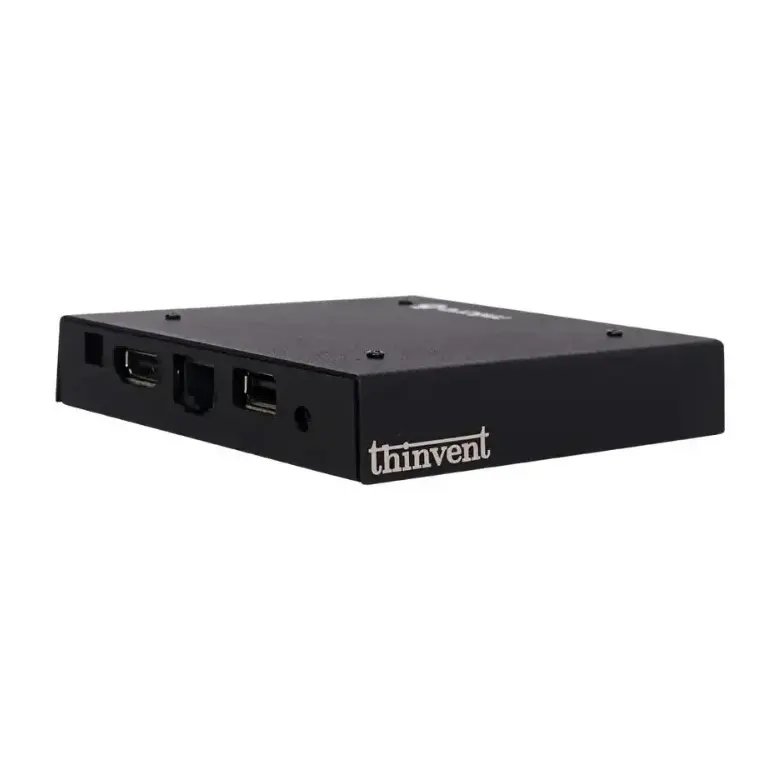
Thinvent builds fanless industrial computers, mini PCs, thin clients and all-in-one PCs designed for exactly this class of deployment. The Thinvent IPC3 series pairs 12th-generation Intel Core i3-1215U processors (6 cores, up to 4.4 GHz, 10 MB cache) with up to 16 GB DDR4 RAM and 1 TB SSD storage, and is available with Quad DB9 serial ports for multi-instrument connectivity. Operating system options include Windows 11 Professional, Windows 11 IoT Value, Thinux Embedded Linux, DOS and configurations without an OS, so the platform can be matched to the application stack rather than the other way round. With no fans, no filters and a 12V DC input, these systems are built to stay running in panels, kiosks and cabinets where ordinary PCs struggle.