What Is a Palmtop?
A palmtop is a class of very small, handheld computer designed to fit in the palm of your hand. The term became popular in the 1990s to describe pocket-sized devices that combined a processor, memory, a small display and a keyboard or stylus input into a single battery-powered unit. Early palmtops ran lightweight operating systems, offered limited storage, and were used mainly for note-taking, scheduling, contact management and simple data entry in the field.
The palmtop concept influenced much of the mobile computing we use today. Many of the ideas first explored on palmtops — instant-on operation, low power draw, solid-state storage, and rugged portability — are now standard expectations in industrial and embedded computing. Where the original palmtop was a personal organiser, its modern descendants are fanless mini PCs, thin clients and all-in-one systems that deliver far more performance in similarly compact, sealed enclosures.
Key Characteristics of Palmtop-Style Computing
The defining traits of palmtop-class devices are portability, low power consumption, and all-in-one integration. A typical palmtop had no moving parts, ran from batteries or a small adapter, and booted almost instantly because its operating system lived in ROM or flash memory. These same principles now guide the design of fanless industrial computers.
| Attribute | Classic Palmtop | Modern Compact Industrial PC |
|---|---|---|
| Size | Handheld, pocket-sized | Small form factor, DIN-rail or panel mount |
| Cooling | Passive (no fan) | Fanless, sealed chassis |
| Storage | ROM / small flash | 128 GB – 1 TB SSD |
| Memory | A few MB | 4 GB – 64 GB DDR4 |
| Processor | 8/16-bit at a few MHz | Intel multi-core up to 4.4 GHz |
| Operating system | Proprietary / DOS | Windows 11 Pro, Linux, DOS |
| Networking | Infrared / serial | Gigabit Ethernet, dual LAN, USB |
The table shows how far the underlying technology has advanced while the core design philosophy — compact, quiet, low-maintenance computing — has remained consistent.
Where Compact Computing Is Used Today
The applications that once drove palmtop adoption still exist, but the hardware has moved on. Field service engineers, warehouse staff, and technicians need small, reliable computers that tolerate dust, vibration and temperature swings. Instead of a fragile handheld, many deployments now use fanless mini PCs and industrial computers mounted inside a kiosk, control cabinet or vehicle, paired with a touchscreen or handheld terminal.
Common use cases include shop-floor data collection, retail point-of-sale, digital signage, thin-client desks in call centres, laboratory instrument control, and edge gateways for industrial IoT. In each case the requirements echo the palmtop brief: a small footprint, no fan to clog with dust, low power draw, and dependable 24/7 operation.
Choosing a Compact System Today
When selecting a modern equivalent of a palmtop, focus on the processor class, memory, storage and thermal design rather than physical size alone. Intel Celeron and N-series processors suit light-duty kiosk and thin-client roles, while Intel Core i3 and i5 chips handle heavier multitasking, multiple displays and virtualisation. Fanless chassis with wide-temperature components are preferable in dusty or hot environments, and dual Gigabit Ethernet ports are valuable for network segmentation or redundancy.
Operating system choice matters too. Windows 11 Pro is common for business applications, Linux suits embedded and custom deployments, and DOS or FreeDOS remains relevant for legacy industrial software. Solid-state storage, ample USB and serial ports, and VESA or DIN-rail mounting options round out a practical specification.
Thinvent's Compact and Industrial Computing Range
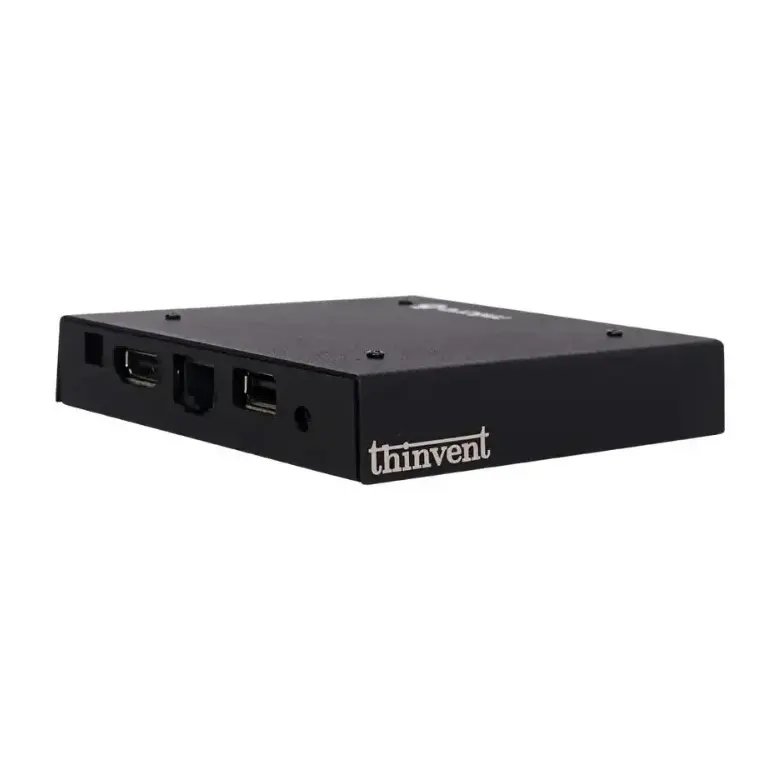
Thinvent builds fanless industrial computers, mini PCs, thin clients and all-in-one PCs that carry forward the palmtop philosophy of small, quiet, dependable computing. Systems such as the IPC3 series pair Intel Core i3-1215U processors with up to 16 GB DDR4 memory and 1 TB SSD storage, sealed fanless enclosures, and options for Windows 11 Pro, embedded Linux, or DOS. Quad DB9 serial variants support legacy equipment, while dual Ethernet and multiple display outputs cover modern networking and signage needs. For organisations replacing ageing handheld or palmtop-class devices, Thinvent's range offers a compact, serviceable and long-life alternative.