What Does PCIe Mean on a PC?
PCIe (Peripheral Component Interconnect Express) is the high-speed serial expansion bus used in virtually every modern computer to connect internal add-in cards and high-bandwidth devices to the processor and chipset. Unlike older parallel PCI or PCI-X slots, PCIe uses dedicated lanes — each lane is a pair of differential signalling wires, one for transmit and one for receive — so data can flow in both directions simultaneously at very high rates. On a PC motherboard, PCIe appears as physical slots (x1, x4, x8, x16) and as embedded links for M.2 storage, Wi-Fi modules, and Ethernet controllers.
PCIe Generations and Lane Widths
The two variables that define any PCIe link are its generation (signalling speed) and its lane count (width). Each generation has roughly doubled the per-lane throughput of the previous one while remaining backward compatible — a Gen4 card will negotiate down to run in a Gen3 slot, and vice versa.
| Generation | Per-Lane Bandwidth | x1 Link | x4 Link | x16 Link |
|---|---|---|---|---|
| PCIe 2.0 | ~500 MB/s | ~500 MB/s | ~2 GB/s | ~8 GB/s |
| PCIe 3.0 | ~985 MB/s | ~985 MB/s | ~3.94 GB/s | ~15.75 GB/s |
| PCIe 4.0 | ~1.97 GB/s | ~1.97 GB/s | ~7.88 GB/s | ~31.5 GB/s |
| PCIe 5.0 | ~3.94 GB/s | ~3.94 GB/s | ~15.75 GB/s | ~63 GB/s |
Note that these are raw signalling rates; real-world throughput after encoding overhead is slightly lower. For most industrial and commercial workloads — NVMe storage, multi-port Gigabit or 2.5G Ethernet, serial expansion, or capture cards — PCIe 3.0 x4 already delivers several gigabytes per second, far more than legacy PCI or SATA can provide.
Where PCIe Matters in a PC
-
Storage: NVMe SSDs connect over PCIe x4 via M.2 or U.2, delivering several times the sequential and random performance of SATA drives. This shortens boot times, speeds up databases, and improves responsiveness under heavy I/O.
-
Networking: Multi-port Gigabit and 2.5G/10G Ethernet adapters use PCIe x1 or x4 links. Industrial systems often need two or more isolated network segments for machine control versus plant network traffic.
-
Expansion cards: Serial (RS-232/RS-485) cards, digital I/O, CAN bus, frame grabbers, and GPU accelerators all attach through PCIe slots.
-
Wireless: Wi-Fi and cellular modules use PCIe (or USB) links on M.2 cards.
PCIe in Industrial and Embedded Systems
In fanless industrial PCs, mini PCs, and thin clients, PCIe is usually present in two forms: internal M.2 slots for storage and wireless, and — on larger industrial models — a physical expansion slot or riser for add-in cards. Because fanless chassis have no airflow from a CPU fan, designers pay close attention to the thermal budget of NVMe drives and expansion cards, often using heat spreaders or thermal pads that couple the drive to the chassis. Ruggedised designs also consider shock and vibration, since M.2 cards are held by a single screw and benefit from retention brackets in mobile installations.
A common misconception is that more PCIe lanes always mean better performance. In practice, lane count matters only when the attached device can saturate the link. A single Gigabit Ethernet controller needs roughly one PCIe 2.0 lane; an NVMe SSD benefits from four Gen3 or Gen4 lanes; a multi-port 10G adapter may want eight. Matching the link width to the device prevents wasted board space and power.
Choosing a PCIe-Equipped System
When specifying a PC with PCIe expansion, confirm three things: the generation and width of each slot, whether the slot is physically accessible in the chassis, and the power and thermal headroom available for the card. For edge deployments, fanless systems with wide-temperature NVMe storage and locking M.2 retention are usually preferable to desktop boards with open slots that collect dust.
Thinvent Systems with PCIe Expansion
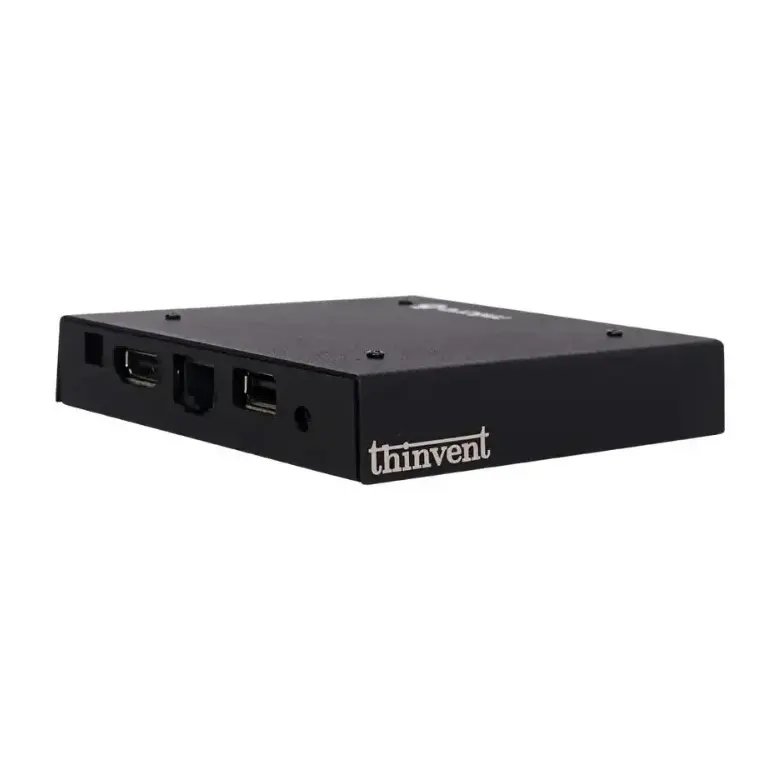
Thinvent's industrial PC range, including the IPC3 series built on 12th-generation Intel® Core™ processors, uses PCIe for NVMe SSD storage and internal expansion. These fanless, dust-tolerant systems are designed for factory floors, kiosks, and remote sites where reliability matters more than raw clock speed. Thinvent mini PCs, thin clients, and all-in-one computers similarly rely on PCIe links for storage and networking, giving integrators a stable, long-lifecycle platform for industrial and commercial deployments.