What Does "PC WAP" Mean?
The term "PC WAP" is ambiguous and can refer to a few different things depending on context. In computing and IT abbreviations, WAP most commonly stands for Wireless Access Point — a networking device that allows wireless-capable devices to connect to a wired network. In this sense, a "PC WAP" setup describes a computer that acts as, or connects through, a wireless access point for network access.
Historically, WAP also stood for Wireless Application Protocol, an early standard (popular in the late 1990s and early 2000s) that let mobile phones access simplified internet content. That protocol is largely obsolete today, replaced by full web browsing over Wi-Fi and cellular data.
If you arrived here searching for an industrial computer to serve as a networking, gateway, or edge device, the sections below explain what to look for.
Industrial PCs vs. Consumer PCs
An industrial PC (IPC) is a computer built for industrial purposes — production, automation, and control environments — rather than home or office use. According to industry references, IPCs sit in form factor between a nettop and a server rack, and are engineered to higher dependability and precision standards than consumer electronics.
Key characteristics that distinguish an industrial PC:
| Feature | Industrial PC | Consumer/Office PC |
|---|---|---|
| Cooling | Often fanless (passive) | Usually active fans |
| Operating temperature | Wide range, extended tolerance | Narrow, office-comfort range |
| Dust & vibration resistance | High (sealed, rugged chassis) | Low |
| Mounting | DIN rail, VESA, panel, wall | Desk only |
| Longevity & lifecycle | Long-term supply, stable BOM | Short refresh cycles |
| I/O | Serial (RS-232/485), GPIO, dual LAN | Standard USB/HDMI |
Common Industrial PC Use Cases
Industrial computers are deployed where reliability matters more than raw speed. Typical applications include:
-
Factory automation and machine control — running HMI/SCADA software, PLC communication, and motion control.
-
Edge computing and IoT gateways — collecting sensor data and forwarding it to cloud or on-premise systems, often acting as a network node (similar in role to a WAP or gateway).
-
Digital signage and kiosks — driving always-on displays in retail, transport, and public spaces.
-
Networking and surveillance — running firewall, VPN, or video management software with dual Ethernet ports.
-
Laboratory and medical equipment — precise, quiet, dust-free operation near sensitive instruments.
What to Look For
When selecting an industrial PC for networking, gateway, or control duties, prioritize fanless cooling (no moving parts means less dust ingress and higher uptime), wide-temperature components, dual Gigabit Ethernet for network segmentation, and serial ports for legacy industrial equipment. Modern processors such as Intel® Core™ i3 and N-series chips deliver strong performance per watt, making them well suited to always-on industrial roles. Choose an operating system that matches your software stack — Windows 11 Pro, Windows 11 IoT, Linux, or a DOS/embedded option.
Thinvent Industrial PCs for Networking and Control
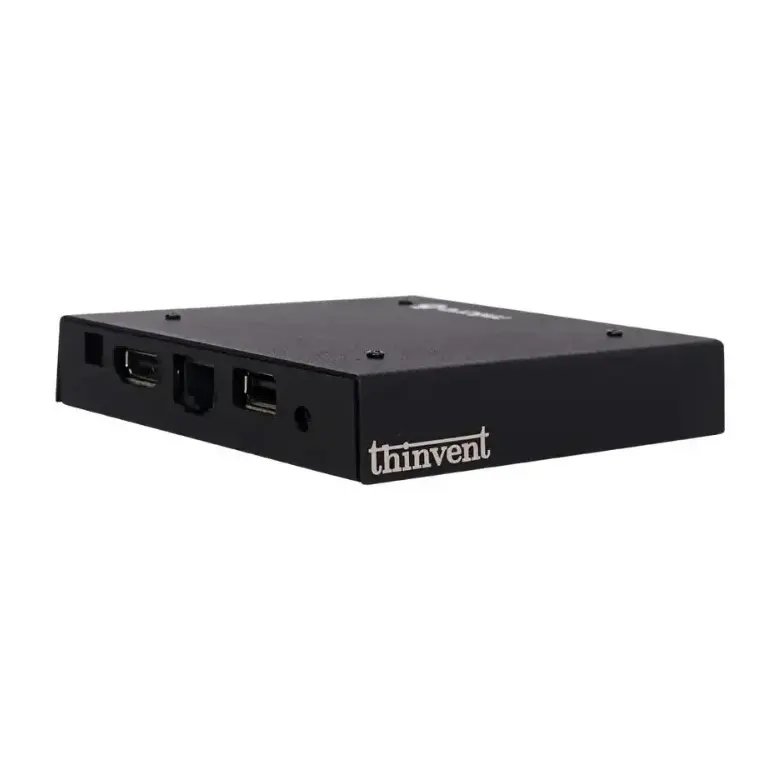
Thinvent manufactures industrial computers, mini PCs, thin clients, and all-in-one PCs engineered for demanding environments worldwide. Our IPC3 series, for example, pairs an Intel® Core™ i3-1215U processor (6 cores, up to 4.4 GHz, 10 MB cache) with 16GB DDR4 RAM and 1TB SSD, available with quad DB9 serial ports for industrial device connectivity. Options span Windows 11 Pro, Windows 11 IoT Value, DOS, and Thinux™ Embedded Linux, so you can deploy the exact platform your application requires. Whether you need a rugged edge node, a fanless control box, or a reliable gateway device, Thinvent's industrial range is built to keep running.