What Is Pinnacle Automation?
"Pinnacle automation" most commonly refers to industrial automation and control system integration — the practice of combining PLCs, SCADA software, HMIs, robotics, machine vision and industrial computers into complete, reliable production systems. Companies such as Pinnacle Industrial Controls, an automation and control solutions provider established in 2000, build and integrate these systems for process plants, factory lines, pharmaceutical facilities and material handling operations. A typical automation stack includes controllers (PLC/PAC), operator interfaces (HMI), supervisory software (SCADA), field instrumentation, industrial networking, and the industrial computer that ties it all together.
Where the Industrial Computer Fits
The industrial computer (IPC) is the workhorse layer of an automation system. It runs SCADA and HMI software, hosts historians and databases, handles machine vision processing, communicates with PLCs over Modbus, OPC UA or Ethernet/IP, and often serves as the gateway between the plant floor and enterprise systems. Because these machines sit on the factory floor rather than in a server room, they must tolerate dust, vibration, wide temperature swings and continuous 24/7 operation. That is why fanless designs, wide-input DC power, solid-state storage and industrial-grade serial and Ethernet connectivity matter far more here than raw consumer benchmarks.
Key Specifications for Automation-Grade Computers
| Requirement | Typical Specification | Why It Matters |
|---|---|---|
| Processor | Intel® Core™ i3/i5, 12th–14th Gen | Deterministic response for SCADA, vision, multi-tasking |
| Memory | 8–32 GB DDR4/DDR5 | Historians, databases, multiple HMI sessions |
| Storage | 256 GB–1 TB SSD | Vibration-proof, fast boot and logging |
| Serial ports | RS-232/RS-485 (DB9) | Legacy PLCs, weigh scales, analyzers, drives |
| Ethernet | Dual Gigabit LAN | Separate plant and enterprise networks |
| Cooling | Fanless, wide-temperature | Dust, heat and reliability in cabinets |
| Power | 12V/24V DC input | Direct from industrial power supplies |
Applications in Automation Systems
Industrial computers are deployed across process automation (batch control, 21 CFR Part 11 compliant pharma systems), factory automation (assembly lines, corrugated box lines, packaging), hoisting and crane control, machine vision inspection, barcode and traceability systems, and robot cell supervision. In each case the IPC must integrate cleanly with PLC platforms, SCADA packages and industrial networks while surviving the environment it is installed in. Quad serial-port configurations are especially common where multiple legacy controllers, drives or instruments must be polled from a single node.
Choosing the Right Platform
When specifying a computer for an automation project, start from the software: check the SCADA/HMI vendor's supported operating systems and processor requirements, then size memory and storage for the historian and database load. Confirm the field interfaces you need — serial, Ethernet, USB — and whether the unit will live inside a panel, on a machine frame or in a control room. Finally, consider lifecycle: automation assets often stay in service for a decade, so long-term OS and hardware availability matter as much as headline performance.
Thinvent Industrial Computers for Automation
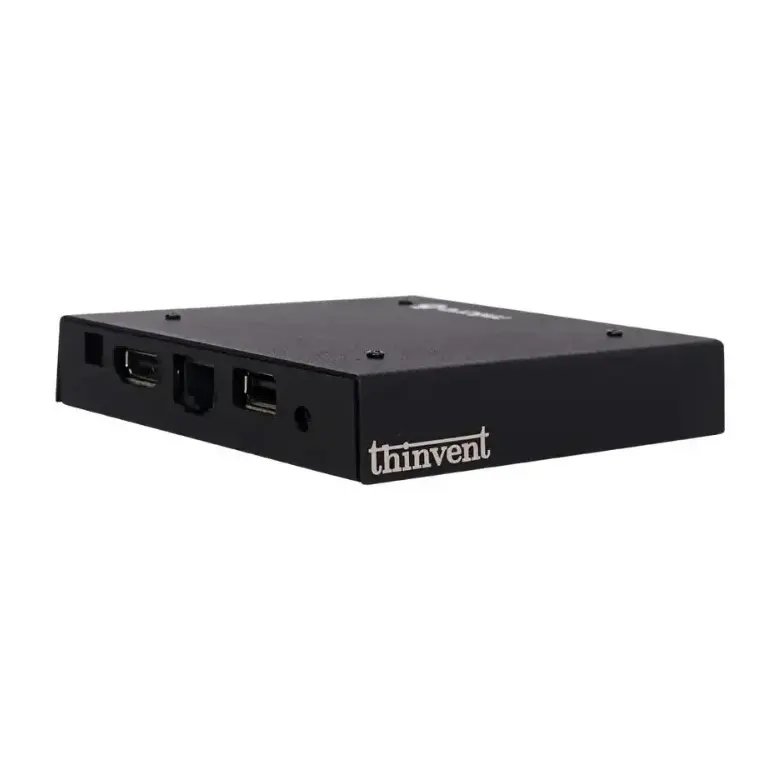
Thinvent manufactures fanless industrial computers, mini PCs, thin clients and all-in-one PCs designed for exactly these environments. The Thinvent® Industrial PC IPC3, for example, pairs an Intel® Core™ i3-1215U processor (6 cores, up to 4.4 GHz, 10 MB cache) with 16 GB DDR4 RAM and 1 TB SSD, and is available with Windows 11 Pro, Windows 11 IoT, DOS or Thinux™ embedded Linux — plus optional quad DB9 serial ports for connecting PLCs, drives and instruments. With dual Gigabit Ethernet, fanless cooling and wide DC input, Thinvent systems are built to run SCADA, HMI, vision and gateway workloads reliably on the plant floor, day after day.