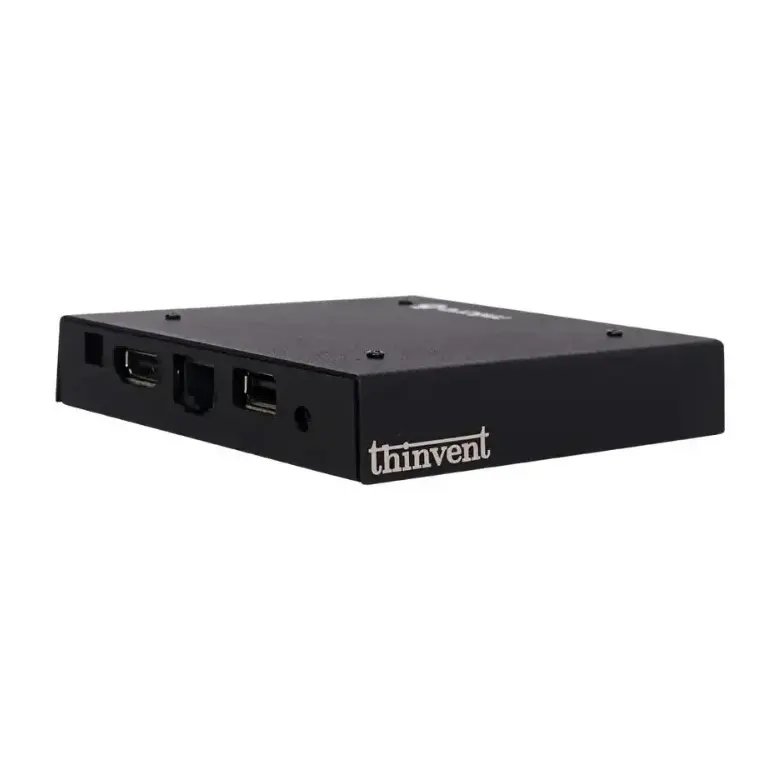
What Is a Mini PC?
A mini PC is a compact, fully self-contained computer that fits in the palm of your hand yet delivers the everyday performance of a desktop tower. Instead of bulky expansion slots and a large power supply, a mini PC integrates the processor, memory, storage and I/O onto a small motherboard housed in a rugged chassis. Because they draw far less power and generate less heat, mini PCs are increasingly chosen for kiosks, digital signage, point-of-sale terminals, thin-client deployments and light industrial control.
The trade-off for that small footprint is a narrower upgrade path: memory and storage are usually soldered or limited to a single SO-DIMM slot, and discrete graphics are rare. What you gain instead is low power consumption, silent operation, VESA-mountable installation behind a monitor, and a much longer service life in dusty or hot environments.
Key Specifications to Compare
When choosing a mini PC, four specifications drive most of the decision: processor, memory, storage and connectivity. Modern Intel® processors in the N and Celeron® series (such as the N100, N150 and N5095A) offer 4 cores with turbo frequencies near 3 GHz while staying within a fanless thermal envelope. Higher-end deployments may step up to Intel® Core™ i3 or i5 processors where multi-tasking, virtualisation or local video processing is required.
| Specification | Typical Entry Level | Typical Performance Level |
|---|---|---|
| Processor | Intel® N100 / N150, 4 cores | Intel® Core™ i3 / i5, 6–12 cores |
| Memory | 8–16 GB DDR4/DDR5 | 16–64 GB DDR4/DDR5 |
| Storage | 128–256 GB SSD | 512 GB–1 TB NVMe SSD |
| Graphics | Integrated Intel® UHD | Integrated Intel® Iris® Xe |
| Networking | 1× Gigabit Ethernet | 2× Gigabit Ethernet |
| Display Output | 1–2× HDMI | 2× HDMI + USB-C |
| Operating System | Windows 11 Pro, Linux, FreeDOS | Windows 11 Pro, Ubuntu |
Cooling, Power and Longevity
Cooling design matters more than raw clock speed in industrial settings. A fanless chassis uses the case itself as a heatsink, so there are no bearings to seize, no filters to clog and no airflow path to pull conductive dust across the board. The result is a computer that can be sealed against particulates and rated for a wide operating temperature range, which is why fanless mini PCs and industrial PCs are common on factory floors, in outdoor cabinets and in unairconditioned retail back offices.
Power draw is the other half of the reliability story. A mini PC running on a 12 V adapter typically consumes a fraction of the wattage of a full desktop, which reduces heat inside the enclosure and makes battery or solar-backed installations practical.
Common Applications
- Thin client and VDI endpoints – low-cost, centrally managed desktops for