What Does "Rugged" Mean in an Industrial Computer?
A rugged industrial computer is a system engineered to keep working where ordinary desktop PCs would struggle: dusty factory floors, hot cabinets, vibration-prone machinery, or locations with no air conditioning. The key design choices are fanless cooling (no vents pulling in dust, no fan bearing to wear out), a wide operating temperature range, protection against electrical noise, and a chassis that can be mounted inside a panel or machine enclosure. Ruggedness here is about continuous, unattended operation, not about dropping the unit off a truck.
The Engineering Behind Fanless Rugged Design
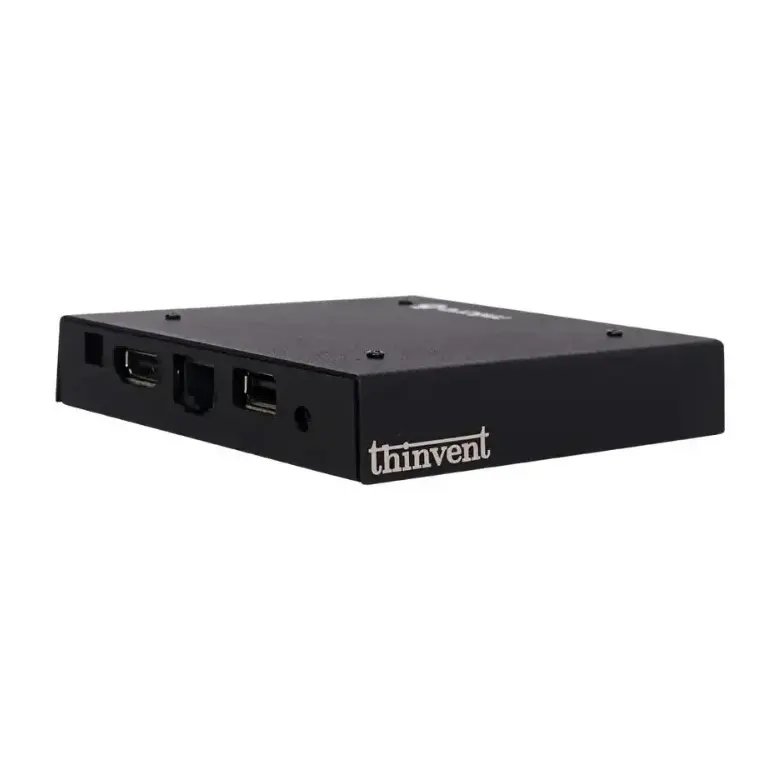
Fanless systems rely on passive heat dissipation: the processor's heat is conducted into a metal heatsink or the chassis itself, then radiated away. Removing the fan removes the most common point of failure in an industrial PC, along with the airflow path that carries dust, metal particles and humidity into the electronics. Thinvent industrial PCs are built around this principle, using low-power Intel® processors with modest thermal design power so that no active cooling is required. Solid-state storage plays a similar role, replacing spinning disks that are sensitive to shock and vibration.
Typical Specifications and Use Cases
Rugged fanless industrial PCs are commonly specified with 4 to 12 core Intel® processors, 8 GB to 32 GB of DDR4 memory, and 128 GB to 1 TB of SSD storage. They usually offer dual Gigabit Ethernet for separating control networks from plant networks, multiple HDMI outputs for operator displays, and USB 3.2 ports for peripherals. Serial ports (RS-232/RS-485) remain essential for connecting to PLCs, weighbridges, energy meters and legacy equipment. Common deployments include production line monitoring, CNC and machine control, kiosk and self-service terminals, warehouse data collection, and any location where a standard office PC would be a maintenance problem.
| Requirement | Typical Rugged Fanless Choice |
|---|---|
| Cooling | Passive, no fan |
| Storage | SSD only, no moving parts |
| Mounting | DIN rail, VESA, panel or wall bracket |
| Networking | Dual Gigabit Ethernet |
| I/O | Serial, USB, HDMI, digital I/O |
| Operating system | Windows 11 Pro, Linux, or without OS |
Choosing the Right Configuration
Start with the software you intend to run, then size the processor and memory accordingly. A monitoring or data-logging application may run comfortably on a 4-core Intel® N-series processor with 8 GB RAM, while machine vision, multiple database clients or virtualised workloads benefit from an Intel® Core™ i3 or i5 with 16 GB to 32 GB. Consider how the unit will be mounted and how cables will be routed before selecting a form factor. If the system will sit in a sealed cabinet, confirm that ambient temperature stays within the rated range, since passive cooling depends on surrounding airflow. Finally, choose the operating system that matches your deployment tooling, whether that is Windows, Linux, or a system shipped without an OS for a custom image.
Thinvent Products Built for Rugged Deployments
Thinvent manufactures fanless industrial computers, mini PCs, thin clients and all-in-one PCs designed for continuous operation in factories, utilities, retail and logistics environments. Our industrial PC range, including the IPC3 series, pairs Intel® Core™ i3 processors with generous memory and SSD storage, dual Gigabit Ethernet, multiple display outputs, and optional quad DB9 serial ports for connecting industrial equipment. Units can be supplied with Windows 11 Pro, Windows 11 IoT, Thinux™ Embedded Linux, DOS, or without an operating system, so you can deploy a standard image across a fleet. Every system is designed to run quietly, tolerate dust and heat, and stay online without routine fan maintenance.