What Is a Rugged Tab / Rugged Computer?
A "rugged tab" or rugged tablet refers to a hardened computing device built to survive conditions that would quickly damage ordinary consumer electronics — dust, vibration, extreme temperatures, humidity, and rough handling. In industrial and commercial deployments, the same rugged design principles are applied to fixed-installation hardware such as industrial PCs, mini PCs, thin clients, and all-in-one PCs. These systems are engineered with fanless cooling, wide-temperature components, sealed enclosures, and vibration-resistant mounting so they keep running reliably on factory floors, in vehicles, at outdoor kiosks, and in remote field sites.
Key Design Characteristics of Rugged Computing Hardware
Ruggedness is not a single feature but a combination of engineering choices. The most important ones include:
-
Fanless cooling: Eliminating moving fans removes the most common point of mechanical failure and prevents dust ingress. Heat is dissipated through the chassis itself.
-
Wide operating temperature range: Industrial-grade components tolerate temperature swings far beyond office-grade hardware.
-
Shock and vibration resistance: Solid-state storage (SSD) replaces spinning disks, and boards are mounted to withstand continuous vibration.
-
Sealed, dust-resistant enclosures: Reduced openings and filtered or fanless designs keep particulates out.
-
Wide-voltage DC input: Stable operation from 12V DC power adapters and industrial power rails, with tolerance for fluctuation.
-
Long lifecycle availability: Industrial platforms are kept in production far longer than consumer models, so deployments can be standardized and maintained.
Typical Specifications for Rugged Deployments
| Attribute | Typical Rugged-Grade Range | Why It Matters |
|---|---|---|
| Cooling | Fanless, passive heatsink chassis | No moving parts, no dust intake |
| Processor | Intel Celeron / N-series, up to i5 | Low power draw, stable thermals |
| Memory | 8–32 GB DDR4 | Multitasking for kiosk and control apps |
| Storage | 128–1024 GB SSD | Shock-resistant, fast boot |
| Networking | Gigabit Ethernet, optional dual ports | Wired reliability over Wi-Fi in plants |
| Display (AIO) | 21.5" or 23.8" panel | Panel-PC form factor for HMIs |
| Operating System | Windows 11 Pro / IoT, Linux, or no OS | Matches application stack and licensing needs |
| Power | 12V DC adapter input | Works with industrial DC supplies |
Where Rugged Computers Are Used
Rugged mini PCs, thin clients, and panel PCs are deployed wherever reliability matters more than portability. Common applications include manufacturing shop-floor terminals and machine HMIs, warehouse and logistics stations, digital signage and outdoor kiosks, transportation and fleet systems, surveillance and access-control nodes, and edge data collection in utilities and telecom cabinets. In each case the hardware must tolerate heat, dust, vibration, and continuous 24/7 duty cycles while remaining easy to service and standardize across many sites.
Choosing Between a Rugged Tablet and a Rugged Fixed-Installation PC
Handheld rugged tablets suit mobile field work such as inspections and inventory scanning. However, most industrial workloads are stationary — a machine panel, a kiosk, a control cabinet, or a workstation — where a rugged mini PC or all-in-one PC delivers better value: larger displays, more I/O, easier power and network wiring, and simpler maintenance. Fixed rugged systems also avoid battery degradation and charging logistics, making them the preferred choice for continuous operation.
Thinvent's Rugged-Grade Product Range
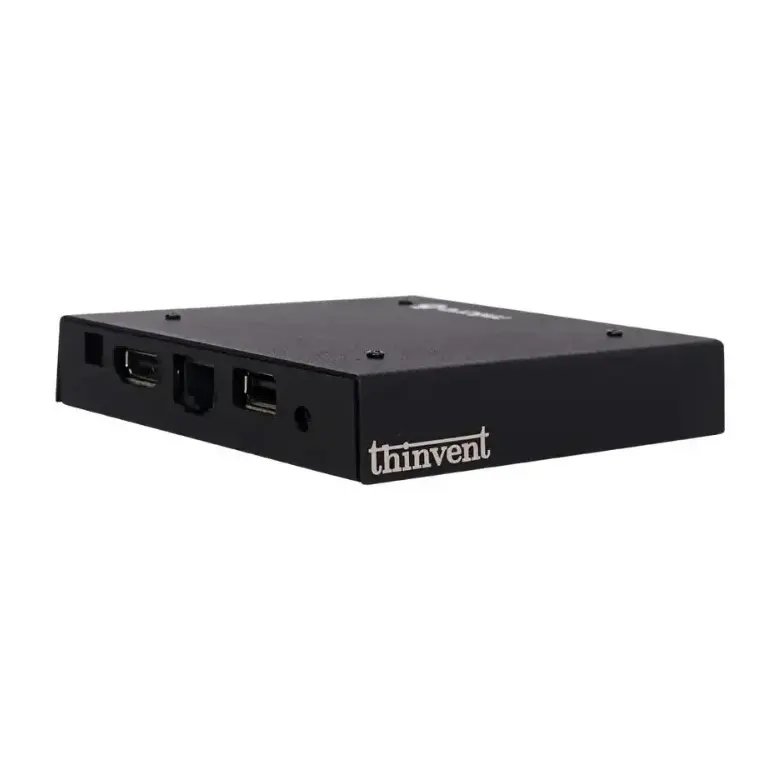
Thinvent manufactures fanless, industrial-grade computing hardware designed for exactly these environments. The range includes industrial PCs and mini PCs with fanless chassis and 12V DC input, thin clients for centralized VDI and kiosk deployments, and all-in-one panel PCs in 21.5" and 23.8" screen sizes. Configurations span Intel Celeron and N-series processors through i3 and i5 options, 4–64 GB memory, 128–1024 GB SSD storage, single or dual Gigabit Ethernet, and a choice of Windows 11 Pro, Windows 11 IoT, Ubuntu Linux, Thinux™ Embedded Linux, FreeDOS, or no operating system. Every unit is built to run continuously in dusty, hot, and vibration-prone installations — no fans, no filters to clog, no surprises.