What This Query Actually Describes
The string settimeout("alert('xss')", 2000) is a JavaScript snippet that calls the browser's setTimeout() function to trigger an alert() dialog after a two-second delay. In its original form it is simply a coding exercise or test snippet — the kind of thing developers paste into a console to check that timers and dialogs work. The " and ' you see are HTML entity encodings of the double and single quotes, which is what happens when such code is passed through a web form, URL parameter, or content field and then rendered back into a page.
The reason this string is interesting to anyone running a web-facing system is that it is a classic reflected XSS (cross-site scripting) payload. If a web application takes user input — a search box, a comment field, a URL query parameter — and echoes it back into the HTML without escaping it, the browser treats the echoed text as executable script rather than plain text. A test payload like this is usually how a security researcher or a penetration tester confirms that an input field is vulnerable. It is not malware in itself; it is a probe.
Why This Matters for Embedded and Industrial Systems
Industrial PCs, kiosks, digital signage players, and thin clients frequently run browser-based dashboards, HMI (human-machine interface) panels, and configuration pages. These interfaces are often built quickly and may not receive the same security review as public websites, because they were assumed to live on an isolated factory network. That assumption has aged badly. Once an HMI or signage box is reachable from a corporate LAN, a VPN, or the internet, an unescaped input field becomes a real risk.
The practical defences are well understood: escape all user-supplied output before rendering it, apply a strict Content-Security-Policy header, avoid innerHTML in favour of safe DOM APIs, and keep the browser engine and operating system patched. On the hardware side, the useful properties are a supported, updatable operating system, enough CPU headroom to run a modern browser engine without stutter, and the ability to lock the device down so that only the intended application runs.
Hardware Requirements for Browser-Based Kiosk and HMI Workloads
A modern Chromium-based browser is a demanding application. A kiosk or HMI panel that renders charts, video, or a large single-page app needs a processor with real single-thread performance, adequate RAM, and reliable storage. Fanless designs are strongly preferred in these roles because they eliminate the dust-ingesting fan that is the most common failure point in a factory or outdoor enclosure.
| Requirement | Typical Target | Why It Matters |
|---|---|---|
| Processor | Intel® Core™ i3 or better, 12th gen+ | Modern browser engines benefit from newer instruction sets |
| Cores | 6+ | Browser tabs, rendering, and background services run in parallel |
| RAM | 16 GB | Prevents swapping when a dashboard holds large datasets |
| Storage | 256 GB–1 TB SSD | Fast boot, reliable logs, no moving parts |
| Cooling | Fanless | No dust ingress, no bearing wear, silent |
| OS | Windows 11 Pro / IoT, Ubuntu LTS, embedded Linux | Receives security patches, supports modern browsers |
| Serial I/O | DB9 RS-232/RS-485 | Connects to PLCs, meters, legacy controllers |
Use Cases
Interactive kiosks and self-service terminals run a locked-down browser full-screen. These benefit from a fanless industrial PC that boots reliably every morning and can be remotely updated.
Digital signage players decode video and render web content continuously. A fanless unit with a 12th-gen i3 and 16 GB RAM handles 1080p and multi-zone layouts comfortably.
HMI and SCADA front-ends sit between operators and PLCs. Quad DB9 serial ports allow direct connection to legacy controllers while the same box drives a modern browser-based dashboard.
Edge gateways collect data from shop-floor equipment and forward it to a cloud or MES system. Here the security posture of the OS matters as much as the CPU.
A Note on Testing Your Own Interfaces
If you are evaluating whether your kiosk or HMI software is vulnerable, a payload such as settimeout("alert('xss')", 2000) is a standard first probe. Run it only against systems you own or are authorised to test. If the dialog appears, the input field is not escaping output and should be fixed before the device is exposed to any untrusted network.
Thinvent Products for Kiosk, Signage and Edge Deployments
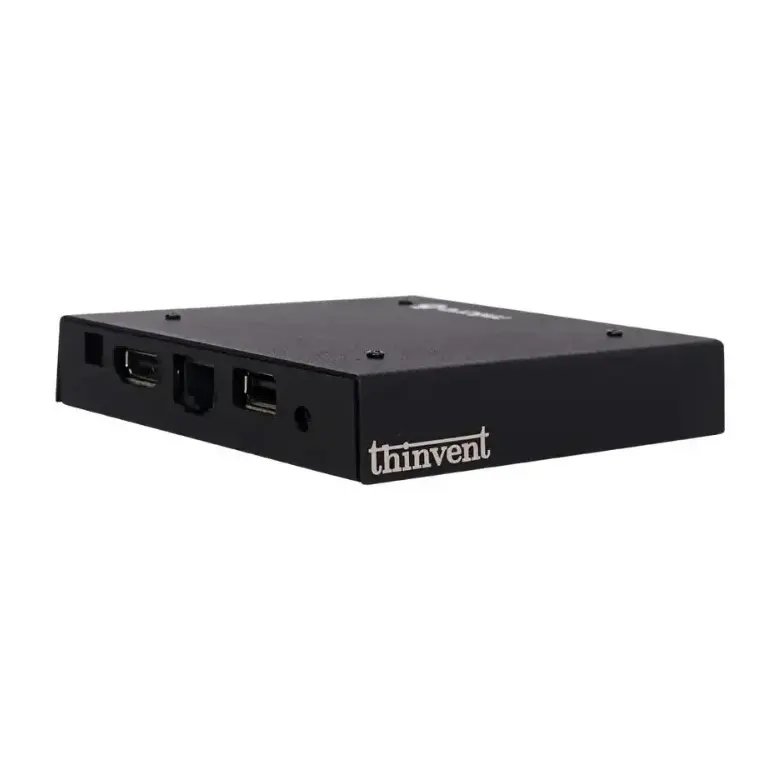
Thinvent builds fanless industrial computers, mini PCs, thin clients, and all-in-one PCs designed for exactly these roles. The IPC3 industrial PC pairs an Intel® Core™ i3-1215U processor (6 cores, up to 4.4 GHz, 10 MB cache) with 16 GB DDR4 RAM and a 1 TB SSD in a fanless chassis, and is available with Windows 11 Pro, Windows 11 IoT Value, DOS, or Thinux™ embedded Linux. Variants with quad DB9 serial ports suit HMI and SCADA installations where legacy controllers must be connected alongside a modern browser-based interface. Because Thinvent supplies the operating system options and the hardware together, deployments can be standardised and patched as a fleet rather than as individual machines.