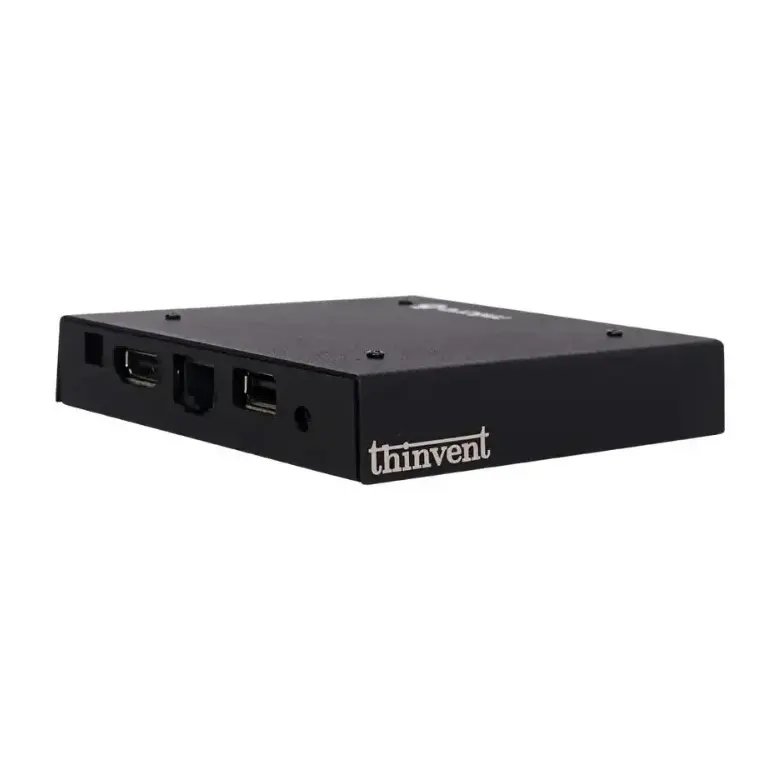
What Are Compact Fanless Mini PCs?
Compact fanless mini PCs are small-form-factor computers designed for industrial and commercial environments where reliability, space efficiency, and silent operation are critical. These systems eliminate moving parts like fans, using passive cooling solutions such as heat sinks and chassis design to dissipate heat. This makes them ideal for dusty, dirty, or vibration-prone settings where traditional computers with fans would fail. They are engineered for 24/7 operation, offering robust performance in a minimal footprint.
Key Specifications and Technical Details
These industrial-grade mini PCs typically feature low-power, high-efficiency processors from Intel's N-series, such as the quad-core Intel N100. Common specifications include 4 to 16GB of DDR4 RAM, SSD storage from 128GB to 1TB, and a range of connectivity options including multiple USB ports, HDMI, and Gigabit Ethernet. Their fanless design ensures operation is completely silent and prevents dust ingress. They often support a wide input voltage range (e.g., 12V DC) for flexible power integration and come in rugged enclosures suitable for wall-mounting or DIN-rail installation.
Use Cases and Applications
The durability and compact size of fanless mini PCs make them perfect for a wide array of industrial and embedded applications.
-
Digital Signage & Kiosks: Powering interactive displays in retail, hospitality, and public spaces.
-
Factory Automation: Acting as a controller for PLCs, HMIs, and machine vision systems on the shop floor.
-
Thin Client & VDI: Providing secure, centralized desktop access in offices, call centers, and healthcare.
-
IoT Gateways: Collecting and processing data from sensors and devices at the network edge.
-
Transportation & Logistics: Used in fleet management, vehicle infotainment, and warehouse management systems.
Comparison of Common Industrial Mini PC Form Factors
| Feature | Fanless Mini PC | Thin Client | Industrial Panel PC |
|---|---|---|---|
| Primary Use | Embedded computing, IoT, automation | Virtual Desktop Infrastructure (VDI) | Human-Machine Interface (HMI) |
| Cooling | Passive (no fans) | Often fanless or very quiet | Varies; panel PCs can be fanless |
| Durability | High (wide temp range, shock/vib resistant) | Moderate (office environment) | High (built for factory floor) |
| I/O & Expansion | Good selection of standard ports | Basic ports for peripherals | Integrated display and touchscreen |
| Deployment | Wall/DIN-rail mount, hidden installations | Desktop | Mounted on machinery or enclosures |
Thinvent Fanless Mini PC Solutions
Thinvent offers a robust lineup of fanless industrial mini PCs designed for demanding environments. Our Aero series, for example, leverages efficient Intel N-series processors to deliver reliable performance without the failure points associated with fans. These systems are pre-configured with your choice of operating system—including Windows 11 IoT, Windows 11 Pro, Ubuntu Linux, or our custom Thinux™ Embedded Linux—ensuring software compatibility for your specific application. Built for global deployment, Thinvent mini PCs provide the durability, silent operation, and compact form factor required for industrial automation, digital signage, and edge computing projects worldwide.