What Is a System on Module?
A System on Module (SoM) is a compact, integrated computing board that packages the core processing elements — CPU, chipset, memory, storage controller and essential I/O — onto a single module. Rather than designing a computer from scratch, engineers mount a SoM onto a custom carrier board that provides the connectors, power delivery and enclosure suited to their specific application. This modular approach shortens development cycles, reduces engineering risk and allows a product family to scale across multiple performance tiers without redesigning the entire system.
The concept is closely related to the single board computer (SBC), but the two differ in intent. An SBC is a complete, ready-to-run board with standard ports, while a SoM is a building block intended to be integrated into a larger system. SoMs typically connect to their carrier board through high-density board-to-board connectors or edge connectors, exposing interfaces such as PCIe, USB, SATA, Ethernet, display outputs, serial ports and GPIO.
Key Specifications to Consider
When evaluating a SoM or a module-based industrial computer, the processor platform sets the ceiling for everything else. Modern x86 modules commonly use Intel processors spanning Celeron and N-series efficiency chips through to Core i3 and i5 parts, with core counts from 4 up to 12 and boost frequencies well beyond 4 GHz. Memory is usually soldered or socketed DDR4/DDR5, with 4 GB to 64 GB being typical across the range. Storage options include eMMC, SATA SSD or NVMe, and industrial designs often add wide-temperature support, watchdog timers and long-life component sourcing.
| Attribute | Typical SoM | Integrated Industrial PC |
|---|---|---|
| Form | Board-level module | Enclosed, ready to deploy |
| Customisation | Carrier board design required | Configured at order |
| Time to deploy | Weeks to months | Immediate |
| Thermal design | Engineer's responsibility | Factory validated |
| Best for | OEM product development | End-user installations |
Use Cases and Applications
System on Module designs are widely used in industrial automation controllers, medical devices, digital signage players, kiosks, retail terminals, in-vehicle systems, robotics and edge gateways. OEMs choose the modular route when they need a custom form factor, a specific connector layout, or the ability to offer several product variants from one base design. Where the requirement is instead for a finished, certified unit that can be mounted and powered immediately, a fanless industrial PC or mini PC built on the same processor families delivers the same compute without the integration effort.
Choosing Between a Module and a Finished System
The decision usually comes down to volume, engineering resource and time to market. High-volume OEM programmes with in-house hardware teams often benefit from a SoM and custom carrier. Lower-volume deployments, pilot projects and applications where certification, enclosure and thermal validation matter more than mechanical customisation are usually better served by an off-the-shelf industrial computer. Both paths can use identical silicon, so software investment carries across.
Thinvent Products Built on These Platforms
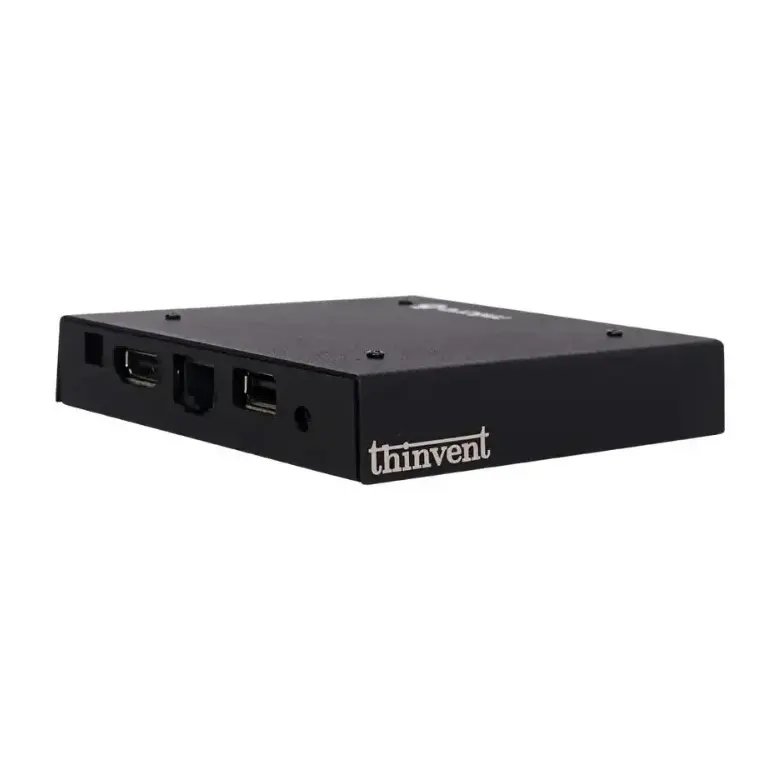
Thinvent's industrial computers, mini PCs, thin clients and all-in-one PCs are built around the same Intel processor families used in modern module designs, including 12th generation Core i3 and i5 parts such as the i3-1215U with 6 cores and up to 4.4 GHz. Configurations range from 4 GB to 64 GB of memory and 128 GB to 1 TB of SSD storage, with Windows 11 Pro, Windows 11 IoT, Ubuntu Linux, Thinux Embedded Linux, FreeDOS or no operating system at all. Fanless chassis options, dual Gigabit Ethernet, multiple HDMI outputs, USB 3.2 Gen 2 and USB-C connectivity, and quad DB9 serial variants make them suitable for automation, signage, kiosk and edge deployments where a module-based design would otherwise be required.