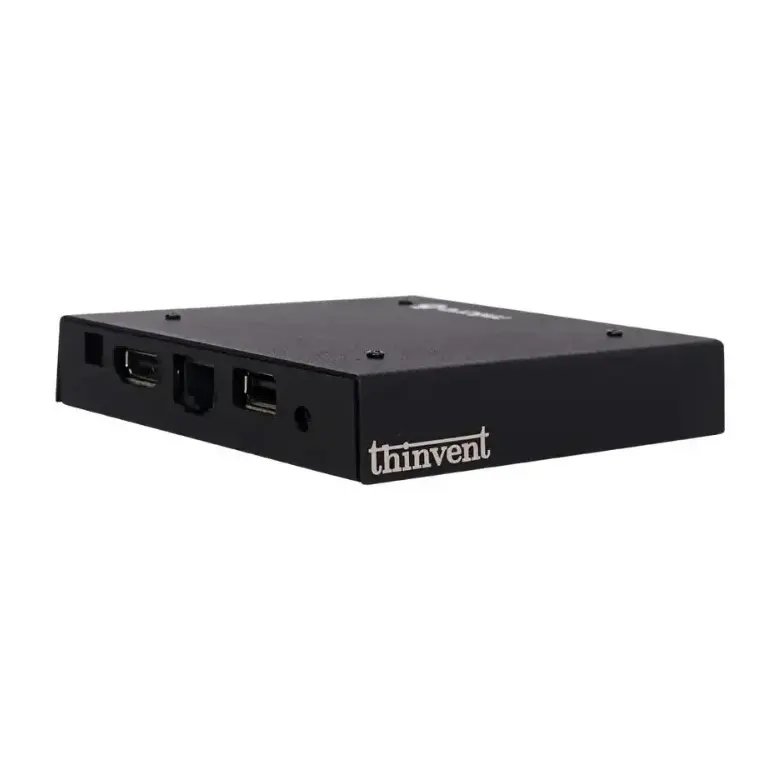
What Is an Industrial PC?
An industrial PC (IPC) is a computer engineered for continuous operation in environments where a standard desktop or office mini PC would struggle: factory floors, control cabinets, kiosks, warehouses, vehicles, and outdoor enclosures. The differences are not cosmetic. Industrial computers are built around wide-temperature components, fanless or heavily filtered cooling, wide-range DC power inputs, watchdog timers, and long-lifecycle availability so that a machine deployed today can still be serviced and replaced with an identical unit years later.
The core design choice is cooling. A fanless chassis conducts heat away from the processor through a machined aluminium heatsink, which removes the single most common point of failure in a factory computer — the fan bearing — and also removes the airflow path that pulls dust, metal filings, and conductive particles into the electronics. The trade-off is that thermal design must be matched carefully to the processor's sustained power envelope, which is why IPC vendors validate specific CPU and chassis combinations rather than offering unlimited configuration options.
Key Specifications That Matter
When specifying an industrial computer, the parameters that decide whether a deployment succeeds are usually not the ones printed largest on a retail box. Sustained performance under load, I/O that matches the machines being connected, and power input flexibility matter more than peak clock speed.
| Specification | Typical Industrial Requirement | Why It Matters |
|---|---|---|
| Cooling | Fanless, passive heatsink | No dust ingress, no fan wear-out, silent operation |
| Operating temperature | 0 °C to 50 °C or wider | Unheated cabinets, roof spaces, non-air-conditioned plants |
| Power input | 12 V or 9–36 V DC, locking connector | Vehicle, DIN-rail and battery-backed installations |
| Serial I/O | RS-232 / RS-485, sometimes 4–6 ports | PLCs, weighbridges, CNC controllers, legacy instrumentation |
| Storage | Industrial SSD, often 128 GB–1 TB | Shock and vibration tolerance, no moving parts |
| Networking | Dual Gigabit Ethernet | Segregating machine network from plant/office network |
| Expansion | Mini PCIe / M.2 for Wi-Fi, 4G, CANbus | Retrofitting connectivity without replacing the unit |
| Mounting | DIN rail, VESA, wall bracket | Fitting into existing control cabinets |