What Does a CPU Cost?
There is no single price for a CPU. The cost of a processor depends on its performance tier, core count, clock speed, cache size, manufacturing generation, and the market segment it targets. A low-power entry-level chip built for thin clients and kiosks may cost a fraction of a high-performance mobile or desktop processor designed for compute-heavy workloads. When you buy a complete computer, the CPU cost is only one part of the total bill of materials — it is bundled with the motherboard, memory, storage, cooling, chassis, power supply, and operating system licence.
What Drives CPU Pricing
Several factors push processor prices up or down:
-
Performance tier and core count — More cores and higher clock speeds generally mean a higher price. A 4-core entry processor sits at the affordable end, while 6-, 10- and 12-core parts command more.
-
Generation and architecture — Newer generations typically cost more at launch but deliver better performance per watt. Older generations often become more affordable over time.
-
Integrated graphics and features — Chips with stronger integrated GPUs, AI acceleration, or vPro-style manageability carry a premium.
-
Power envelope (TDP) — Low-power fanless designs trade peak performance for efficiency, which affects both chip cost and system design cost.
-
Package and socket — BGA-soldered mobile chips differ in cost from socketed desktop parts.
-
Volume and channel — OEM and bulk pricing differs substantially from single-unit retail.
Typical Processor Tiers
The table below shows how processor classes generally map to performance and relative cost. Exact figures vary by market, generation and supplier, so treat this as a guide to positioning rather than a price list.
| Tier | Example Class | Cores | Typical Use | Relative Cost |
|---|---|---|---|---|
| Entry | Intel® Celeron®, Intel® Processor N-series | 4 | Thin clients, kiosks, digital signage | Lowest |
| Mainstream | Intel® Core™ i3 | 6 | Office PCs, industrial control, retail | Moderate |
| Performance | Intel® Core™ i5 | 10–12 | Workstations, multi-app industrial use | Higher |
| High Performance | Intel® Core™ i7 | 12+ | Compute-intensive, virtualisation | Highest |
Why the Full System Cost Matters More
For most buyers, the more useful question is not "what does the CPU cost" but "what does a complete, reliable computer cost for my application." A processor is meaningless without a board, memory, storage and a validated thermal design. In industrial and commercial deployments, the cost of downtime, service calls and replacement units usually outweighs the difference in chip price. This is why fanless, solid-state systems with no moving parts are often more economical over their service life, even when the processor inside is a modest, efficient part.
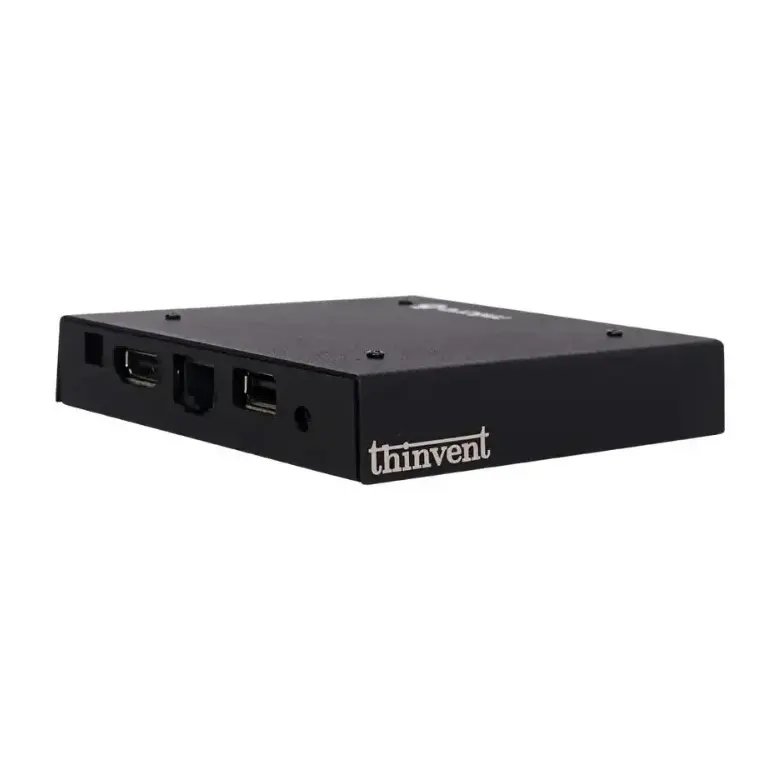
Thinvent Products Featuring These Processors
Thinvent builds industrial computers, mini PCs, thin clients and all-in-one PCs around Intel® and ARM® processors, covering entry-level Intel® Processor N-series and Celeron® chips through Intel® Core™ i3 and i5 generations. Our fanless designs are engineered for dust, heat and continuous operation, with options for dual Ethernet, multiple HDMI outputs, USB-C, serial ports and a choice of Windows 11 Pro, Ubuntu Linux, Thinux™ Embedded Linux or no operating system. Because we manufacture the full system, the processor is matched to a validated thermal and power design — so you get predictable performance and a total cost of ownership you can plan around, rather than a headline chip price in isolation.