What Is the Best CPU?
There is no single "best CPU" — the right processor depends on what the computer has to do. A chip that is ideal for a fanless mini PC driving a digital sign is not the same one you would want in an industrial PC running machine-vision software. The practical answer is to match the processor to the workload, the thermal envelope, and the lifespan you need from the system.
For most industrial, commercial and edge deployments, the sweet spot sits in Intel's modern low-power and mid-range families. These chips deliver strong single-thread performance for responsive applications, enough cores for light multitasking, and modest power draw so they can run in compact, fanless enclosures. Intel's naming makes this easy to navigate: the "N" series (such as the N95, N100 and N150) are efficient quad-core parts aimed at always-on, low-power devices, while the "U" series (such as the 1215U, 1315U and 120U) and "P" series (such as the 1250P) step up to higher clock speeds and more cores for heavier workloads. Higher-tier i3, i5 and i7 parts add cache, threads and memory bandwidth as you move up the stack.
How to Match a CPU to Your Workload
Start with the job the machine performs, then work backwards to the silicon.
-
Thin clients and kiosks: Efficiency matters most. An Intel N-series or a low-power U-series chip keeps heat and power draw down while staying responsive for remote desktop, browsing and point-of-sale software.
-
Industrial control and data logging: You want deterministic, reliable behaviour over raw speed. A 6-core U-series processor with 16 GB of RAM handles SCADA, HMI and serial-connected equipment comfortably, even in a sealed, dust-prone cabinet.
-
Edge analytics and light AI inference: More cores and higher clocks help. Look at U-series or P-series parts with 10–12 cores and 16–32 GB of memory.
-
Multi-display signage and video walls: Prioritise integrated graphics capability and enough memory bandwidth; a modern i3 or i5 with dual HDMI outputs is often ideal.
A Quick Comparison of Common Processor Tiers
| Tier | Example Models | Typical Cores | Best For | Power Profile |
|---|---|---|---|---|
| Entry efficiency | N95, N100, N150 | 4 | Thin clients, kiosks, always-on edge devices | Very low |
| Mainstream mobile | 120U, 1215U, 1315U | 6 | Industrial PCs, HMI, POS, light analytics | Low |
| Performance mobile | 1250P | 10–12 | Edge AI, multi-app workloads, video | Moderate |
| Higher desktop-class | Core i3 / i5 | 6–12+ | Demanding control, vision, virtualisation | Higher |
Two specifications matter more than marketing names: cores (how many tasks run in parallel) and max frequency (how quickly a single task completes). Cache size and memory support round out the picture — a 10 MB cache and DDR4 support, for example, keep data close to the cores for smoother performance.
Cooling, Longevity and Reliability
In industrial settings, the enclosure often decides which CPU you can use. Fanless designs depend on low-thermal-design-power processors that can dissipate heat through the chassis, which is why efficient N-series and U-series chips are so common in sealed, dust-resistant computers. These systems are also built for long life cycles, so choosing a widely adopted processor family makes spare parts and long-term supply easier to manage.
Thinvent Products Featuring These Processors
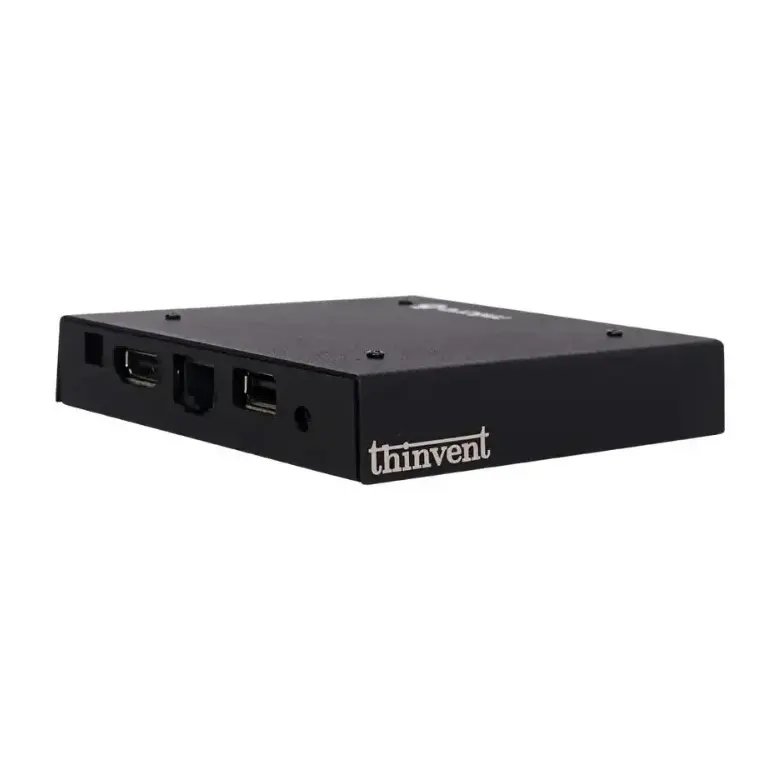
Thinvent builds industrial computers, mini PCs, thin clients and all-in-one PCs around exactly these processor families. Our IPC3 industrial PC, for example, pairs an Intel Core i3-1215U (6 cores, up to 4.4 GHz, 10 MB cache) with 16 GB DDR4 RAM and a 1 TB SSD, and is available with Windows 11 Pro, Windows 11 IoT, DOS or Thinux embedded Linux, plus optional quad DB9 serial ports for legacy equipment. Across the range you will find efficient N-series mini PCs for always-on roles and higher-core i3 and i5 configurations for demanding edge workloads — so you can pick the CPU that fits the job rather than paying for performance you will never use.