Understanding the "World's Smallest CPU"
When people search for the "world's smallest CPU," they are usually looking for one of two very different things: the smallest processor chip itself, or the smallest complete computer built around a compact processor. These are not the same thing, and understanding the difference helps you choose the right product.
A CPU (central processing unit) is a single silicon chip. Modern processors are manufactured at nanometer scales — current-generation chips are built on nodes as small as 3 nm to 10 nm, and a bare processor die can be smaller than a fingernail. However, a bare CPU chip cannot do anything on its own. It needs a motherboard, memory, storage, power delivery, cooling and an enclosure before it becomes a usable computer. That is why most buyers searching for a "smallest CPU" actually want the smallest usable computer, which is where mini PCs come in.
What Determines How Small a Computer Can Be
Several engineering factors decide the physical size of a computer:
-
Processor package and TDP: Low-power processors (often 6 W to 15 W) generate less heat, so they can run with passive cooling instead of a fan. This removes the biggest source of bulk and noise.
-
Cooling method: Fanless designs use the chassis itself as a heat sink, allowing very slim, sealed enclosures that also resist dust.
-
Integrated vs. discrete components: Soldered RAM and onboard storage reduce board area and connector height.
-
Power input: A simple 12 V DC adapter replaces a bulky internal power supply.
-
I/O layout: Careful placement of HDMI, USB and Ethernet ports keeps the footprint minimal without sacrificing connectivity.
The result is a class of devices often called mini PCs, nano PCs or ultra-compact PCs — palm-sized systems that fit behind a monitor or inside a kiosk.
Typical Specifications of Ultra-Compact PCs
| Feature | Typical Ultra-Compact Range |
|---|---|
| Footprint | Roughly 100–130 mm square, often under 1 litre volume |
| Processor | Intel low-power Celeron, N-series or U-series |
| Cores | 4 to 10 |
| Memory | 4 GB to 32 GB DDR4/DDR5 |
| Storage | 128 GB to 1 TB SSD |
| Cooling | Fanless (passive) or low-noise active |
| Power | 12 V DC adapter, often under 30 W |
| Video Output | 1–2 × HDMI |
| Networking | Gigabit Ethernet, optional Wi-Fi |
Where Small Computers Make Sense
Compact, low-power computers are widely used in digital signage, kiosks and self-service terminals, point-of-sale systems, thin client and VDI deployments, industrial control cabinets, laboratory and medical equipment, and home or office desktops where desk space is limited. Because fanless models have no moving air path, they are also preferred in dusty, humid or hygiene-sensitive environments such as food processing and healthcare. Their low power draw keeps them economical to run continuously, which suits always-on applications.
Thinvent's Compact Computing Range
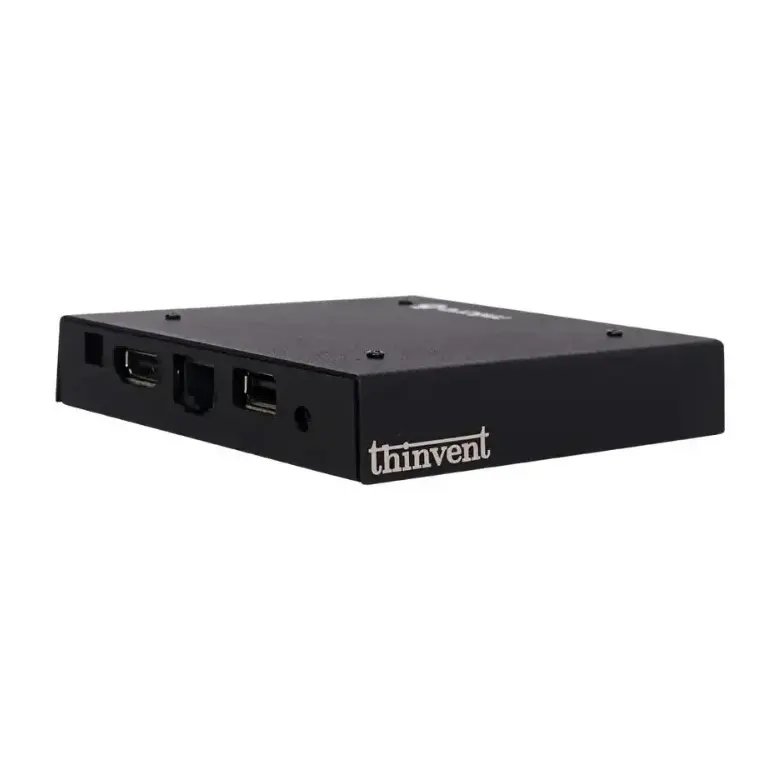
Thinvent builds a complete family of small, reliable computers designed for exactly these needs. The Aero Mini PC series delivers a genuinely compact, fanless form factor powered by Intel processors, with configurations covering 4-core Celeron and N-series chips, up to 16 GB DDR4 memory and 128 GB SSD storage, running Windows 11 IoT, Windows 11 Pro, DOS or Thinux Embedded Linux. Alongside mini PCs, Thinvent offers thin clients for virtual desktop and remote-work deployments, industrial PCs for factory floors and control rooms, and all-in-one PCs in 21.5-inch and 23.8-inch screen sizes for space-saving front-desk and kiosk installations. Every platform is engineered for quiet, dust-tolerant, long-life operation — small in size, dependable in service.