Understanding Xeon E5 Servers for Demanding Workloads
Intel Xeon E5 processors represent a legacy server-grade CPU family designed for high-performance computing, virtualization, and data-intensive tasks. These processors, built on architectures like Sandy Bridge-EP and Haswell-EP, were renowned for their multi-core configurations, support for large amounts of ECC (Error-Correcting Code) memory, and robust reliability for 24/7 operation in data centers and enterprise environments. While the Xeon E5 product line has been succeeded by newer scalable processor families, its core value proposition—delivering exceptional parallel processing power for demanding workloads—remains highly relevant.
Key Specifications and Modern Context
Traditional Xeon E5 servers typically featured processors with 4 to 18 cores, high memory bandwidth via multi-channel DDR3 or DDR4 support, and advanced features like Intel Hyper-Threading and Turbo Boost Technology. They were a staple for dual-socket configurations, offering immense scalability. In the modern context, the performance and efficiency once delivered by these platforms are now achieved by newer Intel Core i5, i7, and i9 processors, as well as current-generation Xeon E and workstation-class CPUs. These modern equivalents offer superior performance per watt, support for faster DDR4/DDR5 memory, integrated graphics, and more advanced I/O like PCIe 4.0/5.0, all within more compact and energy-efficient form factors.
Ideal Use Cases and Applications
Systems built for the performance tier associated with Xeon E5 are ideal for a range of demanding professional and industrial applications. This includes virtualization hosts, medium-scale database servers, CAD/CAM workstations, video encoding and media servers, scientific computing, and industrial automation control systems. The need for sustained, reliable multi-threaded performance makes this class of hardware suitable for environments where uptime and computational throughput are critical, even if the specific CPU architecture has evolved.
Thinvent's High-Performance Computing Solutions
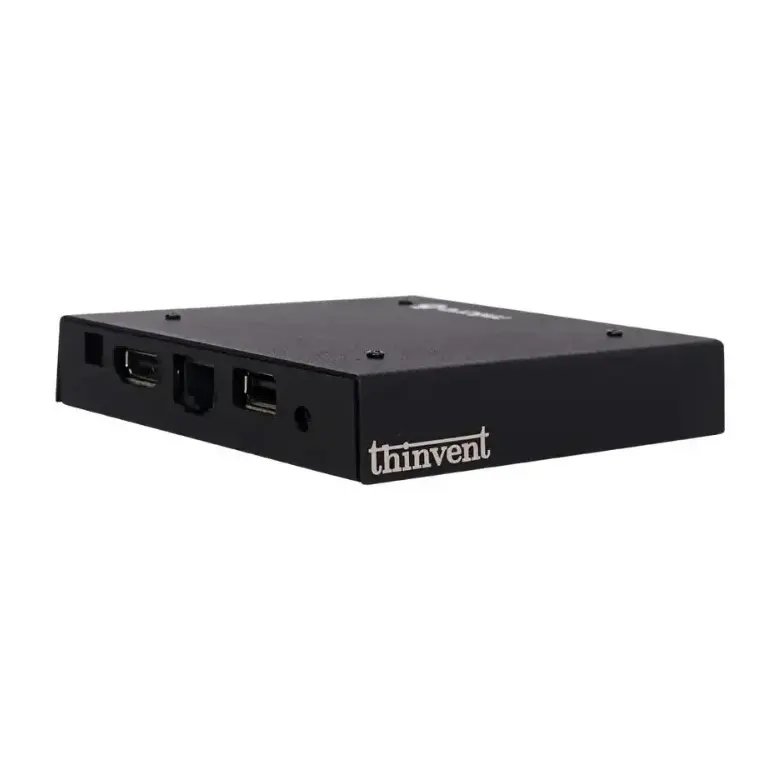
While Thinvent does not manufacture traditional rack-mounted Xeon E5 servers, our product portfolio includes robust industrial and mini PCs that deliver comparable high-performance computing power for embedded and edge applications. Our solutions are designed for reliability in challenging environments, often featuring fanless cooling for silent, maintenance-free operation.
Thinvent Industrial PCs (IPCs): Models like the IPC5, equipped with 12th Gen Intel Core i5 processors (e.g., i5-1250P with 12 cores), provide substantial multi-core performance, ample DDR4 RAM (16GB+), and fast SSD storage. These compact, rugged systems are perfect for replacing bulkier traditional servers in edge computing, factory automation, or as dedicated application hosts. Thinvent Aero Mini PCs: Featuring the latest Intel Core processors, such as the 14th Gen Core 5 120U, these mini PCs offer high clock speeds (up to 5.0 GHz) and modern core architectures in an ultra-compact form factor. They are excellent for space-constrained deployments requiring workstation-level performance for design, simulation, or as powerful thin client hosts.
For workloads that demand the parallel processing legacy of Xeon E5, Thinvent's modern, efficient, and reliable industrial computing solutions offer a powerful and compact alternative.