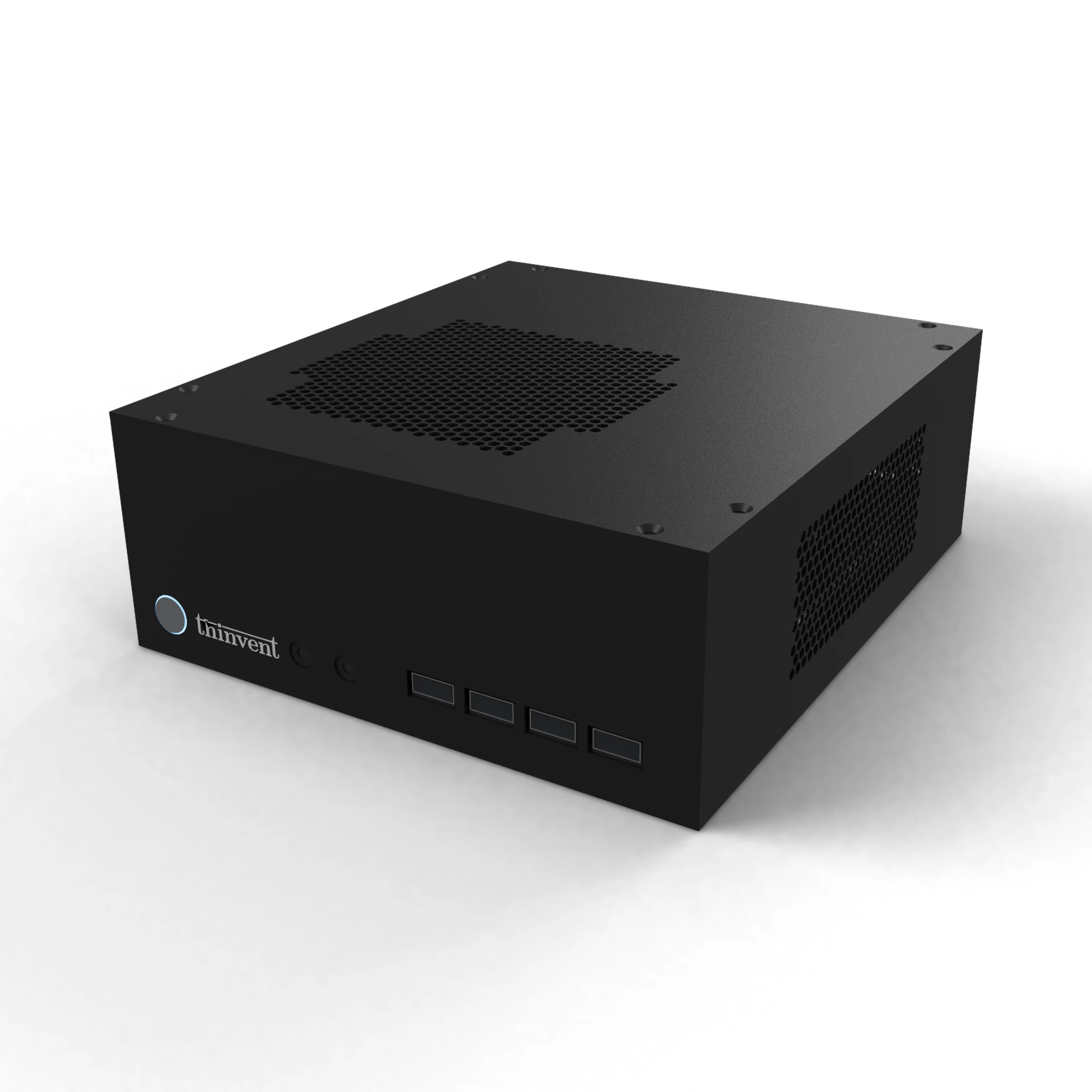
What Is a Fanless Industrial PC?
A fanless industrial PC is a ruggedized computer that uses passive cooling instead of a spinning fan to dissipate heat. By relying on aluminium heatsink fins, careful thermal design, and low-power processors, these systems avoid the single most common point of failure in a traditional computer: the cooling fan. The result is a machine with no moving parts inside, which means no dust ingress through vents, no bearing wear, no vibration, and dramatically reduced maintenance.
Because there is no airflow path, fanless industrial PCs can be sealed to high IP ratings and mounted in locations where a conventional desktop would quickly fail — dusty production floors, hot cabinets, cold stores, and vibration-heavy machinery. They are typically rated for wide input voltages (commonly 9–36V DC) and extended operating temperature ranges, and are built to run continuously, 24 hours a day, for years.
Key Specifications to Look For
| Specification | Typical Industrial PC | Typical Office Desktop |
|---|---|---|
| Cooling | Fanless, passive heatsink | Fan-cooled |
| Ingress protection | Sealed, dust-resistant | Vented chassis |
| Operating temperature | Wide range, often -20°C to 60°C | Narrow, ~10°C to 35°C |
| Power input | 9–36V DC, wide range | Fixed AC mains |
| Mounting | DIN rail, VESA, wall bracket | Desk only |
| Serial / I/O | Multiple RS-232/RS-485 DB9 ports | Few or none |
| Duty cycle | 24/7 continuous | 8-hour working day |
| Lifecycle | Long-term supply, stable BOM | Refreshed frequently |
Processors commonly used in this class include Intel's Celeron and N-series chips (such as the N100, N150 and J4125) for low-power always-on duties, and Intel Core i3, i5 and i7 parts from the 10th generation onward — for example the i3-1215U — when more compute is needed. Memory ranges from 4GB for simple gateway duties to 32GB or 64GB for vision and analytics workloads, with SSD storage from 128GB to 1TB. Look for dual Gigabit Ethernet ports for network segmentation, multiple HDMI outputs for displays, and USB 3.2 Gen 2 and USB-C for fast peripherals.
Where Fanless Industrial PCs Are Used
-
Factory automation: machine control, HMI hosting, PLC supervision and SCADA nodes on the shop floor.
-
Digital signage and kiosks: silent operation in public spaces, with VESA mounting behind the screen.
-
Warehousing and logistics: barcode and RFID stations, conveyor control, forklift terminals.
-
Energy and utilities: substation monitoring, remote telemetry gateways, solar and EV charging controllers.
-
Transport and outdoor cabinets: tolling, ANPR, and roadside equipment exposed to heat and dust.
-
Healthcare and clean environments: silent, sealed units in clinics and laboratories.
-
Edge computing: local data processing, vision inspection and IoT aggregation where a cloud round-trip is too slow.
Choosing Between a Fanless Mini PC and a Full Industrial PC
A fanless mini PC suits office, retail, and light industrial roles where space is tight and the environment is benign. A true industrial PC adds sealed construction, wide-voltage input, extended temperature tolerance, watchdog timers, and legacy I/O such as multiple DB9 serial ports — which many automation and instrumentation deployments still require. If your project involves vibration, conductive dust, temperature swings, or a requirement for 24/7 uptime, the industrial variant is the correct choice.
Thinvent's Fanless Industrial Computers
Thinvent designs and manufactures fanless industrial PCs, mini PCs, thin clients and all-in-one PCs for customers worldwide. Our IPC3 industrial PC pairs an Intel Core i3-1215U processor (6 cores, up to 4.4GHz, 10MB cache) with 16GB DDR4 RAM and a 1TB SSD, and can be configured with quad DB9 serial ports for multi-device automation. Operating system options include Windows 11 Professional, Windows 11 IoT Value, FreeDOS, and Thinux Embedded Linux, so the same hardware can be standardised across an IT fleet and an OT control network. Every unit is built for silent, dust-tolerant, continuous operation.